Not a government app. Sparkwise is an independent study app made by Kodfu Bilisim. It is not affiliated with or endorsed by the IET, BSI, City & Guilds, EAL, NET, the ECS, the JIB, NICEIC, NAPIT, MCS, HSE or OZEV. It does not contain the real exam questions and never reproduces BS 7671 text.
All exams › Solar PV and battery storage
Solar PV (2922-34) and battery storage (2923-34) exam questions
The City & Guilds solar PV and battery storage awards each have an open-book online multiple-choice test: 30 questions in 1 hour, with a pass mark of about 75%. Many courses teach them together, and Sparkwise sells them together. This page sets out the format and what each test covers, then gives you 10 free practice questions with answers. Sparkwise has 477 questions for the two exams and timed mocks for each.
Practise solar PV and battery: get Sparkwise on Google Play Try 10 free questions
Free in the app: 157 questions and one full mock for each exam. Solar PV 2922 + Battery 2923 unlock: £7.99 once for both. No subscription. Android now; iPhone version not yet available.
On this page
The online test format
2922-34 is the Level 3 award in installing small solar photovoltaic systems; 2923-34 is the Level 3 award in small electrical energy storage systems. Both are short courses for electricians who already hold a Level 3 electrotechnical qualification, and each has an online test (unit 301) and a practical assignment (unit 302). Sparkwise covers the online tests.
| Item | 2922-34 solar PV | 2923-34 battery storage |
|---|---|---|
| Questions | 30 multiple choice | 30 multiple choice |
| Time | 1 hour | 1 hour |
| Pass mark | About 75% (Sparkwise mocks: 23 of 30) | About 75% (23 of 30) |
| Books | IET Code of Practice for Grid-connected Solar Photovoltaic Systems (2nd edition) and BS 7671 | IET Code of Practice for Electrical Energy Storage Systems (3rd edition) and BS 7671 |
| Calculator | A non-programmable scientific calculator | |
| Questions in Sparkwise | 275 | 286 |
Source: the City & Guilds handbooks and the 2922 and 2923 qualification pages. Books must be paper copies; ask your centre which amendment of BS 7671 to bring. The two exams share some topics (documents and law, connecting to the network, energy management), so together they have 477 different questions in the app.
What the tests cover
Design and installation is about half of each paper. Safe working and testing and commissioning are assessed in the practical assignment, not the online test.
| Learning outcome | 2922-34 | 2923-34 |
|---|---|---|
| Documentation and legislation | 2 | 2 |
| Characteristics of the systems, components and architectures | 9 | 10 |
| Design and installation considerations | 16 | 15 |
| Micro-generation and energy storage in prosumer’s installations | 3 | 3 |
| Total | 30 | 30 |
Sparkwise topics for solar PV: cells, modules and array behaviour; inverters, metering and architectures; G98 and G99 connection; performance estimates, shading and array sizing; DC design, protection and isolation; inverter sizing, the AC side and labelling. For battery storage: AC and DC coupling and system types; battery types, power conversion and battery management; terminology; battery location and fire safety; DC isolation and sizing; parallel and island-mode operation; labelling. 85 calculation questions have a step-by-step worked solution.
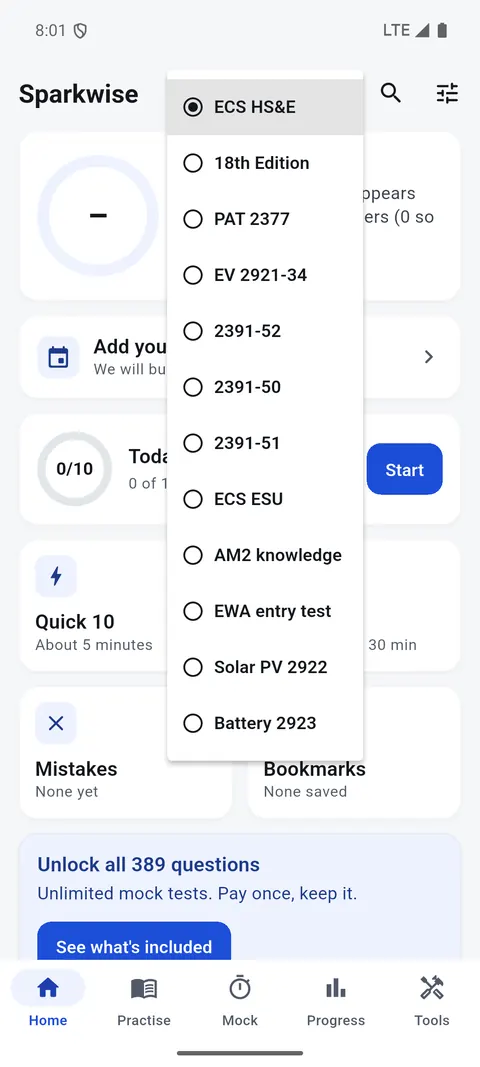
Solar, battery and EV in one app
Solar PV 2922 and Battery 2923 sit in the same Sparkwise app as EV charging 2921-34, the 18th Edition and the 2391. Switch exams from the Home screen; each keeps its own progress and mocks.
10 free solar PV and battery storage questions
Questions from across both exams, with the answer and a short explanation. They are original Sparkwise questions written from BS 7671, MCS and network connection standards and public guidance, not City & Guilds questions, and they never copy the IET Codes of Practice.
Question 1 · Choose one answer
Why are wet lead-acid batteries put in Class 8 when they are carried as dangerous goods?
- They contain corrosive sulphuric acid
- They give off flammable hydrogen gas
- They are classed as miscellaneous articles
- They contain toxic heavy-metal dust
Show the answer
Answer A: They contain corrosive sulphuric acid
Class 8 covers corrosive substances, and a wet lead-acid battery holds sulphuric acid electrolyte (UN2794). Miscellaneous articles are Class 9, the class used for lithium batteries.
Source: CDG 2009 (ADR) · C&G 2923-34 LO2 guidance
Question 2 · Select TWO answers
Which TWO are AC-side functions of a grid-connected PV inverter? Select TWO.
- Synchronising its output with grid voltage and frequency
- Keeping output harmonics and flicker within set limits
- Tracking the array's maximum-power point through the day
- Checking the array's insulation resistance before starting
Show the answer
Answer A: Synchronising its output with grid voltage and frequency, B: Keeping output harmonics and flicker within set limits
Synchronising and keeping waveform quality within harmonic and flicker limits concern the AC output. Maximum power point tracking and insulation monitoring are DC-side functions.
Source: C&G 2922-34 handbook LO3.1
Question 3 · Choose one answer
A developer plans G98 type-tested PV and batteries on 40 new houses on one estate. What does the DNO process require?
- An application before the systems are fitted
- A notification within 28 days of each house commissioning
- A G100 export limit fitted at every house
- No contact, as each house is under 16 A
Show the answer
Answer A: An application before the systems are fitted
Many G98 units close together can affect the local network, so the multiple-premises process needs details agreed with the DNO before installation. The 28-day notify-after route is for a single premises.
Source: ENA EREC G98 multiple premises
Question 4 · Choose one answer
What is the main safety reason for segregating the positive and negative parts inside a PV combiner box?
- To reduce the risk of a DC short-circuit and arc between them
- To allow the negative busbar to be bonded to the earth terminal
- To keep the box cool enough for its IP rating to remain valid
- To let the string fuses share a single common neutral link
Show the answer
Answer A: To reduce the risk of a DC short-circuit and arc between them
Keeping positive and negative parts apart, often in separate sections, lowers the chance of a line-to-line fault and a sustained DC arc. The DC side is not normally earthed.
Source: C&G 2922-34 handbook LO4.2.5
Question 5 · Choose one answer
A 3.68 kW inverter (16 A) feeds the consumer unit over 18 m of 4 mm² cable rated 11 mV/A/m. What is the voltage drop as a share of 230 V?
- About 1.4%, so above the 1% aim
- About 0.4%, so within the 1% aim
- About 3.2%, so above even 3%
- About 0.14%, so well within 1%
Show the answer
Answer A: About 1.4%, so above the 1% aim
VD = 11 × 16 × 18 ÷ 1000 = 3.17 V. 3.17 ÷ 230 × 100 = 1.38%, so a larger cable is needed to meet the 1% aim. 3.2% wrongly reads the volts as a percentage.
Worked solution. Formula: VD (V) = mV/A/m × I × L ÷ 1000; VD% = VD ÷ 230 × 100
- Voltage drop in volts: 11 × 16 × 18 = 3168 mV = 3.17 V
- As a percentage: 3.17 ÷ 230 × 100 = 1.38%
- Compare: 1.38% is above the 1% recommendation
Common mistake: Reading 3.17 V as 3.2% or forgetting to divide mV by 1000.
Source: C&G 2922-34 handbook LO4.4
Question 6 · Select TWO answers
Which TWO are advantages of AC coupling compared with DC coupling? Select TWO.
- The PV and battery inverters can be sized independently
- There is more choice over where the battery can be put
- Fewer conversion stages mean lower losses when storing
- There is no need for any inverter dedicated to the battery
Show the answer
Answer A: The PV and battery inverters can be sized independently, B: There is more choice over where the battery can be put
AC coupling separates storage from generation, so each inverter is sized on its own and the battery can sit wherever an AC circuit can reach. Lower conversion losses are a DC-coupling advantage, and AC coupling needs a battery inverter.
Source: C&G 2923-34 handbook LO3.1.1
Question 7 · Choose one answer
Compared with lithium-ion or lead-acid of the same capacity, a vented nickel-cadmium battery is:
- more expensive and bulkier
- cheaper and more compact
- cheaper but much bulkier
- compact but less tolerant of heat
Show the answer
Answer A: more expensive and bulkier
Vented NiCd is relatively expensive and takes up more space than lithium or lead-acid batteries of equivalent capacity, which is why it is kept for specialist UPS duties.
Source: C&G 2923-34 handbook LO3.1.4
Question 8 · Choose one answer
Which cellar would PAS 63100 rule out for a battery?
- A cellar with no access to the outside of the building
- A cellar with its own door straight out to the back garden
- A cellar that is dry and has a concrete floor slab
- A cellar that has a light and a socket-outlet fitted
Show the answer
Answer A: A cellar with no access to the outside of the building
Cellars and basements without access to the outside are excluded, because a fire there is hard to reach and smoke has no way out except through the house.
Source: PAS 63100:2024 6.5.5 i)
Question 9 · Choose one answer
A household uses 7.2 kWh between the evening and the next morning. The battery allows 90% depth of discharge. What is the smallest nominal capacity that covers this?
- 8.0 kWh
- 6.5 kWh
- 7.2 kWh
- 7.9 kWh
Show the answer
Answer A: 8.0 kWh
Usable energy = nominal capacity × depth of discharge, so nominal = 7.2 ÷ 0.9 = 8.0 kWh. Multiplying by 0.9 or adding 10% gives the wrong answer.
Worked solution. Formula: Nominal capacity = energy needed ÷ depth of discharge
- Energy needed: 7.2 kWh overnight
- Divide by DoD: 7.2 ÷ 0.9 = 8.0 kWh
Common mistake: Multiplying by 0.9 (6.5 kWh) or adding 10% (7.9 kWh) instead of dividing by the depth of discharge.
Source: C&G 2923-34 handbook LO4.2.2
Question 10 · Choose one answer
Which standard, together with BS 7671, sets the colour and alphanumeric identification of DC conductors?
- BS EN IEC 60445
- BS EN 62446-1
- BS EN 60529
- BS EN 62262
Show the answer
Answer A: BS EN IEC 60445
BS EN IEC 60445 covers identification of conductors and terminals by colour and letters. BS EN 62446-1 is PV testing, BS EN 60529 the IP code and BS EN 62262 the IK code.
Source: C&G 2923-34 handbook LO4.4
You’ve seen 10 of 477 questions for the solar PV and battery storage
The Sparkwise app has all 477 across 15 topics, each with an explanation and where to look, and 85 calculations have a step-by-step worked solution. It also has timed 30-question mocks of 1 hour for each exam.
157 of them are free in the app. The Solar PV 2922 + Battery 2923 unlock is £7.99 one-off: every question and every mock for these exams. Or get All exams, £24.99 one-off: all 12 exams in Sparkwise and any exam added later. No subscription.
Android now; iPhone version not yet available.
How to prepare
- Know G98 and G99. Which applies, the 16 A per phase threshold for type-tested units and whether you notify after or apply before connecting are easy marks.
- Practise the PV sums. Annual yield estimates, cable and device ratings on the DC side and voltage drop on the AC side all need a calculator and a method you trust.
- Learn the battery safety rules. Where a battery may and may not go, and what labels the installation needs, run through the 2923 design questions.
- Use your hour well. Two minutes a question is enough if you know where things are in your Code of Practice; tab it before the day.
FAQ
How many questions are in the 2922-34 solar PV exam?
The online test has 30 multiple-choice questions in 1 hour, with a pass mark of approximately 75%. The 2923-34 battery storage test has the same format. Each award also has a practical assignment.
Are the solar PV and battery exams open book?
Yes. For 2922-34 you can use the IET Code of Practice for Grid-connected Solar Photovoltaic Systems (2nd edition) and BS 7671; for 2923-34, the IET Code of Practice for Electrical Energy Storage Systems (3rd edition) and BS 7671. A non-programmable calculator is allowed.
Has 2922-34 replaced the old 2399 solar course?
City & Guilds introduced 2922-34 and 2923-34 in late 2024 as its current solar PV and energy storage awards. Check with your centre if you hold an older qualification and want to know whether you need the new one.
Are these the real exam questions?
No. Every question is original. Sparkwise is an independent app and is not linked to City & Guilds, the IET or MCS.
How much are solar PV and battery storage in Sparkwise?
Free to download, with one full mock in each exam and 157 questions free. One £7.99 unlock covers both exams. All exams, a one-off £24.99, adds EV charging and every other exam in the app.

Practise the C&G 2922-34 solar PV and 2923-34 battery storage exams in the Sparkwise app
477 original questions for the C&G 2922-34 solar PV and 2923-34 battery storage exams, each with an explanation and where to look, and timed 30-question mocks of 1 hour for each exam. Spaced review brings back the questions you got wrong.
- Works offline. No ads, no account, no data collected.
- The same app has the 18th Edition, the ECS HS&E and every other exam: see all 12.
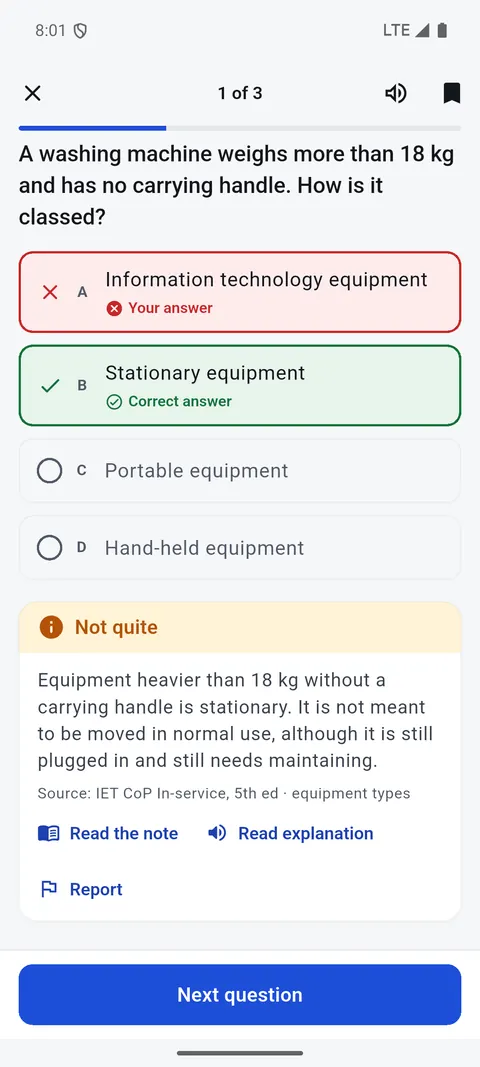
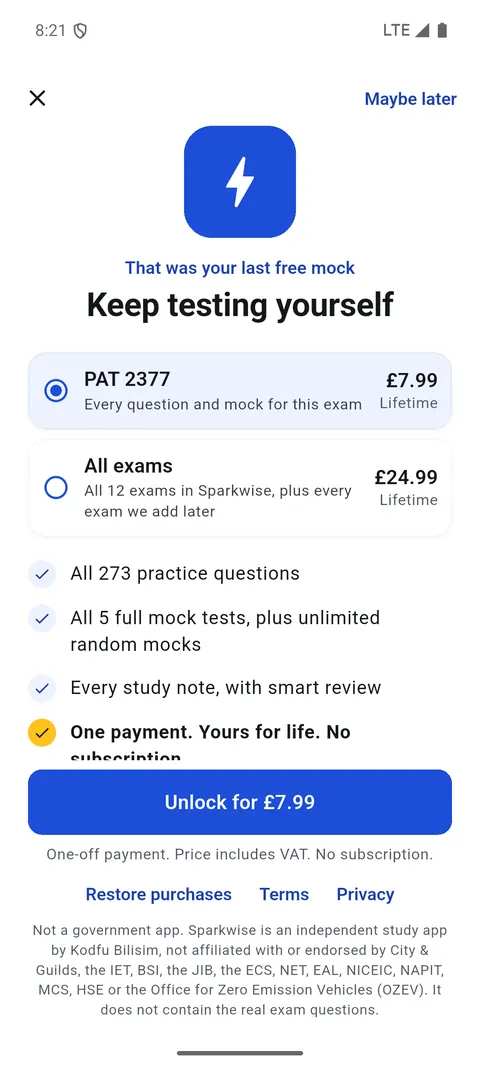
Free: two full topics and three questions in every other topic in each exam, and one full mock for each exam (157 questions).
Solar PV 2922 + Battery 2923, £7.99 one-off: every question and every mock for these exams.
All exams, £24.99 one-off: all 12 exams in Sparkwise and every exam we add later. No subscription.
Android now; iPhone version not yet available. Sparkwise helps you prepare; it cannot promise a pass.
Where the exam facts come from
The format, time and pass mark above come from these public pages. Check them, or ask your centre, before you book.
- 2922 Small Solar Photovoltaic Systems (City & Guilds)
- 2923 Small Electrical Energy Storage Systems (City & Guilds)
- BS 7671 18th Edition wiring regulations (IET)
Exam details can change. Sparkwise is not linked to any awarding or assessment body.