Not a government app. Sparkwise is an independent study app made by Kodfu Bilisim. It is not affiliated with or endorsed by the IET, BSI, City & Guilds, ECS or JIB. It does not contain the real exam questions and never reproduces BS 7671 text.
18th Edition exam guide (City & Guilds 2382-26)
The 18th Edition exam checks that you can find and apply the requirements of the IET Wiring Regulations, BS 7671:2018+A4:2026. It is an open-book, 60-question multiple-choice test lasting 2 hours. This guide explains who needs it, the rules for your book, how BS 7671 is laid out and how to prepare.
On this page
Who needs the 18th Edition exam?
The full name is the City & Guilds Level 3 Award in the Requirements for Electrical Installations BS 7671:2018, and the current version is 2382-26. City & Guilds describes it as being for practising electricians who need to update their certification to the latest edition of the Wiring Regulations, and for newly qualified electricians who need the certificate.
In practice you are likely to sit it if you are:
- an apprentice or trainee whose course includes the current Wiring Regulations;
- a qualified electrician whose employer, client or registration scheme wants evidence that you know the current edition;
- someone changing career into electrical work, often on a short course that includes the 18th Edition.
Whether you personally need to re-sit after an amendment is up to your employer or scheme, not the exam itself. If you are unsure, ask them before you book.
Exam format
| Item | 2382-26 |
|---|---|
| Type | One on-screen multiple-choice test, pass or fail |
| Questions | 60 |
| Time | 2 hours (120 minutes) |
| Pass mark | About 60%, as City & Guilds puts it (Sparkwise mocks use 36 of 60) |
| Book | Open book: BS 7671:2018+A4:2026 only |
| Calculator | Non-programmable calculator |
| Where | At a City & Guilds approved centre |
Two minutes a question sounds generous, but it goes quickly if you have to hunt for every answer. The candidates who struggle are usually the ones who know electrics well but have not practised finding things in the book.
Where the questions come from
The test specification in the City & Guilds 2382-26 handbook spreads the 60 questions across eight learning outcomes. Roughly:
| Area of BS 7671 | Questions |
|---|---|
| Scope, object and fundamental principles (Part 1) | 4 |
| Definitions (Part 2) | 2 |
| Assessment of general characteristics (Part 3, Chapters 31 to 36) | 6 |
| Protection for safety (Part 4, Chapters 41 to 44 and 46) | 15 |
| Selection and erection (Part 5, including stationary secondary batteries) | 14 |
| Inspection and testing (Part 6, Chapters 64 and 65) | 4 |
| Special installations or locations (Part 7, Sections 700 to 753, including 716 Power over Ethernet) | 7 |
| Part 8 and the appendices | 8 |
Parts 4 and 5 make up nearly half the exam, so they deserve the most revision time. Check the current handbook on the City & Guilds 2382 page in case the specification changes.
Open-book rules: what you can take in
You may use your own copy of BS 7671:2018+A4:2026, the edition with the orange cover. An older edition is no use: the questions are written against Amendment 4.
- Allowed: tabs or bookmarks, highlighting, and short cross-reference notes (for example, "see Table 41.3" next to a regulation).
- Not allowed: written notes, sample questions, extra diagrams or loose sheets in the book.
- Calculator: bring a non-programmable one, and do not plan on using your phone.
City & Guilds also publishes a permitted reference materials document on its 2382 page. Rules can be applied slightly differently between centres, so check with your centre before the day, especially if your book is heavily annotated.
How BS 7671 is laid out, Part by Part
Knowing what lives where is the single most useful exam skill. BS 7671 has eight Parts followed by appendices.
- Part 1: Scope, object and fundamental principles
- What the Regulations cover (installations up to 1000 V AC or 1500 V DC) and exclude, plus Chapter 13's fundamental safety principles. Practise Part 1.
- Part 2: Definitions
- The meaning of terms such as exposed-conductive-part, skilled person and PEN conductor. When a question turns on one word, look it up here. Practise definitions.
- Part 3: Assessment of general characteristics
- Chapters 31 to 36: supplies and earthing systems (TN-S, TN-C-S, TT, IT), maximum demand, division into circuits, external influences, compatibility, maintainability, safety services and continuity of service. Practise Part 3.
- Part 4: Protection for safety
- Chapter 41 protection against electric shock (automatic disconnection, disconnection times, maximum Zs, RCDs, SELV and PELV), Chapter 42 thermal effects including AFDDs, Chapter 43 overcurrent, Chapter 44 voltage disturbances and surge protection, Chapter 46 isolation and switching. Practise Chapter 41.
- Part 5: Selection and erection of equipment
- Chapter 51 common rules and identification, Chapter 52 wiring systems, Chapter 53 protection, isolation and switching devices, Chapter 54 earthing and protective conductors, Chapter 55 other equipment, Chapter 56 safety services and the new Chapter 57 stationary secondary batteries. Practise wiring systems.
- Part 6: Inspection and testing
- Chapter 64 initial verification (inspection, the test sequence, certificates) and Chapter 65 periodic inspection and the condition report. Practise Part 6.
- Part 7: Special installations or locations
- Sections in the 700s, from bathrooms (701), pools (702) and construction sites (704) to medical locations (710), solar PV (712), Power over Ethernet (716) and EV charging (722). Practise Part 7.
- Part 8: Functional requirements
- Chapter 81 energy efficiency and Chapter 82 prosumer's installations. Practise Part 8 and the appendices.
- Appendices
- Among others: Appendix 2 statutory regulations, Appendix 3 time/current curves for protective devices, Appendix 4 cable current-carrying capacity and voltage drop, Appendix 5 external influence codes, Appendix 6 model certificates and reports, Appendix 13 escape routes, Appendix 14 prospective fault current and Appendix 15 ring and radial circuit arrangements.
Tips for finding regulations fast
Read the numbers
Regulation numbers tell you where you are. In 411.3.2, the first digit is the Part (4), the first two digits are the Chapter (41) and the first three are the Section (411). Tables follow their Chapter, so Table 41.3 is in Chapter 41 and Table 54.7 is in Chapter 54. Regulations whose last number is in the 200s, such as 422.2.201, are UK-specific additions.
Part 7 numbering mirrors the general rules: a regulation in Section 701 usually ends with the number of the general regulation it changes or adds to. If a question is about a special location, check Part 7 first, because it overrides or adds to the general rules.
Set up your book
- Put a tab on the start of each Part, the index and each appendix you use often.
- Tab the tables you will reach for most: disconnection times (Table 41.1), maximum Zs (Tables 41.2 to 41.4), minimum protective conductor sizes (Table 54.7), insulation resistance (Table 64) and the Appendix 4 cable tables.
- Highlight key words, not whole paragraphs, so they still stand out.
Use the index and the contents
For an unfamiliar topic, start with the index at the back and pick the most specific word in the question. If the question names a type of location or equipment, go straight to Part 7 or the right Chapter of Part 5 instead.
Answer the easy ones first
Do not lose ten minutes on one question. Answer what you know, flag the hard ones and come back. Leave no question blank: an unanswered question scores nothing.
Sparkwise's Find it fast drills ask "where in BS 7671 would you look?" so you can practise this before the exam.
Calculation questions
Expect a handful of calculations. They are usually short, but you need to know which formula and which table to use. The common types are:
- Maximum earth fault loop impedance: Zs × Ia ≤ U0 × Cmin, with Cmin = 0.95. For a Type B circuit-breaker Ia is 5 × In, for Type C 10 × In and for Type D 20 × In.
- Actual Zs: Zs = Ze + (R1 + R2), and the prospective earth fault current is roughly U0 ÷ Zs.
- Voltage drop: (mV/A/m × Ib × length) ÷ 1000, compared with 3% for lighting and 5% for other uses on a public supply.
- Cable sizing with rating factors: It ≥ In ÷ (Ca × Cg × Ci …). Divide by the factors; multiplying is the classic mistake.
- Adiabatic equation: S = √(I²t) ÷ k, to check a protective conductor can survive the fault.
- TT systems with an RCD: RA × IΔn ≤ 50 V.
- Ring final circuit test readings: cross-connected readings of about (r1 + rn) ÷ 4 and (r1 + r2) ÷ 4.
Check each formula against the regulation or appendix it comes from in your own copy, and practise with your exam calculator so the keys are familiar. Try some in cable and fault calculations.
How to prepare
- Get the right book early. Use BS 7671:2018+A4:2026 for all your revision, so you learn where things are in the copy you will take in.
- Learn the layout before the detail. Spend your first sessions finding your way around the eight Parts and the appendices.
- Work through the Parts by weight. Spend most time on Parts 4 and 5, then Part 3, Part 7 and the appendices. Do not skip what changed in Amendment 4.
- Practise with the book open. For each practice question, find the regulation that answers it, even when you think you know.
- Take full timed mocks. Sit at least one 60-question, 2-hour mock under exam conditions before the real thing, and review every wrong answer.
- Go back to your weak areas. Use your mock results by Part to choose what to revise next.
Many people take the exam at the end of a short course run by the centre. A course helps, but the practice of finding answers in the book is something only you can do.
Booking, the day and results
Booking through a centre
You cannot book the 2382 directly with City & Guilds. You take it through an approved centre, such as a college or training provider. Many sell it as part of a short course with the exam at the end; some offer the exam only, for example as a resit. Prices vary between centres, so compare what is included: course, exam, resit and whether the book is supplied.
On the day
- Bring your BS 7671:2018+A4:2026, a non-programmable calculator and the photo ID your centre asks for.
- Arrive early and check your book follows the centre's rules on notes and tabs.
- Read each question fully. Many hinge on a word such as "minimum", "maximum" or "shall".
Results and certificate
The result is a pass or fail. Ask your centre when and how you will get your result. City & Guilds issues the certificate as a digital credential, so make sure the centre registers you with an email address you use. If you do not pass, ask the centre about a resit and focus on the Parts where you dropped marks.
2382-22 has ended
The previous version, 2382-22, was based on BS 7671:2018+A2:2022. Centres had to use 2382-26 from 16/04/2026, and 2382-22 closed to new registrations on 31/07/2026. BS 7671:2018+A2:2022 itself was withdrawn on 15/10/2026, so all new revision should be for 2382-26 and A4:2026. If you passed an earlier version, your certificate still shows what you achieved; whether you need the update is a question for your employer or scheme.
Practise the 18th Edition free. Try free practice questions in your browser, or go straight to a topic: protection against electric shock, protective devices, earthing and bonding, inspection and testing or Amendment 4. New to earthing arrangements? Start with our earthing systems guide, then the RCD protection guide.

Practise both exams in the Sparkwise app
927 original questions across every Part of BS 7671:2018+A4:2026 and every ECS HS&E syllabus area, timed mock exams in the real format, worked solutions for calculations and explanations that show where to look in the book.
- 18th Edition: 538 questions, 60-question mock exams in 2 hours, a maximum Zs calculator and a guide to Amendment 4
- ECS HS&E: 389 questions and 50-question mock tests in 30 minutes
- Works offline. No ads, no account, no data collected.
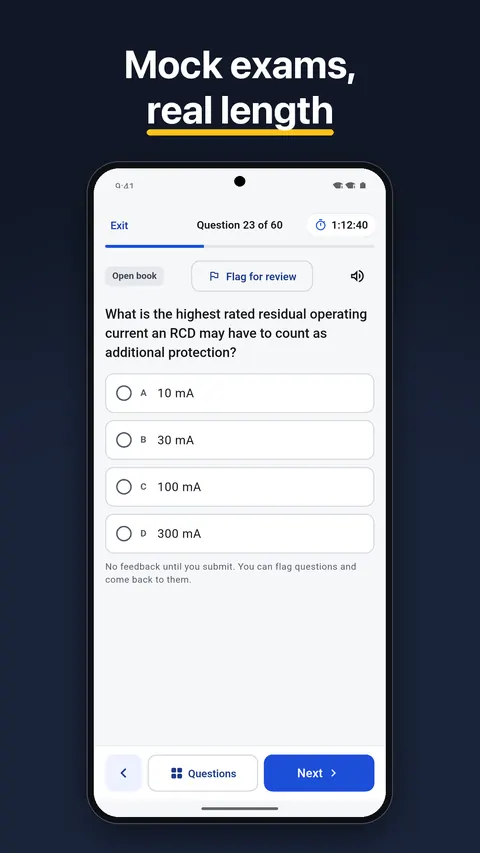
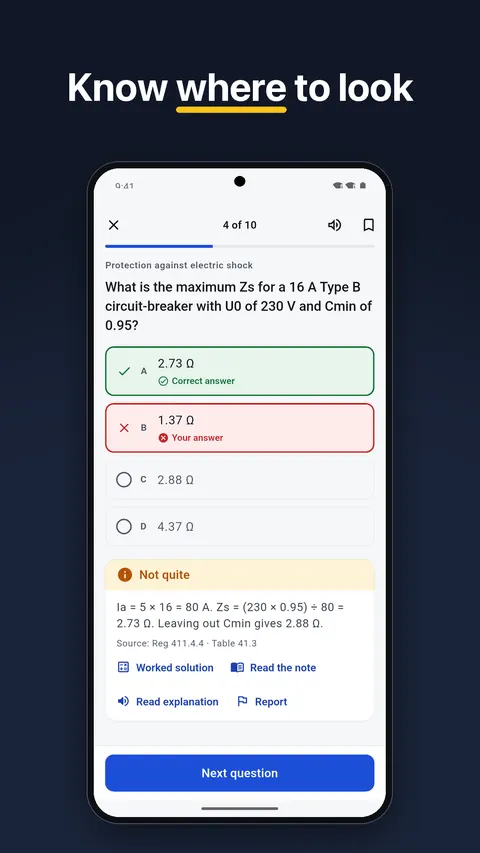
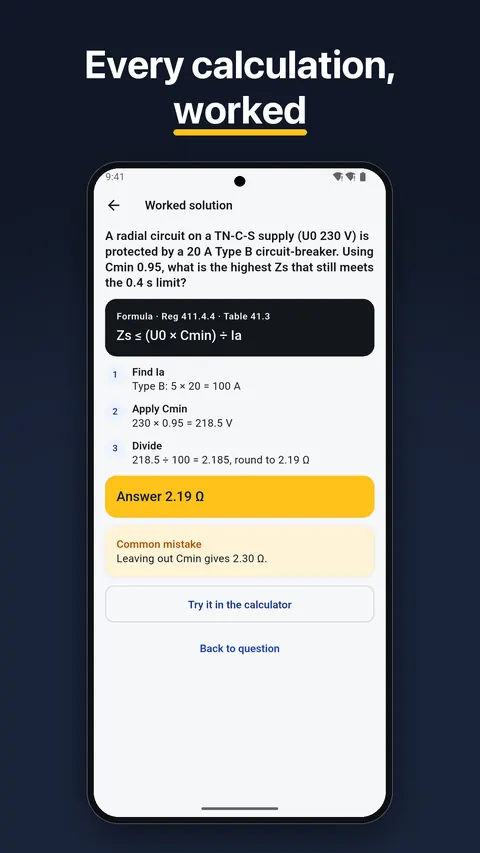
Free: two full topics in each exam, three questions in every other topic, one full mock exam for each exam, the maximum Zs calculator and checklists.
Sparkwise Pro, £12.99 one-off: every question, every mock exam and every worked solution, for both exams. No subscription.
Android now; iPhone version not yet available. Sparkwise helps you prepare; it cannot promise a pass.
Official sources
Check these public pages before you book, apply or claim.
- BS 7671 18th Edition wiring regulations (IET)
- Requirements for Electrical Installations (2382) (City & Guilds)
- Health, Safety & Environmental Assessment (ECS, run by the JIB)
- Electrical safety at work (Health and Safety Executive (HSE))
- The Electricity at Work Regulations 1989 (legislation.gov.uk)
Exam details can change. Check with the awarding body or your exam centre before you book, and always check real installations against your own copy of BS 7671.