Not a government app. Sparkwise is an independent study app made by Kodfu Bilisim. It is not affiliated with or endorsed by the IET, BSI, City & Guilds, ECS or JIB. It does not contain the real exam questions and never reproduces BS 7671 text.
Scope, object and fundamental principles: free 18th Edition practice questions
What BS 7671 covers and excludes, its legal status, departures, and the fundamental principles of Chapter 13.
10 original questions from the Sparkwise app, each with the answer and an explanation. Open book: have your copy of BS 7671:2018+A4:2026 ready and look each answer up, as you would in the exam. No sign-up, nothing saved. These are not the real exam questions: no app or website can show you those.
Question 1 · Choose one answer
Up to what nominal AC voltage do the Wiring Regulations apply?
- 1000 V
- 400 V
- 1500 V
- 690 V
Show the answer
Answer A: 1000 V
BS 7671 covers circuits with a nominal voltage up to and including 1000 V AC. 1500 V is the limit for DC.
Where to look: Reg 110.1.2
Question 2 · Choose one answer
Lightning protection systems for buildings are excluded from BS 7671 because they are covered by which standard?
- BS EN 60204
- BS EN 81
- BS 5839
- BS EN 62305
Show the answer
Answer D: BS EN 62305
Lightning protection of structures is dealt with by the BS EN 62305 series. BS 7671 still requires the lightning protection system to be bonded where appropriate.
Where to look: Reg 110.2
Question 3 · Choose one answer
Which statutory regulations place duties mainly on electricity distributors and suppliers?
- Electricity at Work Regulations 1989
- Electricity Safety, Quality and Continuity Regs 2002
- Electrical Equipment (Safety) Regulations 2016
- Provision and Use of Work Equipment Regs 1998
Show the answer
Answer B: Electricity Safety, Quality and Continuity Regs 2002
The ESQCR 2002 cover distributors' networks and the quality and continuity of supply, for example the rules on combining neutral and protective functions.
Where to look: Appendix 2
Question 4 · Select TWO answers
A new material leads to a departure from the Regulations. Select TWO conditions that apply.
- The degree of safety must be no less than if the Regulations were met in full
- The departure must be recorded on the Electrical Installation Certificate
- The material must be approved by the local building control body
- The installation must be re-inspected every 12 months
Show the answer
Answer A: The degree of safety must be no less than if the Regulations were met in full, B: The departure must be recorded on the Electrical Installation Certificate
New materials or inventions are allowed if safety is not reduced, and the departure is recorded on the EIC.
Where to look: Reg 120.4
Question 5 · Select TWO answers
Chapter 13 says protection against electric shock is provided in two forms. Select TWO.
- Basic protection
- Fault protection
- Functional switching
- Selectivity
Show the answer
Answer A: Basic protection, B: Fault protection
Basic protection covers normal, fault-free conditions; fault protection covers single-fault conditions. Functional switching and selectivity are not shock protection.
Where to look: Reg 131.2
Question 6 · Choose one answer
A piece of equipment does not comply with any British or harmonised standard. When may it be used?
- Never, under any circumstances
- Only in domestic installations
- If the designer confirms equal safety
- Only if made by a UK manufacturer
Show the answer
Answer C: If the designer confirms equal safety
Where equipment is not to a recognised standard, the designer (or specifier) is responsible for confirming it provides a degree of safety no less than compliant equipment.
Where to look: Reg 133.1.3
Question 7 · Choose one answer
Where must a single-pole fuse, switch or circuit-breaker be connected?
- In the neutral conductor only
- In the protective conductor
- In the line conductor only
- In either the line or neutral conductor
Show the answer
Answer C: In the line conductor only
Single-pole protective devices and switches must be in the line conductor so that opening them leaves the circuit beyond them dead.
Where to look: Reg 132.14.1
Question 8 · Choose one answer
An older installation was built to the 16th Edition. What does BS 7671 say about such installations?
- It must be rewired within five years
- It is not necessarily unsafe
- It is automatically coded C1
- It must be disconnected until upgraded
Show the answer
Answer B: It is not necessarily unsafe
The Regulations are not retrospective. An installation built to an earlier edition may differ from current rules without being unsafe for continued use.
Where to look: BS 7671 Introduction
Question 9 · True or false?
BS 7671 recommends that every electrical installation is subject to periodic inspection and testing.
- True
- False
Show the answer
Answer A: True
The fundamental principles recommend periodic inspection and testing so that deterioration is found before it becomes dangerous.
Where to look: Reg 135.1
Question 10 · Choose one answer
Where in BS 7671 would you look for the principle that existing equipment must be adequate before an addition is made?
- Chapter 12
- Chapter 13
- Chapter 31
- Chapter 65
Show the answer
Answer B: Chapter 13
Chapter 13, the fundamental principles, covers additions and alterations to an installation.
Where to look: Chapter 13
You’ve seen 10 of 31 questions in this topic
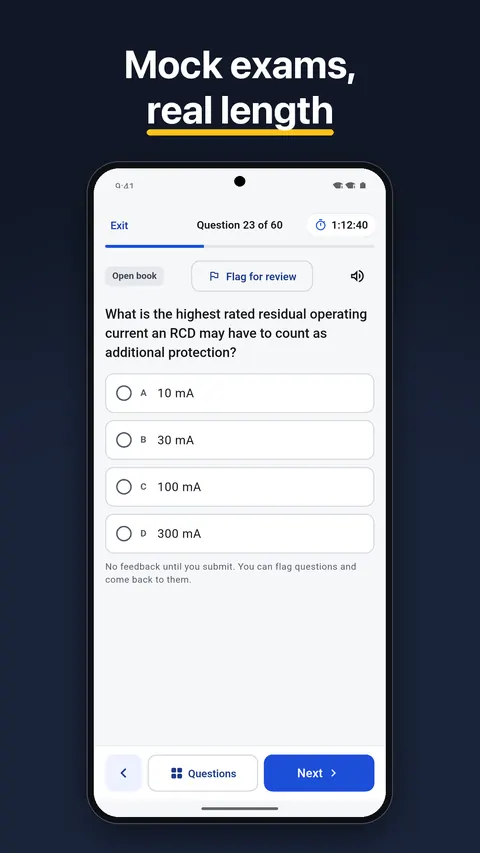
The Sparkwise app has all 31, each with an explanation. Across the whole 18th Edition there are 538 questions in 16 topics, plus timed 60-question mock exams of 2 hours.
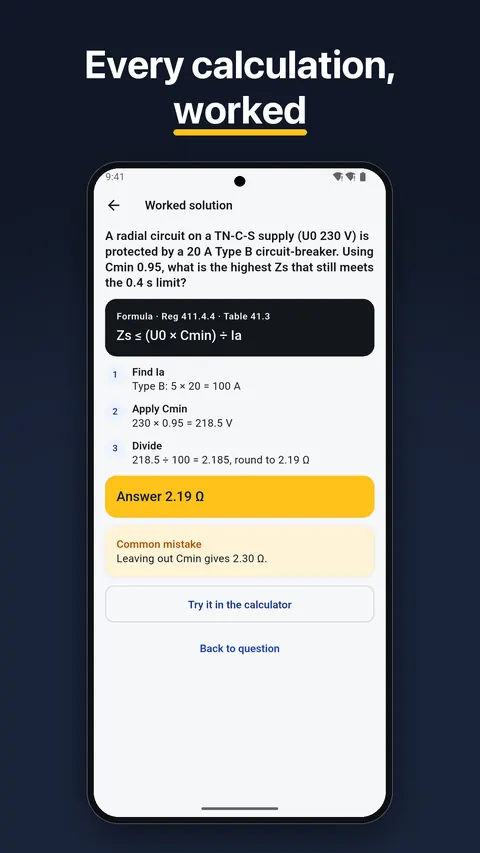
All 31 are free in the app. Sparkwise Pro is £12.99 one-off and unlocks every question, every mock exam and every worked solution for both exams. No subscription.
Android now; iPhone version not yet available.
Revision notes
What BS 7671 covers
Part 1 sets the reach of the Regulations. They apply to the design, erection and verification of electrical installations in homes, shops, offices, factories, farms, caravan parks, construction sites, marinas, exhibitions, medical locations, street furniture and solar PV systems, among others. They cover circuits at nominal voltages up to 1000 V AC or 1500 V DC. For AC the preferred frequencies are 50 Hz, 60 Hz and 400 Hz, though others are not ruled out. Additions and alterations are covered too, along with any part of an existing installation that the work affects.
What BS 7671 does not cover
Some systems sit outside the Regulations because other rules or standards deal with them. Examples are the public distribution network, railway traction and rolling stock, the electrical equipment of motor vehicles (except where Part 7 says otherwise), ships, aircraft, offshore installations, the statutory parts of mines and quarries, lightning protection of buildings (covered by BS EN 62305), lift installations covered by BS EN 81 and the electrical equipment of machines covered by BS EN 60204. Radio interference suppression is excluded except where it affects safety.
Legal status
BS 7671 is a British Standard, not a law, so it is non-statutory. However, it is widely accepted as the benchmark for safe installation work. Following it is likely to help show compliance with statutory duties such as the Electricity at Work Regulations 1989, and Building Regulations guidance in England and Wales points to it for dwellings. The Electricity Safety, Quality and Continuity Regulations 2002 place duties on network operators. Appendix 2 lists the statutory regulations and associated guidance that relate to electrical installations. The standard can be used in court as evidence of good practice.
Departures and new materials
A designer may depart from the detailed rules of Parts 3 to 7 only after special consideration, and the result must be at least as safe as full compliance would have been. Any intended departure has to be written on the Electrical Installation Certificate. The same applies when new materials or inventions lead to a departure: the safety level must not drop, and the departure is recorded on the certificate so that the next person to work on the installation knows about it.
Fundamental principles: protection for safety
Chapter 13 states the aims every installation must meet. Persons, livestock and property must be protected against shock currents, excessive temperatures that could cause burns or fire, overcurrent, fault current, voltage disturbances and electromagnetic effects, the effects of power supply interruption, and mechanical movement of electrically operated equipment. Protection against electric shock has two parts: basic protection for normal conditions and fault protection for single-fault conditions. The detailed rules in Parts 4 and 5 put these principles into practice.
Design, selection and erection
The design must account for the characteristics of the supply, the nature of the demand, safety services, environmental conditions, conductor sizes, wiring type, protective equipment, isolation and switching, accessibility and documentation. Equipment should comply with the relevant British or harmonised standard; if it does not, the designer must confirm it is at least as safe. Erection must use good workmanship by suitably skilled or instructed people and proper materials. Every installation must be inspected and tested during erection and on completion, before it is put into service.
Additions and alterations
Before an addition or alteration is made, the person doing it must check that the rating and condition of any existing equipment that will carry extra load, including the distributor's equipment, are adequate. The earthing and bonding arrangements needed for the new work must also be adequate. If they are not, the work should not go ahead until they are put right. The new work must comply with the current Regulations and must not reduce the safety of the existing installation.
More 18th Edition topics
- Previous: What changed in A4:2026What A4:2026 brought in: batteries, functional earthing, PoE, medical locations, PNB, AFDD wording and the new model forms.
- Next: DefinitionsThe key terms of Part 2 in plain English: conductive parts, persons, protection types, systems and devices.
- 18th Edition exam guideFormat, rules, booking and how to prepare

Practise both exams in the Sparkwise app
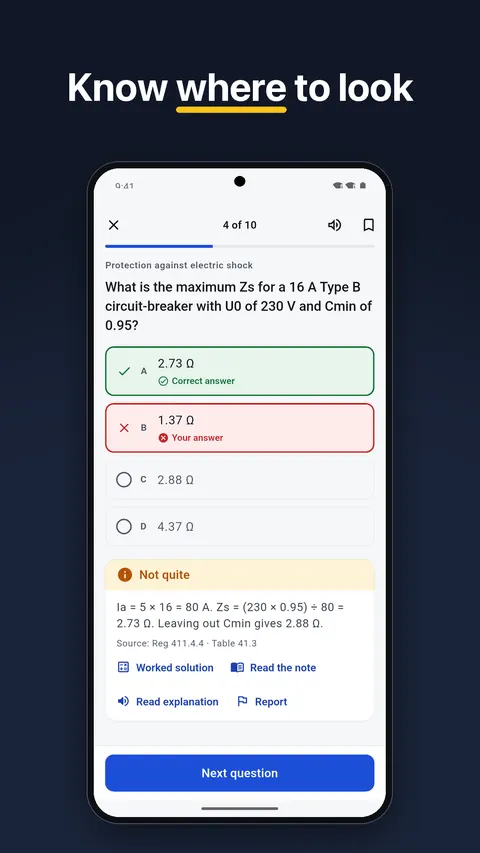
927 original questions across every Part of BS 7671:2018+A4:2026 and every ECS HS&E syllabus area, timed mock exams in the real format, worked solutions for calculations and explanations that show where to look in the book.
- 18th Edition: 538 questions, 60-question mock exams in 2 hours, a maximum Zs calculator and a guide to Amendment 4
- ECS HS&E: 389 questions and 50-question mock tests in 30 minutes
- Works offline. No ads, no account, no data collected.
Free: two full topics in each exam, three questions in every other topic, one full mock exam for each exam, the maximum Zs calculator and checklists.
Sparkwise Pro, £12.99 one-off: every question, every mock exam and every worked solution, for both exams. No subscription.
Android now; iPhone version not yet available. Sparkwise helps you prepare; it cannot promise a pass.