Not a government app. Sparkwise is an independent study app made by Kodfu Bilisim. It is not affiliated with or endorsed by the IET, BSI, City & Guilds, ECS or JIB. It does not contain the real exam questions and never reproduces BS 7671 text.
ECS Health, Safety and Environmental assessment guide
The ECS HS&E assessment is the health and safety test for people who work in the electrotechnical industry. You need a pass, or a valid exemption, to apply for an ECS card. It is 50 multiple-choice questions in 30 minutes, and you need 43 right. This guide covers who needs it, what it covers, how to book and how to prepare.
On this page
Who needs the ECS HS&E assessment?
The Electrotechnical Certification Scheme (ECS) is the card scheme for the electrotechnical industry, run by the JIB. Many employers and sites ask for an ECS card to show that you are qualified and safety-aware. To apply for an ECS card you must either pass the ECS Health, Safety and Environmental assessment or hold a valid exemption. The ECS says it sets a minimum safety standard for cardholders.
That covers most people starting out or moving up in the trade: apprentices and trainees, electricians and installers, and other electrotechnical workers. Some higher or equivalent qualifications count as an exemption; the ECS website lists which ones. See the ECS HS&E assessment page for the card types and exemptions that apply to you.
In Scotland, ECS applications and information are handled by the Scottish Joint Industry Board (SJIB).
Format and pass mark
| Item | ECS HS&E assessment |
|---|---|
| Questions | 50 multiple choice, one correct answer from four |
| Time | 30 minutes |
| Pass mark | 43 out of 50 (86%) |
| Book or notes | None: closed book |
| How | Online with remote invigilation, or face to face at a venue |
The pass mark is high. You can only get seven questions wrong, so a "mostly right" level of knowledge is not enough. Thirty minutes for 50 questions is a little over half a minute each, so there is no time to puzzle over every one. Aim to know the material well enough to answer most questions straight away.
Questions are drawn from a bank the ECS publishes in its own revision book, which you can download from the ECS website's preparation and revision section. That makes the official revision book the first thing to read.
Syllabus areas
The assessment covers 11 areas. The ECS revision guide sets out how many questions come from each; at the time of writing the split was:
| Area | Questions | What it covers |
|---|---|---|
| General health and safety at work | 6 | Health and Safety at Work etc. Act duties, enforcement, risk assessments, method statements, permits, CDM, safety signs |
| Manual handling | 4 | Avoid, assess, reduce; safe lifting; handling aids |
| Reporting accidents | 3 | RIDDOR, the accident book, near misses, first aid |
| Personal protective equipment | 4 | Who provides PPE, choosing and caring for it, PPE as the last resort |
| Health and hygiene | 3 | COSHH, dust, noise, vibration, skin problems, Weil's disease, welfare |
| Fire and emergency | 9 | Fire triangle, extinguishers, fire stopping, hot work, evacuation, first aid, electric shock |
| Work at height | 5 | Work at Height Regulations, ladders, stepladders, towers, scaffolds, MEWPs |
| Work equipment | 4 | PUWER, hand and power tools, 110 V site supplies, lifting equipment |
| Special site hazards | 3 | Asbestos, buried services, overhead lines, excavations, confined spaces |
| Electrotechnical safety | 6 | Electricity at Work Regulations, safe isolation, test equipment, lock-off, live working |
| Environmental | 3 | Waste duty of care, WEEE, hazardous waste, spills, nuisance |
Fire and emergency is the biggest area, with almost a fifth of the questions. Check the current revision guide in case the split has changed.
How to book and sit it
Online, with remote invigilation
You can sit the assessment at home, at work or anywhere else private, with a webcam and a suitable internet connection. Monitoring software uses your webcam, microphone, keyboard and mouse and checks your identity. If it detects unusual activity, the assessment is failed automatically, so sit alone, clear your desk and close other programs. Bookings are made through your MyECS account or by your employer through the ECS Employer Portal; the ECS website explains the current route and the setup checks to run first.
Face to face
Face-to-face sessions run through selected employers and training providers in England, Wales and Northern Ireland, listed on the ECS venues page. In Scotland, contact the SJIB.
Cost
The ECS lists its fees on its website, and some providers add their own charge for running the assessment, so prices vary. Check the current fee with the ECS or your provider before you book. The ECS warns against third-party booking agents who charge extra: you do not need an agent to book the assessment or apply for a card.
Help with reading
If you need text-to-speech, contact the ECS Customer Experience Centre before the assessment. For other adjustments, speak to your test provider or employer.
Results, validity and renewal
After the assessment, your MyECS account is updated or a result letter is sent to you, usually by email. Once you have passed, you continue your card application in MyECS.
A pass is valid for two years. Within that time you need to apply for your ECS card; if you leave it longer, you will need to take a new assessment. When your card comes up for renewal, check in MyECS what the renewal asks for, and book a fresh assessment in good time if you need one.
How it differs from the CITB HS&E test
People often mix up the two. The CITB Health, Safety and Environment test is the one used for CSCS cards across general construction. The ECS HS&E assessment is a separate test for the electrotechnical industry and leads to an ECS card.
- Not interchangeable: the ECS does not accept the CITB (CSCS) test. It says its own assessment covers the safety needs of electrotechnical workers, including fire safety.
- Different content: the ECS assessment has its own electrotechnical safety section (safe isolation, test equipment, live working) and a large fire and emergency section.
- Different format and booking: the CITB test has its own question count, time limit and pass mark and is booked through CITB. Do not use CITB revision material as your main source for the ECS assessment.
How to prepare
- Download the ECS revision book from the ECS website and read it through once, area by area.
- Practise by topic. Start with the big areas: fire and emergency, general health and safety, electrotechnical safety and work at height.
- Learn the reasons, not just the answers. Know why safe isolation follows the order it does, why CO2 suits electrical fires and why PPE comes last in the hierarchy. Understanding carries over to questions worded differently.
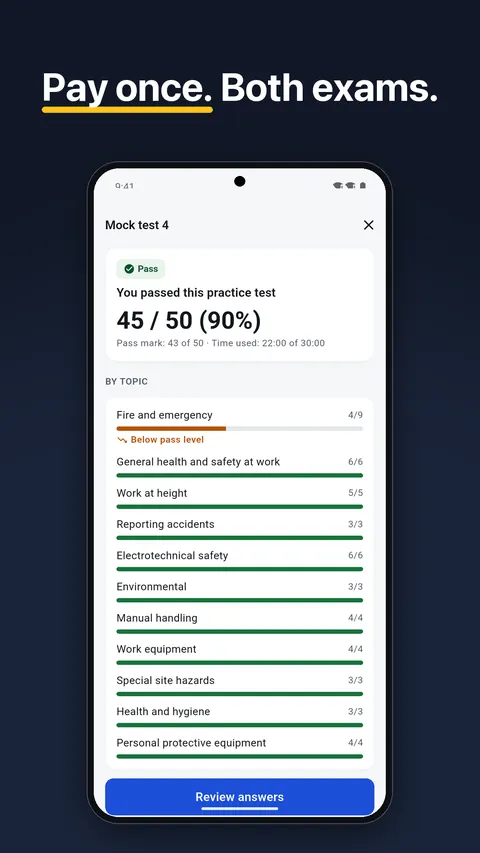
- Take timed mocks. Sit full 50-question, 30-minute mocks and aim to score well above 43 before booking, so a few unlucky questions on the day do not matter.
- Go back over your mistakes. Revisit the questions you got wrong a day or two later.
- Check your setup if you are sitting online: webcam, microphone, connection, a quiet private room and the ECS system checks.
Sparkwise's ECS questions are written from health and safety law and HSE guidance, not copied from the ECS revision book, and its mocks use the same topic mix and the 43 out of 50 pass mark. Use them alongside the official revision book, not instead of it.
Practise the ECS HS&E free. Try free practice questions in your browser, or pick a topic: fire and emergency, electrotechnical safety or work at height. Also sitting the wiring regulations exam? Read our 18th Edition exam guide.

Practise both exams in the Sparkwise app
927 original questions across every Part of BS 7671:2018+A4:2026 and every ECS HS&E syllabus area, timed mock exams in the real format, worked solutions for calculations and explanations that show where to look in the book.
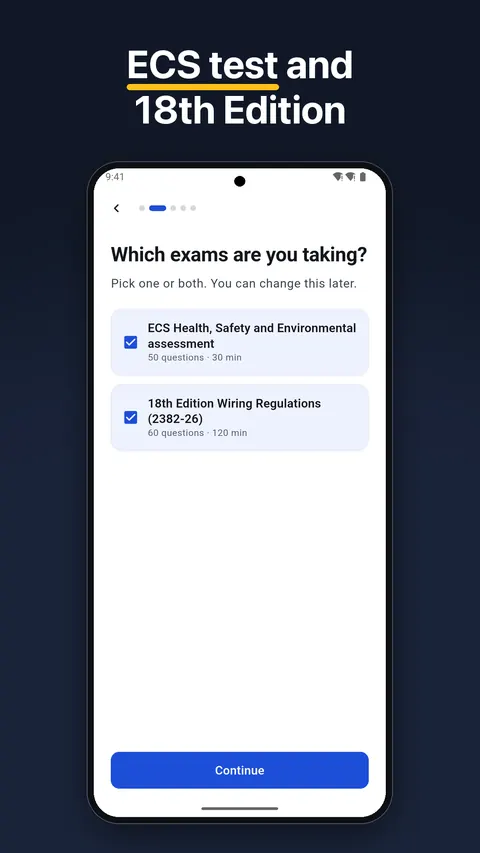
- 18th Edition: 538 questions, 60-question mock exams in 2 hours, a maximum Zs calculator and a guide to Amendment 4
- ECS HS&E: 389 questions and 50-question mock tests in 30 minutes
- Works offline. No ads, no account, no data collected.
Free: two full topics in each exam, three questions in every other topic, one full mock exam for each exam, the maximum Zs calculator and checklists.
Sparkwise Pro, £12.99 one-off: every question, every mock exam and every worked solution, for both exams. No subscription.
Android now; iPhone version not yet available. Sparkwise helps you prepare; it cannot promise a pass.
Official sources
Check these public pages before you book, apply or claim.
- BS 7671 18th Edition wiring regulations (IET)
- Requirements for Electrical Installations (2382) (City & Guilds)
- Health, Safety & Environmental Assessment (ECS, run by the JIB)
- Electrical safety at work (Health and Safety Executive (HSE))
- The Electricity at Work Regulations 1989 (legislation.gov.uk)
Exam details can change. Check with the awarding body or your exam centre before you book, and always check real installations against your own copy of BS 7671.