Not a government app. Sparkwise is an independent study app made by Kodfu Bilisim. It is not affiliated with or endorsed by the IET, BSI, City & Guilds, ECS or JIB. It does not contain the real exam questions and never reproduces BS 7671 text.
Reporting accidents: free ECS HS&E practice questions
RIDDOR, the accident book, near misses, dangerous occurrences and first-aid provision.
10 original questions from the Sparkwise app, each with the answer and an explanation. Closed book, like the real assessment: answer first, then open the explanation. No sign-up, nothing saved. These are not the real exam questions: no app or website can show you those.
Question 1 · Choose one answer
Why should near misses be reported?
- So the site can claim on its insurance
- So the cause can be fixed before someone is hurt
- Because HSE must be told about every one
- So the person involved can be found and disciplined
Show the answer
Answer B: So the cause can be fixed before someone is hurt
A near miss shows a weakness in controls. Fixing it now prevents a future injury.
Source: HSE: Investigating accidents (HSG245)
Question 2 · Choose one answer
You are injured at work. Who should you report it to first?
- Your trade union office
- HSE, using the RIDDOR line
- Nobody, if you can still work
- Your supervisor or manager
Show the answer
Answer D: Your supervisor or manager
Your supervisor can arrange first aid, record the injury and start any reporting or investigation. Reporting to HSE is the responsible person's job, not yours.
Source: HSE: Investigating accidents (HSG245)
Question 3 · Choose one answer
An apprentice cuts his hand on sharp trunking. What belongs in the accident book entry?
- The apprentice's bank details for sick pay
- Who you think was to blame for it
- How it happened and what the injury was
- The cost of the trunking that was damaged
Show the answer
Answer C: How it happened and what the injury was
Entries record the facts: who, when, where, how it happened and the injury.
Source: Social Security (Claims and Payments) Regs 1979
Question 4 · Choose one answer
Under RIDDOR, who normally has the duty to make a report about an injured employee?
- The injured worker, as soon as possible
- The hospital that treats the worker
- The responsible person, usually the employer
- The police, after they attend the scene
Show the answer
Answer C: The responsible person, usually the employer
For employees the employer is the responsible person. The self-employed and those in control of premises have duties in other cases.
Source: RIDDOR 2013 regs 4-8
Question 5 · Choose one answer
A worker breaks a finger at work. Is this a specified injury under RIDDOR?
- Yes, but only if it needs an operation
- Yes, every fracture of any bone is a specified injury
- No, but report it if off normal work over 7 days
- No, and it never needs to be reported
Show the answer
Answer C: No, but report it if off normal work over 7 days
Fractures of fingers, thumbs and toes are excluded from specified injuries, but an over-seven-day absence still makes it reportable.
Source: RIDDOR 2013 regs 4-8
Question 6 · Choose one answer
A worker is off normal work for five days after an accident. What does RIDDOR require?
- It must be reported to HSE within 24 hours
- It must be reported to the police
- Nothing; it is too minor to record
- It must be recorded, but not reported
Show the answer
Answer D: It must be recorded, but not reported
Over-three-day injuries must be recorded by the employer. They only become reportable after more than seven days.
Source: RIDDOR 2013 reg 12
Question 7 · Choose one answer
For how long must RIDDOR records be kept?
- Until the job ends
- At least 3 years
- At least 3 months
- At least 1 year
Show the answer
Answer B: At least 3 years
Records of reportable incidents and over-three-day injuries must be kept for at least three years.
Source: RIDDOR 2013 reg 12
Question 8 · Choose one answer
Which electrical incident is a reportable dangerous occurrence?
- A short circuit fire stopping the plant for over 24 hours
- A circuit breaker tripping when a kettle is switched on
- An RCD tripping during a routine test of the board
- A lamp failing in a corridor and being replaced
Show the answer
Answer A: A short circuit fire stopping the plant for over 24 hours
Electrical incidents causing fire or explosion with plant stopped for over 24 hours must be reported.
Source: RIDDOR 2013 reg 7 and Sch 2
Question 9 · Choose one answer
Which regulations require employers to provide first-aid equipment and people?
- Health and Safety (First-Aid) Regulations 1981
- Electricity at Work Regulations 1989
- Provision and Use of Work Equipment Regs 1998
- Control of Substances Hazardous to Health Regs
Show the answer
Answer A: Health and Safety (First-Aid) Regulations 1981
The First-Aid Regulations require adequate and appropriate first-aid equipment, facilities and people.
Source: Health and Safety (First-Aid) Regulations 1981
Question 10 · Choose one answer
You use the last large dressing in the site first-aid kit. What should you do?
- Nothing, as the kit is checked once every year
- Buy one yourself and keep it in your van
- Tell the person responsible so it is restocked
- Remove the kit so nobody relies on it
Show the answer
Answer C: Tell the person responsible so it is restocked
Kits must be kept stocked. Letting the responsible person know means the next casualty is not let down.
Source: Health and Safety (First-Aid) Regulations 1981
You’ve seen 10 of 24 questions in this topic
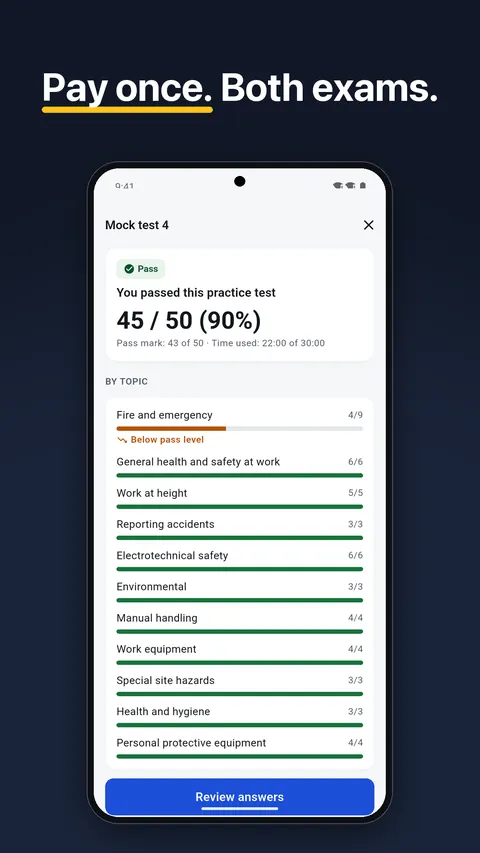
The Sparkwise app has all 24, each with an explanation. Across the whole ECS HS&E there are 389 questions in 11 topics, plus timed 50-question mock exams of 30 minutes.
3 of them are free in the app, the rest come with Pro. Sparkwise Pro is £12.99 one-off and unlocks every question, every mock exam and every worked solution for both exams. No subscription.
Android now; iPhone version not yet available.
Revision notes
Why report accidents and near misses
Reporting helps stop the same thing happening again. Tell your supervisor about every accident, however minor, and about every near miss: an event that could have caused injury or damage but by luck did not, such as a tool dropping from height and landing beside someone. Report hazards you spot, too, such as a damaged lead or a missing guardrail. Near misses are free lessons; if they are ignored, the next one may end in serious injury.
The accident book
Employers with ten or more employees, and owners of certain premises, must keep an accident book or equivalent record. Each entry should give the injured person's details, the date, time and place, how it happened and the injury. Record even minor injuries: the record can matter later if the injury turns out worse than it seemed or leads to a claim, and patterns of small injuries show where controls are weak. Entries are personal information and must be kept confidential.
RIDDOR: what must be reported
The Reporting of Injuries, Diseases and Dangerous Occurrences Regulations 2013 (RIDDOR) require the 'responsible person', usually the employer, the self-employed person or whoever controls the premises, to report certain events to the enforcing authority. These include work-related deaths, specified injuries such as most fractures, amputations, serious burns and loss of sight, injuries that keep a worker off normal duties for more than seven days, members of the public taken to hospital for treatment, certain occupational diseases and listed dangerous occurrences.
RIDDOR time limits and records
Deaths and specified injuries must be reported without delay; there is an online form and a telephone line for fatal and specified injuries, and the written report must follow within ten days. An injury that keeps someone off normal work for more than seven days, not counting the day of the accident, must be reported within 15 days. An over-three-day injury must be recorded but not reported. Reportable diseases are reported once a doctor's written diagnosis is received. Records must be kept for at least three years.
Dangerous occurrences and occupational diseases
Dangerous occurrences are listed near misses that must be reported even if nobody is hurt. Examples include the collapse or partial collapse of a scaffold more than 5 m high, plant coming into contact with or arcing from an uninsulated overhead line above 200 V, an electrical short circuit or overload causing a fire or explosion that stops plant for more than 24 hours, and the overturning or collapse of lifting equipment. Reportable occupational diseases include hand-arm vibration syndrome, carpal tunnel syndrome, occupational dermatitis, occupational asthma and occupational cancer.
First-aid arrangements
The Health and Safety (First-Aid) Regulations 1981 require employers to provide adequate first-aid equipment, facilities and people, based on an assessment of their needs. A first-aider is trained to give first aid. An appointed person, used where the risk assessment allows, takes charge of arrangements, looks after the kit and calls the emergency services. Workers must be told what the arrangements are. First-aid kits should not contain tablets or medicines. Tell the person responsible when you use items, so the kit is restocked.
More ECS HS&E topics
- Previous: Manual handlingAvoiding, assessing and reducing lifting risks, safe lifting technique and handling aids.
- Next: Personal protective equipmentWho provides and looks after PPE, choosing the right head, eye, hand, foot, hearing and breathing protection.
- ECS HS&E assessment guideFormat, rules, booking and how to prepare

Practise both exams in the Sparkwise app
927 original questions across every Part of BS 7671:2018+A4:2026 and every ECS HS&E syllabus area, timed mock exams in the real format, worked solutions for calculations and explanations that show where to look in the book.
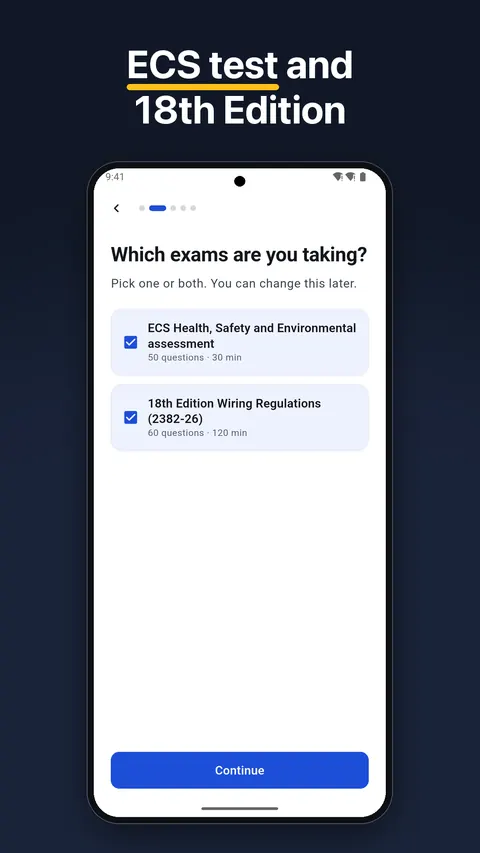
- 18th Edition: 538 questions, 60-question mock exams in 2 hours, a maximum Zs calculator and a guide to Amendment 4
- ECS HS&E: 389 questions and 50-question mock tests in 30 minutes
- Works offline. No ads, no account, no data collected.
Free: two full topics in each exam, three questions in every other topic, one full mock exam for each exam, the maximum Zs calculator and checklists.
Sparkwise Pro, £12.99 one-off: every question, every mock exam and every worked solution, for both exams. No subscription.
Android now; iPhone version not yet available. Sparkwise helps you prepare; it cannot promise a pass.