Not a government app. Sparkwise is an independent study app made by Kodfu Bilisim. It is not affiliated with or endorsed by the IET, BSI, City & Guilds, ECS or JIB. It does not contain the real exam questions and never reproduces BS 7671 text.
Personal protective equipment: free ECS HS&E practice questions
Who provides and looks after PPE, choosing the right head, eye, hand, foot, hearing and breathing protection.
10 original questions from the Sparkwise app, each with the answer and an explanation. Closed book, like the real assessment: answer first, then open the explanation. No sign-up, nothing saved. These are not the real exam questions: no app or website can show you those.
Question 1 · Choose one answer
Where does PPE come in the hierarchy of risk control?
- Last, once other controls have been used
- It is not part of the hierarchy at all
- Only after an accident has happened
- First, before anything else is considered
Show the answer
Answer A: Last, once other controls have been used
PPE only protects the wearer and only when worn properly, so it is used when other controls cannot adequately control the risk.
Source: PPE at Work Regulations 1992 (amended 2022)
Question 2 · Choose one answer
Your safety glasses get badly scratched and you can hardly see through them. What should you do?
- Carry on and replace them at the end of the week
- Carry on without eye protection for now
- Report it and get a replacement before going on
- Polish out the scratches and carry on
Show the answer
Answer C: Report it and get a replacement before going on
Damaged PPE must be reported and replaced. Poor visibility is a hazard in itself.
Source: PPE at Work Regulations 1992 (amended 2022)
Question 3 · Choose one answer
Your safety helmet falls from a scaffold onto concrete. It looks undamaged. What should you do?
- Check it with a torch and keep using it
- Keep using it because it looks fine
- Get it replaced, as it may have hidden damage
- Use it only for light, low-risk work from now on
Show the answer
Answer C: Get it replaced, as it may have hidden damage
A heavy impact can weaken the shell without visible marks. Replace it as the manufacturer advises.
Source: BS EN 397 · PPE at Work Regulations 1992
Question 4 · Choose one answer
You are cutting a chase in a brick wall with a wall chaser. Which eye protection is most suitable?
- Impact-rated goggles or a face shield
- Tinted sunglasses with plastic lenses
- Your own everyday prescription glasses
- None, if you look away during the cut
Show the answer
Answer A: Impact-rated goggles or a face shield
Chasing throws out fast particles and dust. Goggles or a face shield marked for impact give proper protection.
Source: BS EN 166 · PPE at Work Regulations 1992
Question 5 · Choose one answer
Why must electrical insulating gloves be checked before every use?
- They shrink a little every time they are worn
- They lose their colour over time
- They are only valid for a single use
- A tiny hole could let current pass through
Show the answer
Answer D: A tiny hole could let current pass through
Check for holes, cuts and damage, for example by trapping air and squeezing. Damaged gloves must not be used.
Source: BS EN 60903 · PPE at Work Regulations 1992
Question 6 · Choose one answer
Which features would you expect on safety boots for a construction site?
- A toe cap and a puncture-resistant midsole
- Smooth leather soles for comfort
- Lightweight trainers with good grip
- Soft fabric uppers and thin flexible soles
Show the answer
Answer A: A toe cap and a puncture-resistant midsole
Toe caps protect against dropped loads and midsoles stop nails going through.
Source: BS EN ISO 20345 · PPE at Work Regulations 1992
Question 7 · Choose one answer
Which disposable mask grade gives the highest level of protection?
- Dust mask
- FFP1
- FFP3
- FFP2
Show the answer
Answer C: FFP3
FFP3 has the highest assigned protection factor of the disposable grades (20, against 10 for FFP2 and 4 for FFP1), so it is chosen for hazardous dusts such as silica from chasing walls.
Source: COSHH 2002 · HSE: RPE fit testing (INDG479)
Question 8 · Choose one answer
An electrician with a full beard is given a disposable FFP3 mask for chasing walls.
What should happen?
- Wear the mask anyway and press it on tighter
- Skip RPE because the chasing is short
- Ask his supervisor for a powered hood instead
- Wear two masks, one on top of the other
Show the answer
Answer C: Ask his supervisor for a powered hood instead
Facial hair stops tight-fitting masks sealing. Loose-fitting powered RPE, such as a hood, does not rely on a face seal.
Source: COSHH 2002 · HSE: RPE fit testing (INDG479)
Question 9 · Choose one answer
A job needs a safety helmet, ear defenders and goggles worn together. What does the PPE at Work Regulations 1992 require the employer to make sure of?
- That the worker buys matching items themselves
- That the items fit together and still protect
- That only the single most important item is worn
- That each item comes from a different maker
Show the answer
Answer B: That the items fit together and still protect
Regulation 5 says that where several items must be worn at once, they must be compatible and each must stay effective against its own risk. For example, ear defenders must still seal properly when worn with a helmet. PPE is free to the worker, and no needed item can simply be dropped.
Source: PPE at Work Regs 1992 reg 5
Question 10 · Choose one answer
At the end of a shift, what do the PPE at Work Regulations expect you to do with the ear defenders and goggles you were issued?
- Leave them on your workbench overnight
- Throw them away and draw new ones
- Return them to the storage provided
- Hang them on the scaffold for tomorrow
Show the answer
Answer C: Return them to the storage provided
Regulation 10(4) asks workers to take reasonable steps to return PPE to the accommodation provided after use, and regulation 8 makes the employer provide that storage. Proper storage stops PPE being damaged, contaminated or lost.
Source: PPE at Work Regs 1992 regs 8 and 10(4)
You’ve seen 10 of 28 questions in this topic
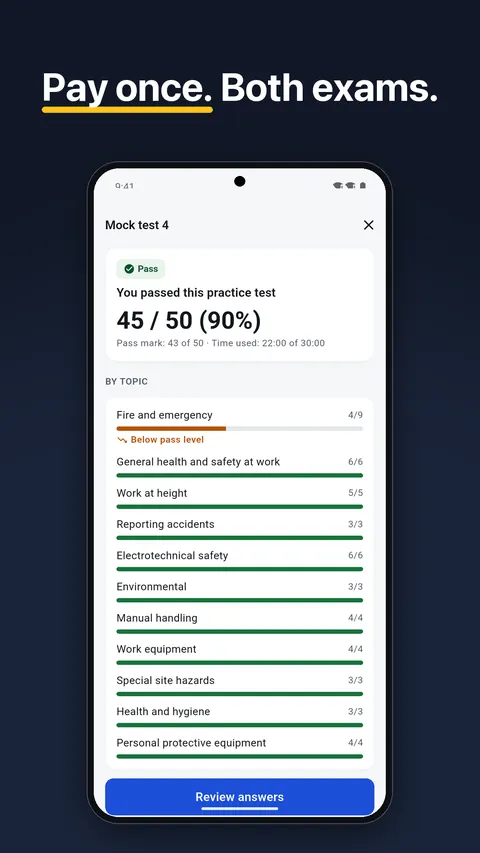
The Sparkwise app has all 28, each with an explanation. Across the whole ECS HS&E there are 389 questions in 11 topics, plus timed 50-question mock exams of 30 minutes.
3 of them are free in the app, the rest come with Pro. Sparkwise Pro is £12.99 one-off and unlocks every question, every mock exam and every worked solution for both exams. No subscription.
Android now; iPhone version not yet available.
Revision notes
PPE law and your duties
Under the Personal Protective Equipment at Work Regulations 1992, employers must provide suitable PPE free of charge wherever risks cannot be adequately controlled in other ways. Since 2022 this also covers most casual or 'limb (b)' workers. PPE must fit, be maintained, stored properly and come with training. It is the last line of defence because it only protects the wearer and only when worn correctly. Workers must use PPE as trained, look after it, and report any loss or defect straight away.
Head protection
A safety helmet protects your head from falling objects and from knocks against fixed objects. Wear it the right way round with the harness adjusted to fit, and use a chin strap when working at height or bending down a lot. Check the shell and harness before use. Do not paint it, drill it or add stickers unless the manufacturer allows it, because this can weaken it or hide damage. Replace a helmet that has taken a heavy blow, even if it looks fine. A bump cap is not a safety helmet.
Eye and face protection
Chasing, drilling, cutting, grinding and using cartridge tools all throw out fast-moving particles and dust. Choose eye protection marked as suitable for the hazard: safety spectacles with side protection for light work, goggles for dust and splashes, and a full face shield for grinding, and an arc-rated face shield where arc flash is possible. Ordinary glasses are not impact rated and leave gaps at the sides. Keep eye protection clean and replace it when scratched.
Hand protection
No single glove protects against everything. Use cut-resistant gloves for sharp metalwork, chemical-resistant gloves such as nitrile for cement, solvents and adhesives, and electrical insulating gloves, made to BS EN 60903 and rated for the voltage, for any justified live work. Check insulating gloves for holes and damage before every use, for example by rolling the cuff to trap air. Do not wear loose gloves near rotating parts such as drill chucks, where they can be caught and drag your hand in.
Foot protection
Safety footwear protects against dropped loads, crushing, sharp objects underfoot and slips. Site boots normally have a protective toe cap, a midsole that resists nails and other sharp objects, a slip-resistant sole and good ankle support. Choose footwear marked for the hazards on your site, keep it in good repair and replace it when the sole, upper or toe cap is damaged. Trainers and ordinary shoes are not acceptable on construction sites.
Hearing protection
Earplugs and ear defenders protect against noise-induced hearing loss, which is permanent. They must be worn in hearing protection zones and whenever your employer says noise is at or above the upper exposure action value. Protection only works if it fits and is worn the whole time you are in the noise: taking it off for even a few minutes greatly reduces the protection over a day. Insert plugs as trained and keep defenders' seals clean and undamaged.
Respiratory protective equipment (RPE)
Dust from chasing, drilling and cutting can cause serious lung disease. Disposable masks are graded FFP1, FFP2 and FFP3; FFP3 gives the highest protection and is the usual choice for silica and short non-licensed asbestos work. Tight-fitting RPE must be face-fit tested for the wearer, and you must be clean-shaven where the mask seals against your face. A 'nuisance dust' mask is not RPE. If you cannot get a seal, for example because of a beard, a powered hood may be suitable.
High-visibility clothing and harnesses
High-visibility clothing makes you easier to see, especially for drivers of vehicles and plant on site and near roads. Keep it clean and replace it when faded or torn. Fall protection harnesses and lanyards must be checked before every use for cut or worn webbing, damaged stitching, faulty buckles and deployed shock absorbers, and inspected in detail at regular intervals. Any harness or lanyard that has arrested a fall must be taken out of use.
More ECS HS&E topics
- Previous: Reporting accidentsRIDDOR, the accident book, near misses, dangerous occurrences and first-aid provision.
- Next: Health and hygieneCOSHH, dust, noise, vibration, skin problems, Weil's disease, welfare and fitness for work.
- ECS HS&E assessment guideFormat, rules, booking and how to prepare

Practise both exams in the Sparkwise app
927 original questions across every Part of BS 7671:2018+A4:2026 and every ECS HS&E syllabus area, timed mock exams in the real format, worked solutions for calculations and explanations that show where to look in the book.
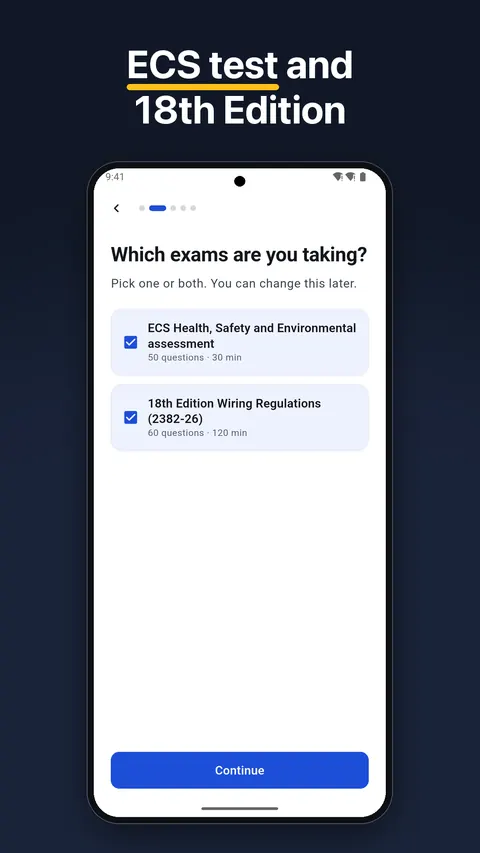
- 18th Edition: 538 questions, 60-question mock exams in 2 hours, a maximum Zs calculator and a guide to Amendment 4
- ECS HS&E: 389 questions and 50-question mock tests in 30 minutes
- Works offline. No ads, no account, no data collected.
Free: two full topics in each exam, three questions in every other topic, one full mock exam for each exam, the maximum Zs calculator and checklists.
Sparkwise Pro, £12.99 one-off: every question, every mock exam and every worked solution, for both exams. No subscription.
Android now; iPhone version not yet available. Sparkwise helps you prepare; it cannot promise a pass.