Not a government app. Sparkwise is an independent study app made by Kodfu Bilisim. It is not affiliated with or endorsed by the IET, BSI, City & Guilds, ECS or JIB. It does not contain the real exam questions and never reproduces BS 7671 text.
Manual handling: free ECS HS&E practice questions
Avoiding, assessing and reducing lifting risks, safe lifting technique and handling aids.
10 original questions from the Sparkwise app, each with the answer and an explanation. Closed book, like the real assessment: answer first, then open the explanation. No sign-up, nothing saved. These are not the real exam questions: no app or website can show you those.
Question 1 · Select TWO answers
Which of these are manual handling operations? Select TWO.
- Reading a cable schedule at your desk
- Driving the company van to the site
- Pushing a loaded trolley along a corridor
- Carrying a consumer unit up a flight of stairs
Show the answer
Answer C: Pushing a loaded trolley along a corridor, D: Carrying a consumer unit up a flight of stairs
Manual handling covers lifting, carrying, pushing and pulling loads by hand or bodily force. Reading and driving do not involve handling a load.
Source: Manual Handling Operations Regulations 1992
Question 2 · Choose one answer
What is one of your duties as an employee under the Manual Handling Operations Regulations?
- Use the handling aids and safe systems provided
- Provide your own trolleys and lifting aids
- Lift any load you are given without questioning it
- Carry out the employer's risk assessment
Show the answer
Answer A: Use the handling aids and safe systems provided
Employees must make full and proper use of the system of work provided, including handling aids.
Source: Manual Handling Operations Regulations 1992
Question 3 · Choose one answer
Which of these is an 'individual' factor in a manual handling assessment?
- A load with sharp metal edges
- A worker recovering from a back injury
- Poor lighting on the stairway
- A long way to carry the load each time
Show the answer
Answer B: A worker recovering from a back injury
Individual factors are about the person: their health, strength, training and any condition that affects their ability to handle loads.
Source: HSE: Manual handling at work (INDG143)
Question 4 · Choose one answer
A female apprentice is carrying boxes of fittings held against her waist. Which HSE guideline figure applies to her in that position?
- About 5 kg
- About 16 kg
- About 30 kg
- About 25 kg
Show the answer
Answer B: About 16 kg
The guideline figure for women in the best lifting position is about 16 kg.
Source: HSE: Manual handling at work (INDG143)
Question 5 · Choose one answer
You are about to move a heavy box of fittings to another floor. What is the first thing to do?
- Lift one corner quickly to test how heavy it is
- Plan it: check the weight, route and destination
- Clear a route after you have picked it up
- Put on a back support belt before lifting
Show the answer
Answer B: Plan it: check the weight, route and destination
Planning shows whether you need help or a handling aid and makes sure the route is clear.
Source: HSE: Manual handling at work (INDG143)
Question 6 · Choose one answer
Where should the load be held while carrying it?
- Close to your waist
- Above your head
- At arm's length
- Against your knees
Show the answer
Answer A: Close to your waist
Keeping the load close reduces the leverage on your lower back.
Source: HSE: Manual handling at work (INDG143)
Question 7 · Choose one answer
What is the main extra hazard when carrying long lengths of trunking through a busy area?
- It gives off dust as it rubs
- It conducts static electricity
- It is too heavy for one person to carry
- The ends can hit people or objects
Show the answer
Answer D: The ends can hit people or objects
Long loads are hard to control at both ends. Get help, watch corners and warn people nearby.
Source: HSE: Manual handling at work (INDG143)
Question 8 · Choose one answer
You need to move a heavy distribution board to the second floor. A sack truck and a goods lift are available.
What should you do?
- Carry it up the stairs with a colleague
- Use the sack truck and the goods lift
- Carry it up the stairs on your own in stages
- Wait until the end of the day and see who is free
Show the answer
Answer B: Use the sack truck and the goods lift
Where a mechanical aid is available, use it. It avoids the hazardous lift altogether.
Source: MHOR 1992 reg 4
Question 9 · Choose one answer
Some manual handling assessments use TILEO rather than TILE. Which of these would be recorded under the extra 'O' for other factors?
- A worker who is new and not yet trained
- A load that is hot, sharp or slippery
- A wet, uneven floor along the route
- PPE or clothing that restricts movement
Show the answer
Answer D: PPE or clothing that restricts movement
MHOR 1992 Schedule 1 lists the task, the load, the working environment, individual capability and other factors; the last asks whether PPE or clothing hinders movement or posture. Hot or sharp loads are load factors, floors are environment and inexperience is individual.
Source: MHOR 1992 Sch 1 para 5 · HSE L23
Question 10 · Choose one answer
You are carrying a heavy box that has to end up in an exact spot against a wall. What is the safest way to position it?
- Drop it the last few centimetres to save effort
- Put it down first, then slide it into place
- Twist at the waist to line it up as you lower it
- Hold it out and lower it straight onto the spot
Show the answer
Answer B: Put it down first, then slide it into place
HSE's good handling advice is put down, then adjust: set the load down and then slide it into its final position. Lining it up while still holding it means reaching or twisting with the full weight, which strains the back.
Source: HSE: good handling technique
You’ve seen 10 of 27 questions in this topic
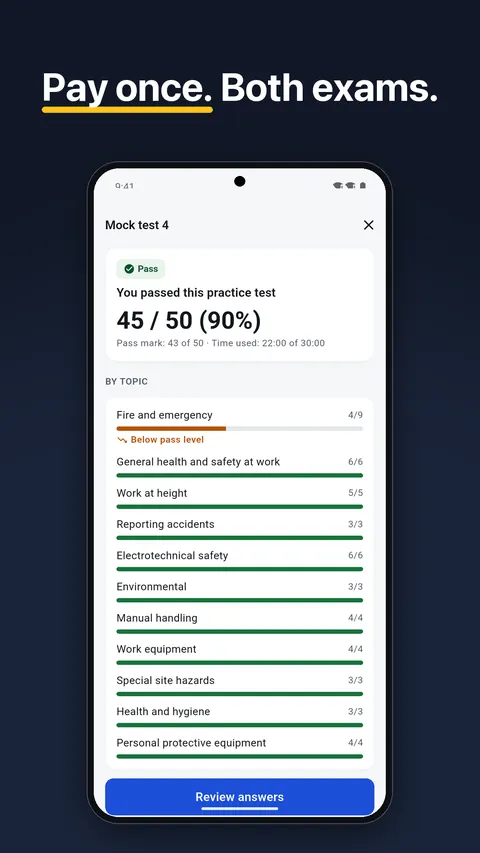
The Sparkwise app has all 27, each with an explanation, and 1 with a step-by-step worked solution. Across the whole ECS HS&E there are 389 questions in 11 topics, plus timed 50-question mock exams of 30 minutes.
3 of them are free in the app, the rest come with Pro. Sparkwise Pro is £12.99 one-off and unlocks every question, every mock exam and every worked solution for both exams. No subscription.
Android now; iPhone version not yet available.
Revision notes
The Manual Handling Operations Regulations 1992
Manual handling means moving or supporting a load by hand or by bodily force: lifting, lowering, pushing, pulling, carrying or holding. Employers must avoid hazardous manual handling so far as reasonably practicable, for example by using hoists, trolleys or deliveries to the point of use. Where it cannot be avoided, they must assess the risk and reduce it to the lowest reasonably practicable level. Employees must follow the safe systems of work they are given and use the handling aids provided.
Assessing a load with TILE
A simple way to assess a manual handling task is TILE. Task: does it involve twisting, stooping, reaching, long carrying distances or repeated lifting? Individual: is the person strong enough, fit, trained and not pregnant or recovering from injury? Load: is it heavy, bulky, unstable, sharp, hot or hard to grip? Environment: are there stairs, slopes, uneven or slippery floors, poor lighting, wind, tight spaces or high temperatures? Answers to these questions show where the risk can be reduced.
Guideline weights
HSE gives guideline figures to help spot tasks that need a closer look. For lifting close to the body at waist height, the figure is about 25 kg for men and 16 kg for women. The figures fall sharply when the load is held away from the body, above shoulder height or below knee height, or when it is lifted often. They are a filter, not a legal limit: a lighter load can still be risky and a heavier one may be acceptable after a proper assessment. The same figures can be used for carrying a load held against the body for about 10 m or less without a rest.
A good lifting technique
Plan before you lift: how heavy is it, where is it going, is the route clear and do you need help or a handling aid? Stand close with your feet apart and one leg slightly forward. Bend your knees and keep your back in its natural upright position. Get a firm grip, keep the load close to your waist and lift smoothly. Do not twist; turn by moving your feet. Put the load down, then adjust its position. For a team lift, one person gives the instructions. A team can usually handle about 85% of the sum of its members' capacities.
Handling aids and cable drums
Mechanical aids remove or reduce the need to lift. Use trolleys, sack trucks, pallet trucks, goods lifts and hoists wherever they are available. Pushing is usually better than pulling because you can use your body weight and see where you are going. Cable drums are heavy and awkward. Move them with suitable equipment, and when pulling in cable, mount the drum on a spindle with drum stands or jacks so it turns freely rather than dragging cable off a stationary drum.
Injuries from poor handling
Manual handling causes many workplace injuries. Most are musculoskeletal disorders: back injuries, strains, sprains and damage to joints, often built up over time by repeated poor lifting. Other injuries include hernias, cuts from sharp edges and crushed fingers or feet from dropped loads. Report pain or discomfort early so the task can be looked at and changed before the damage becomes serious or long-lasting.
More ECS HS&E topics
- Previous: General health and safety at workHealth and safety law, duties, risk assessment, method statements, CDM 2015, permits and safety signs.
- Next: Reporting accidentsRIDDOR, the accident book, near misses, dangerous occurrences and first-aid provision.
- ECS HS&E assessment guideFormat, rules, booking and how to prepare

Practise both exams in the Sparkwise app
927 original questions across every Part of BS 7671:2018+A4:2026 and every ECS HS&E syllabus area, timed mock exams in the real format, worked solutions for calculations and explanations that show where to look in the book.
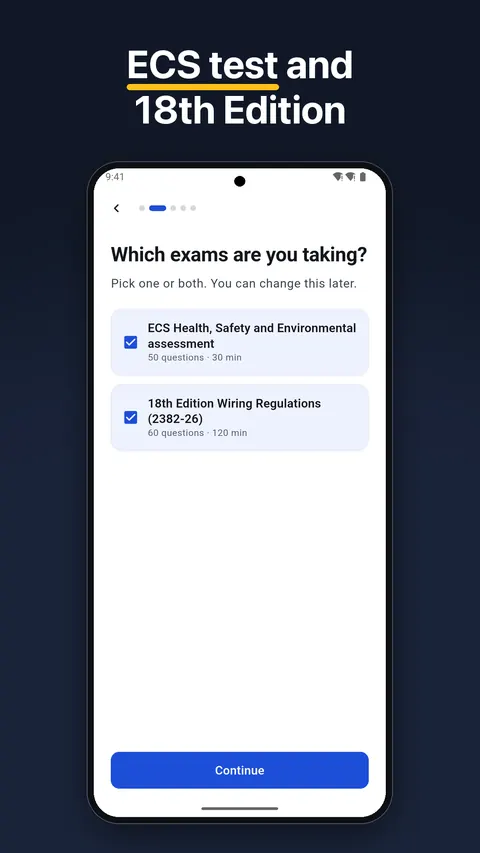
- 18th Edition: 538 questions, 60-question mock exams in 2 hours, a maximum Zs calculator and a guide to Amendment 4
- ECS HS&E: 389 questions and 50-question mock tests in 30 minutes
- Works offline. No ads, no account, no data collected.
Free: two full topics in each exam, three questions in every other topic, one full mock exam for each exam, the maximum Zs calculator and checklists.
Sparkwise Pro, £12.99 one-off: every question, every mock exam and every worked solution, for both exams. No subscription.
Android now; iPhone version not yet available. Sparkwise helps you prepare; it cannot promise a pass.