Not a government app. Sparkwise is an independent study app made by Kodfu Bilisim. It is not affiliated with or endorsed by the IET, BSI, City & Guilds, ECS or JIB. It does not contain the real exam questions and never reproduces BS 7671 text.
General health and safety at work: free ECS HS&E practice questions
Health and safety law, duties, risk assessment, method statements, CDM 2015, permits and safety signs.
10 original questions from the Sparkwise app, each with the answer and an explanation. Closed book, like the real assessment: answer first, then open the explanation. No sign-up, nothing saved. These are not the real exam questions: no app or website can show you those.
Question 1 · Choose one answer
Under the Health and Safety at Work etc. Act 1974, who must take reasonable care of their own health and safety and that of others affected by their work?
- Only supervisors and managers
- Only the employing company
- Every employee at work
- Only the site safety adviser
Show the answer
Answer C: Every employee at work
The Act places a personal duty on every employee to take reasonable care of themselves and of anyone else who could be affected by what they do or fail to do at work.
Source: Health and Safety at Work etc. Act 1974
Question 2 · Choose one answer
What does 'so far as is reasonably practicable' mean in health and safety law?
- Precautions are only needed once an accident has happened
- Act unless the cost is grossly out of proportion to the risk
- Only precautions that cost nothing extra have to be taken
- The client decides which of the precautions are worth paying for
Show the answer
Answer B: Act unless the cost is grossly out of proportion to the risk
The duty holder balances the risk against the sacrifice needed to control it. Only when the cost is grossly disproportionate to the risk can a measure be left out.
Source: Health and Safety at Work etc. Act 1974
Question 3 · Choose one answer
An employer must record the significant findings of a risk assessment when they employ at least how many people?
- Five
- Ten
- Twenty
- Fifty
Show the answer
Answer A: Five
The Management of Health and Safety at Work Regulations 1999 require employers with five or more employees to write down the significant findings.
Source: MHSWR 1999 reg 3(6)
Question 4 · Choose one answer
Your method statement says to install cable tray from a mobile tower. When you arrive, the floor is badly uneven and the tower cannot be levelled.
What should you do?
- Stand a stepladder on the tower platform to gain extra height
- Put packing under the wheels and carry on
- Carry on carefully because the job is short
- Stop and tell your supervisor so the method can be reviewed
Show the answer
Answer D: Stop and tell your supervisor so the method can be reviewed
When site conditions do not match the method statement, the safe system of work no longer applies. Stop and report it so a safe method can be agreed.
Source: MHSWR 1999 Sch 1 (principles of prevention)
Question 5 · Choose one answer
What does an improvement notice require?
- The company must close down permanently
- Each worker involved must pay a fixed fine
- All work on the site must stop immediately
- A breach must be put right within a set time
Show the answer
Answer D: A breach must be put right within a set time
An improvement notice states what is wrong and gives a deadline, at least 21 days, to put it right.
Source: HSWA 1974 ss20-22 · HSE enforcement
Question 6 · Choose one answer
Under CDM 2015, when must a construction project be notified to HSE?
- Only when the client is a public body such as a council
- Whenever any electrical work is carried out on the site
- Only when the work includes demolition, asbestos removal or excavation
- Over 30 working days with 20+ workers at once, or over 500 person days
Show the answer
Answer D: Over 30 working days with 20+ workers at once, or over 500 person days
A project is notifiable if it is scheduled to exceed 30 working days with more than 20 workers simultaneously at any point, or to exceed 500 person days.
Source: CDM 2015 reg 6
Question 7 · Choose one answer
What does a blue circular safety sign mean?
- Something is not allowed, such as smoking
- Warning of a hazard, such as electricity
- The way to a safe condition, such as a fire exit route
- You must do something, such as wear eye protection
Show the answer
Answer D: You must do something, such as wear eye protection
Blue circles are mandatory signs. They tell you what you must do, for example wear a hard hat or hearing protection.
Source: Safety Signs and Signals Regulations 1996
Question 8 · Choose one answer
What is a permit to work?
- A note from your doctor saying you are fit for work
- A formal written system for controlling high-risk work
- Planning permission for the building from the council
- The card that shows your trade qualifications
Show the answer
Answer B: A formal written system for controlling high-risk work
A permit to work makes sure specific precautions are in place before high-risk work starts and that the work is formally handed back when it ends.
Source: CDM 2015 reg 13 · HSE: permits to work (HSG250)
Question 9 · Choose one answer
What is one role of a trade union safety representative?
- To serve prohibition notices on unsafe sites
- To decide whether any injury must be reported to the HSE
- To sign off electrical installation certificates
- To represent workers in health and safety consultation
Show the answer
Answer D: To represent workers in health and safety consultation
Safety representatives raise workers' concerns, investigate hazards and complaints and take part in inspections. The employer keeps its legal duties.
Source: HSWA 1974 s2(4) · SRSC Regulations 1977
Question 10 · Choose one answer
Under CDM 2015, which document sets out the health and safety arrangements and site rules for the construction phase of a project?
- The construction phase plan
- The pre-construction information
- The health and safety file
- The F10 notification form
Show the answer
Answer A: The construction phase plan
Regulation 12 has the principal contractor draw up the construction phase plan before the site is set up, covering the arrangements and site rules. The health and safety file holds information for later work on the building, and the F10 notifies HSE of a project.
Source: CDM 2015 reg 12
You’ve seen 10 of 43 questions in this topic
The Sparkwise app has all 43, each with an explanation. Across the whole ECS HS&E there are 389 questions in 11 topics, plus timed 50-question mock exams of 30 minutes.
All 43 are free in the app. Sparkwise Pro is £12.99 one-off and unlocks every question, every mock exam and every worked solution for both exams. No subscription.
Android now; iPhone version not yet available.
Revision notes
The Health and Safety at Work etc. Act 1974
The 1974 Act is the main health and safety law in Great Britain (Northern Ireland has a matching Order). Employers must, so far as is reasonably practicable, protect employees and anyone else affected by their work: safe plant, safe systems of work, information, instruction, training and supervision, and a safe workplace. Employees must take reasonable care of themselves and others and co-operate with their employer. Nobody may intentionally or recklessly interfere with or misuse anything provided for safety, and workers cannot be charged for things the law requires the employer to provide.
Hazards, risks and risk assessment
A hazard is anything with the potential to cause harm, such as a live conductor or an unguarded floor opening. Risk is the chance that the hazard will actually cause harm, combined with how bad that harm could be. Employers must assess the risks of their work. A simple approach has five steps: identify the hazards, decide who might be harmed and how, evaluate the risks and choose precautions, record the significant findings, then review and update the assessment. Businesses with five or more employees must write the significant findings down.
Controlling risks and method statements
Controls follow a hierarchy. First try to eliminate the hazard altogether, then substitute something less dangerous, then use engineering controls such as barriers or extraction, then safe working procedures, signs and training, and only then personal protective equipment. A method statement turns the risk assessment into a step-by-step safe way of doing a particular job. Read it, make sure you understand it and follow it. If the site does not match what the method statement assumes, stop and tell your supervisor rather than improvising.
Enforcement and penalties
On construction sites in Great Britain, health and safety law is enforced mainly by the Health and Safety Executive (HSE); local authorities cover places such as offices and shops. Inspectors can enter premises, take samples and photographs and interview people. An improvement notice gives a deadline to put a breach right. A prohibition notice stops an activity that risks serious personal injury, often with immediate effect. Companies and individuals, including employees, can be prosecuted, and courts can impose unlimited fines and, for some offences, prison.
CDM 2015 on site
The Construction (Design and Management) Regulations 2015 set out who does what on a construction project. The client appoints a principal designer and a principal contractor when more than one contractor will work on the project. The principal contractor plans, manages and co-ordinates the construction phase and prepares the construction phase plan. Contractors plan and supervise their own work. Workers must co-operate, follow instructions and report anything likely to endanger themselves or others. Larger projects must also be notified to HSE before work starts.
Safety signs and colours
Safety signs use shape and colour so they can be understood at a glance. A red circle with a diagonal bar means something is prohibited, such as no smoking. A blue circle shows a mandatory action, such as wearing eye protection. A yellow triangle with a black border warns of a hazard, such as electricity. A green rectangle or square shows a safe condition, such as an emergency exit or first aid. Red rectangles or squares mark fire-fighting equipment and fire alarm call points.
Inductions, toolbox talks and permits to work
Before starting on any site you should receive an induction covering site rules, the main hazards, welfare, first aid and what to do in an emergency. Toolbox talks are short briefings on one subject, often given at the work area. High-risk jobs such as hot work, entry into confined spaces or work on high-voltage systems may be controlled by a permit to work: a formal written system, issued by an authorised person, that sets out the precautions, who may do the work and for how long. When the work ends the permit is formally closed.
Policies, consultation and representatives
An employer with five or more employees must have a written health and safety policy and bring it to the attention of staff. Employers must display the approved health and safety law poster or give workers the matching leaflet. Employers must consult their workers on health and safety. They can consult directly, or through union-appointed safety representatives or elected representatives. Union safety representatives can also investigate complaints and carry out inspections. Whoever is consulted, the legal duties stay with the employer.
More ECS HS&E topics
- Previous: EnvironmentalWaste duty of care, WEEE, hazardous waste, pollution, spills, nuisance and saving energy.
- Next: Manual handlingAvoiding, assessing and reducing lifting risks, safe lifting technique and handling aids.
- ECS HS&E assessment guideFormat, rules, booking and how to prepare

Practise both exams in the Sparkwise app
927 original questions across every Part of BS 7671:2018+A4:2026 and every ECS HS&E syllabus area, timed mock exams in the real format, worked solutions for calculations and explanations that show where to look in the book.
- 18th Edition: 538 questions, 60-question mock exams in 2 hours, a maximum Zs calculator and a guide to Amendment 4
- ECS HS&E: 389 questions and 50-question mock tests in 30 minutes
- Works offline. No ads, no account, no data collected.
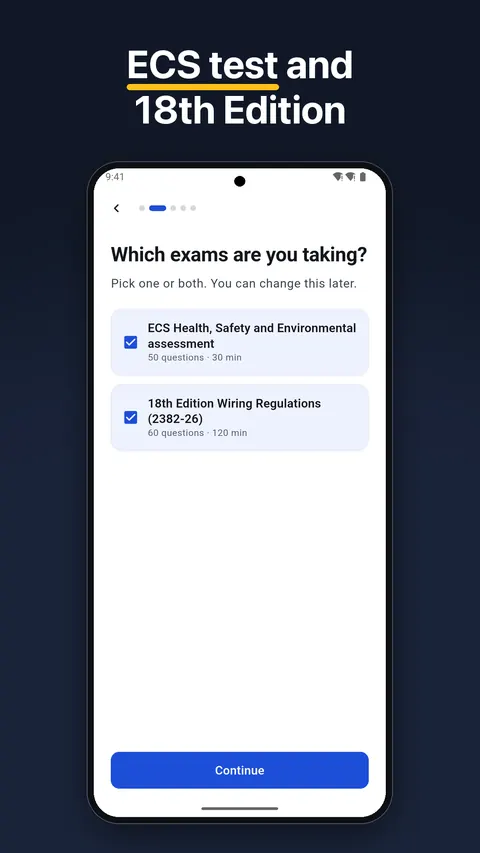
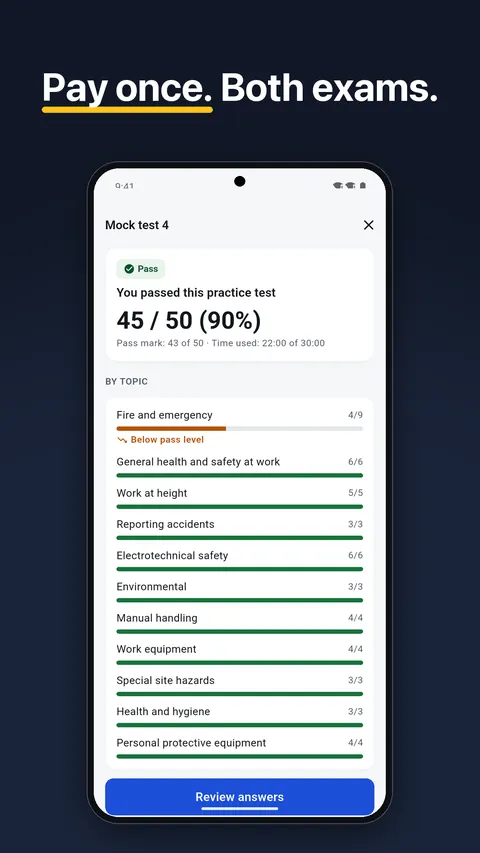
Free: two full topics in each exam, three questions in every other topic, one full mock exam for each exam, the maximum Zs calculator and checklists.
Sparkwise Pro, £12.99 one-off: every question, every mock exam and every worked solution, for both exams. No subscription.
Android now; iPhone version not yet available. Sparkwise helps you prepare; it cannot promise a pass.