Not a government app. Sparkwise is an independent study app made by Kodfu Bilisim. It is not affiliated with or endorsed by the IET, BSI, City & Guilds, ECS or JIB. It does not contain the real exam questions and never reproduces BS 7671 text.
Special site hazards: free ECS HS&E practice questions
Asbestos, buried services, excavations, overhead lines, confined spaces and lone working.
10 original questions from the Sparkwise app, each with the answer and an explanation. Closed book, like the real assessment: answer first, then open the explanation. No sign-up, nothing saved. These are not the real exam questions: no app or website can show you those.
Question 1 · Choose one answer
Which buildings may contain asbestos?
- Any built or refurbished before 2000
- Only buildings built before 1950
- Only industrial and commercial buildings
- Only buildings with flat roofs
Show the answer
Answer A: Any built or refurbished before 2000
Asbestos was used widely until the full UK ban in 1999, so any building from before 2000 could contain it.
Source: HSE: asbestos · Control of Asbestos Regs 2012
Question 2 · Select TWO answers
Which of these are common places to find asbestos in buildings from before 2000? Select TWO.
- Insulating board ceiling tiles
- Textured decorative ceiling coatings
- Modern PVC trunking and conduit
- Plasterboard installed in 2020
Show the answer
Answer A: Insulating board ceiling tiles, B: Textured decorative ceiling coatings
Insulating board and textured coatings were common uses of asbestos. Modern plastics and recent plasterboard do not contain it.
Source: HSE: asbestos · Control of Asbestos Regs 2012
Question 3 · Choose one answer
Who has the duty to manage asbestos in non-domestic premises?
- Every electrician who works there
- The local council's building control
- The company that made the asbestos
- The person in charge of maintenance
Show the answer
Answer D: The person in charge of maintenance
The duty holder, usually the owner or whoever is responsible for maintenance and repair, must find, record and manage asbestos.
Source: Control of Asbestos Regulations 2012 regs 4, 10
Question 4 · Choose one answer
Before digging near where buried cables may be, what should you do?
- Get service plans and use a cable avoidance tool
- Dig with a pick to find them quickly
- Assume there are no services if none are on the plan
- Ask the client whether they remember any
Show the answer
Answer A: Get service plans and use a cable avoidance tool
Plans help you plan, and a locator used by a trained person helps find what is actually there.
Source: HSE: Avoiding danger from underground services (HSG47)
Question 5 · Choose one answer
How should you dig close to a located buried cable?
- With a pick or fork to loosen the ground
- With a mechanical excavator to finish quickly
- By hand with a spade or shovel, in trial holes
- By driving a steel spike down to find it
Show the answer
Answer C: By hand with a spade or shovel, in trial holes
Hand digging with spades and shovels is less likely to damage the cable than picks, forks or machines.
Source: HSE: Avoiding danger from underground services (HSG47)
Question 6 · Choose one answer
When must an excavation be inspected by a competent person?
- Only once, when it is first dug
- Once a month by the site manager
- At the start of every shift
- Only after someone has been injured
Show the answer
Answer C: At the start of every shift
A competent person inspects at the start of every shift and after any event that may have affected safety, such as a fall of material.
Source: CDM 2015 reg 22 (excavations)
Question 7 · Choose one answer
Unless the line owner confirms otherwise, how should overhead power lines be treated?
- As dead
- As phone lines
- As disused
- As live
Show the answer
Answer D: As live
Overhead lines can carry very high voltages. Assume they are live until the owner confirms that they are dead.
Source: HSE: Avoiding danger from overhead lines (GS6)
Question 8 · Choose one answer
Why should ladders and scaffold tubes be carried horizontally near overhead lines?
- Because they are lighter that way
- To keep them well below the wires
- So they do not block the footpath
- So the wind cannot catch them
Show the answer
Answer B: To keep them well below the wires
Long conductive objects carried upright can reach or approach the wires.
Source: HSE: Avoiding danger from overhead lines (GS6)
Question 9 · Choose one answer
What must be in place before anyone enters a confined space?
- A warning sign fixed at the entrance only
- A torch and a working mobile phone
- A colleague waiting in the canteen
- A safe system and rescue arrangements
Show the answer
Answer D: A safe system and rescue arrangements
Entry needs a safe system, often a permit and gas testing, and rescue arrangements ready before anyone goes in.
Source: Confined Spaces Regulations 1997
Question 10 · Choose one answer
At a petrol station forecourt, what is special about electrical equipment installed in the hazardous zones?
- It can be standard domestic-grade equipment
- It must run at 110 V for safety
- It must be rated for explosive atmospheres
- It must be mounted at least 2 m high
Show the answer
Answer C: It must be rated for explosive atmospheres
Ordinary equipment can spark and ignite flammable vapour. Equipment in these zones must be designed and certified for that use.
Source: DSEAR 2002 reg 7 · BS EN 60079 (Ex equipment)
You’ve seen 10 of 36 questions in this topic
The Sparkwise app has all 36, each with an explanation. Across the whole ECS HS&E there are 389 questions in 11 topics, plus timed 50-question mock exams of 30 minutes.
3 of them are free in the app, the rest come with Pro. Sparkwise Pro is £12.99 one-off and unlocks every question, every mock exam and every worked solution for both exams. No subscription.
Android now; iPhone version not yet available.
Revision notes
Asbestos: where it is and why it matters
Asbestos was widely used in buildings until it was fully banned in the UK in 1999, so any building built or refurbished before 2000 may contain it. Electricians meet it in insulating board ceiling tiles and panels, old fuse board backing boards and flash guards, textured ceiling coatings, floor tiles, pipe lagging and cement sheets. Breathing in the fibres can cause mesothelioma, asbestos-related lung cancer, asbestosis and pleural thickening. These diseases appear decades later and are usually incurable. All types of asbestos are dangerous, whatever their colour.
Asbestos: before and during work
Whoever is responsible for maintaining non-domestic premises has a duty to manage asbestos: find it, record it in an asbestos register and plan, and share that information with anyone who could disturb it. Ask to see it before drilling, cutting or lifting anything in an older building. Intrusive refurbishment needs a refurbishment and demolition survey first. Anyone liable to disturb asbestos needs asbestos awareness training. If you find suspect material, stop work at once, do not disturb it further, keep others away and report it.
Buried services
Underground cables and pipes are hard to see and easy to hit. HSE guidance (HSG47) sets out three steps: plan the work using service records, but remember plans are not exact and many services are not shown; locate services with a cable avoidance tool (CAT) and signal generator used by a trained person, and mark their positions on the ground; then dig safely, hand-digging trial holes near located services with spades and shovels rather than picks or forks. Treat every buried cable as live until proved otherwise.
Excavations
Trench sides can collapse without warning, and a cubic metre of soil weighs over a tonne. Even shallow excavations can bury someone, so support the sides, batter them back or step them where there is a risk. Protect edges with barriers, keep spoil, materials and plant away from the edge, and use stop blocks so vehicles cannot tip in. Provide a safe way in and out, such as a secured ladder. A competent person must inspect excavations at the start of each shift and after any event that may have affected their safety.
Overhead power lines
Treat all overhead lines as live unless the line owner confirms otherwise. Electricity can arc across a gap, so you do not have to touch a line to be killed. Where possible, plan work away from lines or ask the network operator to divert or switch them off. Otherwise use barriers, goalposts and height limits to keep plant, scaffold tubes, ladders and long materials well clear. If a machine touches a line, the operator should stay in the cab unless there is fire; if they must leave, they jump clear without touching the machine and the ground together.
Confined spaces
A confined space is a substantially enclosed place where a serious injury could result from hazards such as lack of oxygen, toxic gas or fumes, flooding, fire or explosion, or extreme heat. Electricians may need to enter cable chambers, ducts, tanks, voids and plant rooms that fit this description. Under the Confined Spaces Regulations 1997, avoid entry if the work can be done from outside. Otherwise follow a safe system of work, often with a permit, gas testing and trained people, and have emergency rescue arrangements in place before anyone goes in.
Lone working and other special hazards
Working alone is not illegal, but it must be risk assessed. Lone workers need a way to raise the alarm, a check-in system and a supervisor who knows where they are. Some work, such as confined space entry or justified live working, should never be done alone. Other special hazards include explosive atmospheres at places such as petrol stations, where only specially protected equipment may be used, contaminated land, old lead paint, and working in occupied buildings where the public must be kept away from the work.
More ECS HS&E topics
- Previous: Work equipmentPUWER, hand and power tools, 110 V site supplies, cordless tools, abrasive wheels and lifting equipment.
- Next: Electrotechnical safetyElectricity at Work Regulations, safe isolation, test equipment, lock-off, live working, RCDs and solar PV.
- ECS HS&E assessment guideFormat, rules, booking and how to prepare

Practise both exams in the Sparkwise app
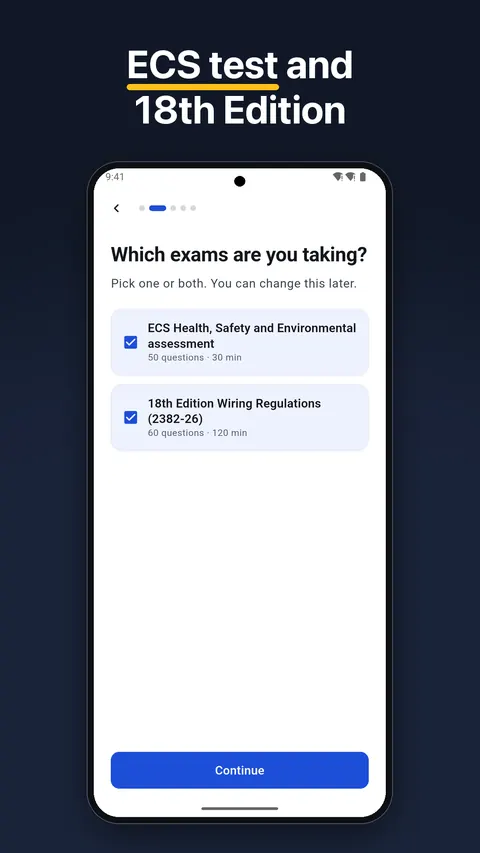
927 original questions across every Part of BS 7671:2018+A4:2026 and every ECS HS&E syllabus area, timed mock exams in the real format, worked solutions for calculations and explanations that show where to look in the book.
- 18th Edition: 538 questions, 60-question mock exams in 2 hours, a maximum Zs calculator and a guide to Amendment 4
- ECS HS&E: 389 questions and 50-question mock tests in 30 minutes
- Works offline. No ads, no account, no data collected.
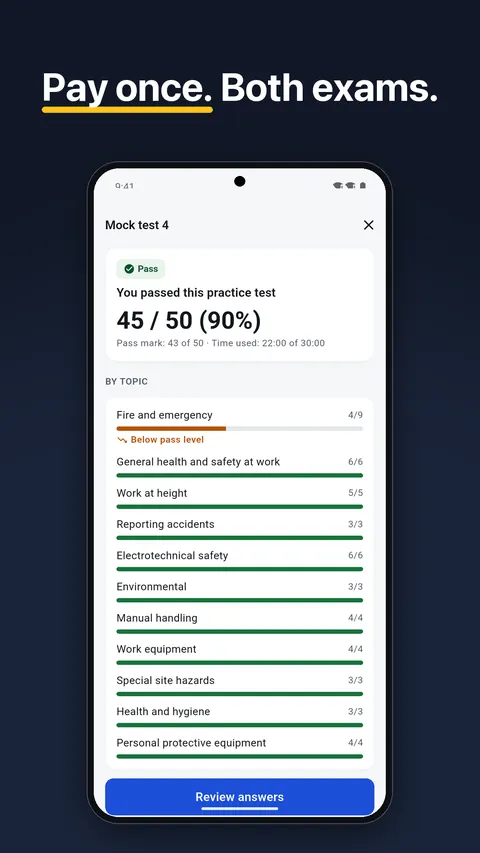
Free: two full topics in each exam, three questions in every other topic, one full mock exam for each exam, the maximum Zs calculator and checklists.
Sparkwise Pro, £12.99 one-off: every question, every mock exam and every worked solution, for both exams. No subscription.
Android now; iPhone version not yet available. Sparkwise helps you prepare; it cannot promise a pass.