Not a government app. Sparkwise is an independent study app made by Kodfu Bilisim. It is not affiliated with or endorsed by the IET, BSI, City & Guilds, ECS or JIB. It does not contain the real exam questions and never reproduces BS 7671 text.
Work equipment: free ECS HS&E practice questions
PUWER, hand and power tools, 110 V site supplies, cordless tools, abrasive wheels and lifting equipment.
10 original questions from the Sparkwise app, each with the answer and an explanation. Closed book, like the real assessment: answer first, then open the explanation. No sign-up, nothing saved. These are not the real exam questions: no app or website can show you those.
Question 1 · Choose one answer
What does PUWER stand for?
- Power Unit Wiring and Earthing Rules
- Protection of Users of Woodworking Equipment Regulations
- Provision and Use of Work Equipment Regulations
- Portable Use of Workshop Electrical Regulations
Show the answer
Answer C: Provision and Use of Work Equipment Regulations
PUWER 1998 covers the selection, maintenance, inspection and use of all work equipment.
Source: PUWER 1998
Question 2 · Choose one answer
What should you do before using a mains-powered drill on site?
- Check the plug, cable and casing for damage
- Plug it in and run it to see if it sparks
- Nothing, if it was working yesterday
- Remove the cable grip to inspect the wires
Show the answer
Answer A: Check the plug, cable and casing for damage
A quick user check catches most faults that make tools dangerous.
Source: HSE: Maintaining portable equipment (HSG107)
Question 3 · Choose one answer
Why should you never carry a power tool by its cable?
- It makes the tool feel heavier
- It wears out the motor bearings faster
- It can twist the trigger switch
- It can damage the cable and terminals
Show the answer
Answer D: It can damage the cable and terminals
Strain on the cable can break conductors or pull them out of their terminals, creating shock or fire risks.
Source: HSE: Maintaining portable equipment (HSG107)
Question 4 · Choose one answer
What should you do if a hammer head is loose on its handle?
- Use it for light tapping work only
- Tape the head firmly to the handle
- Stop using it until it is repaired
- Soak it in water so the wood swells
Show the answer
Answer C: Stop using it until it is repaired
A loose head can fly off and injure you or someone nearby.
Source: PUWER 1998 regs 4-5
Question 5 · Choose one answer
What colour is a 110 V industrial plug or socket?
- Green
- Yellow
- Red
- Blue
Show the answer
Answer B: Yellow
Yellow connectors are used for 110 V, so 110 V tools cannot be plugged into higher-voltage supplies.
Source: BS EN 60309 · BS 7375
Question 6 · Choose one answer
How should extension leads be run on site?
- Along the floor of the main walkway
- Under fire doors so that the doors stay shut
- Across doorways, the shortest way
- Away from walkways and sources of damage
Show the answer
Answer D: Away from walkways and sources of damage
Leads across walkways cause trips, and leads trapped or run over get damaged.
Source: BS EN 60309 · BS 7375
Question 7 · Choose one answer
Who should change the disc on an angle grinder?
- Anyone who has used an angle grinder before
- The newest apprentice, to learn
- The storeman who issues the discs
- A person trained and competent to do so
Show the answer
Answer D: A person trained and competent to do so
Incorrect mounting is a common cause of disc failure, so training is needed.
Source: HSE: Abrasive wheels (HSG17) · PUWER 1998
Question 8 · Choose one answer
Who may use a cartridge-operated fixing tool?
- Only trained and authorised people
- Anyone on site who needs a fixing
- Any worker aged 18 or over
- Only the site manager or foreman
Show the answer
Answer A: Only trained and authorised people
These tools fire fixings with explosive force. Training covers cartridge selection, materials and hazards.
Source: PUWER 1998 · manufacturer instructions
Question 9 · Choose one answer
How often must lifting accessories such as slings and shackles be thoroughly examined?
- At least every 6 months
- Only when they look damaged
- At least every 5 years
- At least every 3 years
Show the answer
Answer A: At least every 6 months
Accessories and equipment for lifting people need examination at least every six months, or as an examination scheme sets.
Source: LOLER 1998 reg 9
Question 10 · Choose one answer
A dumper driver offers you a lift across site on the side of his machine, which has only a driver's seat.
What should you do?
- Sit on the side of the skip and hold on
- Stand on the back step and hold the frame
- Refuse and walk along the pedestrian route
- Accept, as it is only a short distance
Show the answer
Answer C: Refuse and walk along the pedestrian route
Riding on plant without a proper seat leads to falls and crush injuries.
Source: PUWER 1998 reg 25
You’ve seen 10 of 31 questions in this topic
The Sparkwise app has all 31, each with an explanation. Across the whole ECS HS&E there are 389 questions in 11 topics, plus timed 50-question mock exams of 30 minutes.
3 of them are free in the app, the rest come with Pro. Sparkwise Pro is £12.99 one-off and unlocks every question, every mock exam and every worked solution for both exams. No subscription.
Android now; iPhone version not yet available.
Revision notes
PUWER: the basics
The Provision and Use of Work Equipment Regulations 1998 (PUWER) cover everything from screwdrivers to power tools, ladders and machinery. Equipment must be suitable for the job and conditions, maintained in good working order, inspected where wear could cause danger, and used only by people who have had the right information, instruction and training. Dangerous parts must be guarded and there must be suitable controls and means of isolation. Users should check equipment before use and report any defect.
Hand tools
Many injuries come from simple hand tools. Use the right tool for the job and check it before use. Do not use a hammer with a loose head or split handle, a chisel with a mushroomed head that can shed fragments, or a screwdriver with a worn tip or broken handle. Never use a screwdriver as a chisel or lever. Keep cutting tools sharp, use safety or retractable knives, cut away from your body and carry sharp tools safely.
Checking portable power tools
Before using a mains tool, check the plug, the cable, the cable grip and the casing. Look for damaged or taped cable, exposed inner cores, cracked casings, loose parts and burn marks. If you find a fault, do not use the tool: take it out of use, label it and report it. A current inspection or test label does not replace your own check, because damage can happen at any time. Never carry a tool by its cable, and disconnect it before changing bits or blades.
Site power: 110 V, colours and leads
On construction sites, portable mains tools should run at 110 V from a centre-tapped transformer. Industrial plugs and sockets are colour coded: yellow for 110 V, blue for 230 V and red for 400 V, so tools cannot be plugged into the wrong supply. Battery tools are safer still because there is no trailing lead and the voltage is low. Domestic extension reels are not made for site conditions. Route leads where they will not be tripped over or damaged, and fully unwind cable reels under heavy load.
Abrasive wheels and grinders
Angle grinders and cut-off saws cause serious injuries when discs shatter or snag. Use the correct disc for the material and the tool, and check that the disc's maximum speed is at least the tool's speed. Only trained, competent people should change discs. Keep the guard fitted and adjusted, hold the tool with both hands, wear eye and face protection and control the dust. Let the disc stop completely before putting the tool down, and never use a damaged disc.
Cartridge-operated fixing tools
Cartridge or powder-actuated tools fire fixings into steel, concrete and masonry with explosive force. Only trained and authorised people should use them. Choose the correct cartridge strength and fixing for the material, and check what is behind it, because fixings can pass right through or ricochet off hard surfaces. Wear eye and hearing protection and keep others clear. Store cartridges securely, and never leave a loaded tool unattended or point it at anyone.
Lifting equipment and LOLER
The Lifting Operations and Lifting Equipment Regulations 1998 (LOLER) require lifting operations to be properly planned by a competent person, supervised and carried out safely. Lifting equipment and accessories must be strong enough, marked with their safe working load (SWL) and thoroughly examined by a competent person at set intervals: at least every six months for accessories such as slings and for equipment used to lift people, and at least every twelve months for other lifting equipment, unless a written examination scheme sets other intervals. Never exceed the SWL and check accessories before use.
Plant and site vehicles
Site plant such as dumpers, telehandlers and excavators is involved in many serious accidents. Only trained, competent and authorised people may operate it. Keep to pedestrian routes, stay out of the operator's blind spots and never walk behind a reversing vehicle. Reversing should be controlled by a trained signaller where it cannot be avoided. Never ride on plant unless it has a proper passenger seat, and never stand under a suspended load.
More ECS HS&E topics
- Previous: Work at heightThe Work at Height Regulations, ladders, stepladders, scaffolds, mobile towers and MEWPs.
- Next: Special site hazardsAsbestos, buried services, excavations, overhead lines, confined spaces and lone working.
- ECS HS&E assessment guideFormat, rules, booking and how to prepare

Practise both exams in the Sparkwise app
927 original questions across every Part of BS 7671:2018+A4:2026 and every ECS HS&E syllabus area, timed mock exams in the real format, worked solutions for calculations and explanations that show where to look in the book.
- 18th Edition: 538 questions, 60-question mock exams in 2 hours, a maximum Zs calculator and a guide to Amendment 4
- ECS HS&E: 389 questions and 50-question mock tests in 30 minutes
- Works offline. No ads, no account, no data collected.

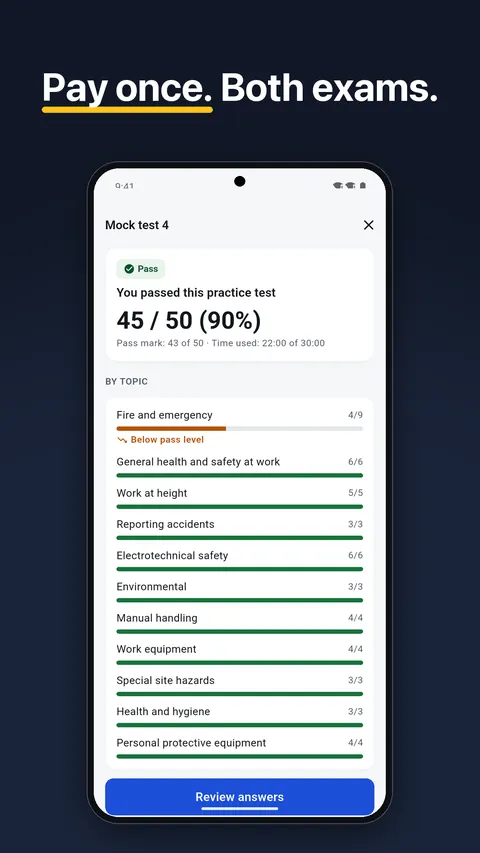
Free: two full topics in each exam, three questions in every other topic, one full mock exam for each exam, the maximum Zs calculator and checklists.
Sparkwise Pro, £12.99 one-off: every question, every mock exam and every worked solution, for both exams. No subscription.
Android now; iPhone version not yet available. Sparkwise helps you prepare; it cannot promise a pass.