Not a government app. Sparkwise is an independent study app made by Kodfu Bilisim. It is not affiliated with or endorsed by the IET, BSI, City & Guilds, ECS or JIB. It does not contain the real exam questions and never reproduces BS 7671 text.
Work at height: free ECS HS&E practice questions
The Work at Height Regulations, ladders, stepladders, scaffolds, mobile towers and MEWPs.
10 original questions from the Sparkwise app, each with the answer and an explanation. Closed book, like the real assessment: answer first, then open the explanation. No sign-up, nothing saved. These are not the real exam questions: no app or website can show you those.
Question 1 · Choose one answer
Under the Work at Height Regulations 2005, what counts as work at height?
- Only work on scaffolds, towers, roofs and ladders
- Only work more than 2 m above the ground
- Only work more than 3 m above the ground
- Anywhere a fall could injure you, even below ground
Show the answer
Answer D: Anywhere a fall could injure you, even below ground
There is no minimum height. A fall into an excavation or through a floor opening counts too.
Source: Work at Height Regulations 2005
Question 2 · Choose one answer
When is a ladder a suitable choice for work at height?
- For any job, as ladders are quick to set up
- For short, light, low-risk tasks only
- For heavy work lasting all day
- Whenever no scaffold is available nearby
Show the answer
Answer B: For short, light, low-risk tasks only
Ladders are a last choice for low-risk, short-duration tasks. Longer or heavier work needs a platform.
Source: HSE: Safe use of ladders (INDG455)
Question 3 · Choose one answer
When working from a leaning ladder, what is a simple check that you are not overreaching?
- Lean out until you feel the ladder move
- Keep both hands above your head
- Keep your belt buckle within the stiles
- Keep one foot against the wall
Show the answer
Answer C: Keep your belt buckle within the stiles
If your belt buckle is outside the stiles you are leaning too far. Climb down and move the ladder.
Source: HSE: Safe use of ladders (INDG455)
Question 4 · Choose one answer
During a pre-use check you find a ladder with a missing foot. What should you do?
- Pack the stile with cardboard and use it
- Use it but ask someone to foot it
- Use it carefully on a level floor
- Label it as defective and report it
Show the answer
Answer D: Label it as defective and report it
A damaged ladder must be taken out of use. Labelling it stops someone else picking it up.
Source: HSE: Safe use of ladders (INDG455)
Question 5 · Choose one answer
Which steps of a stepladder does HSE guidance say you should generally avoid standing on?
- The bottom two steps, as they take most load
- Any step below the halfway point
- Only the bottom step of any type
- Top two, or top three on swing-back types
Show the answer
Answer D: Top two, or top three on swing-back types
Standing too high leaves nothing to hold and makes the stepladder unstable. Use a taller stepladder or other equipment.
Source: HSE: Safe use of ladders (INDG455)
Question 6 · Choose one answer
On a construction site, what is the minimum height of the main guardrail on a working platform?
- 750 mm
- 500 mm
- 950 mm
- 1200 mm
Show the answer
Answer C: 950 mm
Schedule 2 of the Work at Height Regulations 2005 requires the main guardrail on construction work platforms to be at least 950 mm high, so a person cannot easily topple over it.
Source: WAHR 2005 Schedules 2 and 7
Question 7 · Choose one answer
Which statement about moving a mobile tower is correct?
- It can be moved with one person on it if they hold on
- It can be moved by pushing at platform level
- It can be moved under overhead power lines without a check
- Never move it with people or materials on the platform
Show the answer
Answer D: Never move it with people or materials on the platform
Moving an occupied tower can tip it over. Clear the platform, check the route for obstructions and overhead lines, then move it.
Source: PASMA code of practice · WAHR 2005
Question 8 · Choose one answer
You are working from a mobile tower and the platform is not quite high enough. What should you do?
- Get a competent person to raise the tower
- Put a box on the platform and stand on it
- Stand a stepladder on the platform
- Stand on the lower guardrail
Show the answer
Answer A: Get a competent person to raise the tower
Using steps or boxes on a platform puts you above the guardrails and can tip the tower.
Source: PASMA code of practice · WAHR 2005
Question 9 · Select TWO answers
Which of these should be checked before using a MEWP? Select TWO.
- That the ground is firm and level enough
- That the basket can be overloaded if needed
- That the pre-use checks have been carried out
- That the guardrails can be removed to reach further
Show the answer
Answer A: That the ground is firm and level enough, C: That the pre-use checks have been carried out
Soft ground can tip the machine, and pre-use checks find faults before work starts. Guardrails stay in place and loads stay within the safe working load.
Source: IPAF guidance · LOLER 1998
Question 10 · Choose one answer
What is the best way to stop tools falling from height onto people below?
- Shout a warning before you drop anything
- Make sure everyone below wears a hard hat
- Work faster so less time is spent at height
- Tool lanyards and an exclusion zone below
Show the answer
Answer D: Tool lanyards and an exclusion zone below
Tethering tools stops them falling and an exclusion zone keeps people out of harm's way if something does.
Source: WAHR 2005 regs 9-10 · HSE: fragile roofs (HSG33)
You’ve seen 10 of 38 questions in this topic
The Sparkwise app has all 38, each with an explanation. Across the whole ECS HS&E there are 389 questions in 11 topics, plus timed 50-question mock exams of 30 minutes.
3 of them are free in the app, the rest come with Pro. Sparkwise Pro is £12.99 one-off and unlocks every question, every mock exam and every worked solution for both exams. No subscription.
Android now; iPhone version not yet available.
Revision notes
The Work at Height Regulations 2005
Work at height means work in any place where a person could fall a distance likely to cause injury, including falling into an opening or excavation at or below ground level. There is no minimum height. Work must be properly planned, supervised and done by competent people. Follow the hierarchy: avoid work at height where you can, prevent falls by using an existing safe place or suitable equipment, and where the risk remains, minimise the distance and consequences of a fall. Collective protection such as guardrails comes before personal protection such as harnesses.
Leaning ladders
Ladders are for short, light, low-risk work where something safer is not justified. Set a leaning ladder at about 75 degrees, one unit out for every four up, on firm, level ground. It should rest against a strong surface, not guttering or plastic, and extend at least 1 m above a landing point unless there is another secure handhold. Tie it where possible. Keep three points of contact when climbing, carry tools in a belt, and keep your belt buckle within the stiles so you do not overreach.
Checking a ladder before use
Check every ladder or stepladder before use. Look for bent, split or damaged stiles, missing or worn feet, loose, bent or missing rungs or treads, and damaged locking bars. Make sure it is clean and free of contamination such as wet paint, mud or oil. Do not use a damaged ladder: label it and report it. Wooden ladders should not be painted because paint can hide cracks. For electrical work near live parts, use a non-conductive glass-fibre ladder rather than an aluminium one.
Stepladders
Open a stepladder fully and make sure any locking devices are engaged before you climb. Stand it on firm, level ground and face the work where possible. Avoid standing on the top two steps, or the top three on swing-back or double-sided stepladders where a step forms the very top, unless there is a suitable handhold. Keep a handhold or three points of contact at your working position for anything more than very short light tasks. Do not overreach or push sideways; climb down and move the stepladder instead.
Scaffolds
Only competent scaffolders may erect, alter or dismantle a scaffold. Never move boards, remove guardrails or take out ties yourself, even for a moment; ask for the change to be made. Scaffolds must be inspected before first use, at intervals of no more than seven days and after anything that could affect their stability, such as high winds. Many sites use tags to show whether a scaffold is safe to use. On construction sites, platforms need a main guardrail at least 950 mm high, an intermediate rail leaving no gap above 470 mm, and toe boards.
Mobile access towers
Mobile towers must be built by trained, competent people following the manufacturer's instructions. Use the stabilisers or outriggers supplied, level the base and lock every castor before climbing. Climb on the inside using the built-in ladder or frames, never the outside. Never move a tower with people or materials on it, and look out for overhead obstructions and power lines when moving it. Do not use ladders or steps on the platform to gain extra height. Stop work if the wind exceeds the manufacturer's limit.
Mobile elevating work platforms (MEWPs)
Only trained and authorised people should operate a MEWP, after carrying out the manufacturer's pre-use checks. Check that the ground can take the load, set up any outriggers and keep an exclusion zone below. In boom-type MEWPs, wear a full body harness with a short work restraint lanyard clipped to the anchor point in the basket. Watch for overhead hazards and the risk of being trapped between the basket and nearby steelwork or ceilings. There must be a plan to rescue someone from the platform.
Fragile surfaces, openings and falling objects
Many roofs have fragile surfaces, such as old cement sheets and rooflights, that will not take a person's weight. Never walk on them; use staging with guardrails, covers or safety nets. Holes and openings in floors must be protected by guardrails or by covers that are strong, fixed in place and clearly marked. Falling tools and materials can kill people below, so use toe boards, tool lanyards and exclusion zones, and never throw materials down: use a chute or hoist.
More ECS HS&E topics
- Previous: Fire and emergencyFire triangle, extinguishers, fire stopping and compartmentation, hot work, evacuation, first aid and electric shock.
- Next: Work equipmentPUWER, hand and power tools, 110 V site supplies, cordless tools, abrasive wheels and lifting equipment.
- ECS HS&E assessment guideFormat, rules, booking and how to prepare

Practise both exams in the Sparkwise app
927 original questions across every Part of BS 7671:2018+A4:2026 and every ECS HS&E syllabus area, timed mock exams in the real format, worked solutions for calculations and explanations that show where to look in the book.
- 18th Edition: 538 questions, 60-question mock exams in 2 hours, a maximum Zs calculator and a guide to Amendment 4
- ECS HS&E: 389 questions and 50-question mock tests in 30 minutes
- Works offline. No ads, no account, no data collected.

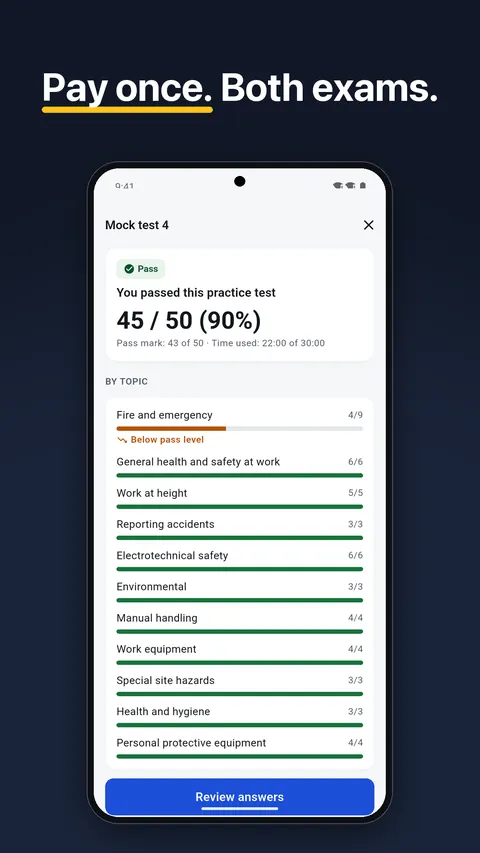
Free: two full topics in each exam, three questions in every other topic, one full mock exam for each exam, the maximum Zs calculator and checklists.
Sparkwise Pro, £12.99 one-off: every question, every mock exam and every worked solution, for both exams. No subscription.
Android now; iPhone version not yet available. Sparkwise helps you prepare; it cannot promise a pass.