Not a government app. Sparkwise is an independent study app made by Kodfu Bilisim. It is not affiliated with or endorsed by the IET, BSI, City & Guilds, ECS or JIB. It does not contain the real exam questions and never reproduces BS 7671 text.
Definitions: free 18th Edition practice questions
The key terms of Part 2 in plain English: conductive parts, persons, protection types, systems and devices.
10 original questions from the Sparkwise app, each with the answer and an explanation. Open book: have your copy of BS 7671:2018+A4:2026 ready and look each answer up, as you would in the exam. No sign-up, nothing saved. These are not the real exam questions: no app or website can show you those.
Question 1 · Choose one answer
The metal case of a Class I washing machine is an example of which kind of part?
- An extraneous-conductive-part
- An exposed-conductive-part
- A live part
- A protective bonding conductor
Show the answer
Answer B: An exposed-conductive-part
It is part of the equipment, can be touched, and is not normally live but could become live under fault, so it is an exposed-conductive-part.
Where to look: Part 2
Question 2 · Choose one answer
Earthing, bonding and automatic disconnection together protect people if basic insulation fails. What is this kind of protection called?
- Fault protection
- Basic protection
- Functional protection
- Selective protection
Show the answer
Answer A: Fault protection
Fault protection deals with a single fault such as failure of basic insulation. Earthing, bonding and automatic disconnection usually provide it.
Where to look: Part 2
Question 3 · Choose one answer
A person who is adequately advised or supervised by a skilled person so they can avoid electrical dangers is:
- An ordinary person in the trade
- An instructed person (electrically)
- A skilled person (electrically)
- A duty holder under the EAWR
Show the answer
Answer B: An instructed person (electrically)
An instructed person is advised or supervised by a skilled person, enabling them to perceive risks and avoid hazards.
Where to look: Part 2
Question 4 · Choose one answer
What is a PEN conductor?
- A conductor used only for functional earthing
- A conductor combining protective and neutral functions
- A bonding conductor connected to service pipes
- A line conductor with an earthed neutral point
Show the answer
Answer B: A conductor combining protective and neutral functions
PEN stands for protective earthed neutral: one conductor doing both jobs, as in the supply side of a TN-C-S system.
Where to look: Part 2
Question 5 · Choose one answer
Which term describes an overcurrent caused by a fault of negligible impedance between live conductors?
- Overload current
- Short-circuit current
- Protective conductor current
- Design current
Show the answer
Answer B: Short-circuit current
A short-circuit current results from a fault of negligible impedance between live conductors at different potentials in normal use.
Where to look: Part 2
Question 6 · Choose one answer
Which statement describes reinforced insulation?
- Basic insulation with an earthed metal sheath
- One insulation system equal to double insulation
- Insulation twice the normal thickness
- Insulation applied only to protective conductors
Show the answer
Answer B: One insulation system equal to double insulation
Reinforced insulation is a single system that provides protection against shock equivalent to double insulation.
Where to look: Part 2
Question 7 · Choose one answer
What is the upper limit of extra-low voltage for AC?
- 25 V
- 50 V
- 110 V
- 120 V
Show the answer
Answer B: 50 V
Extra-low voltage does not exceed 50 V AC or 120 V ripple-free DC (Part 2). At these levels the shock risk in normal dry conditions is low, which is why SELV and PELV systems use extra-low voltage.
Where to look: Part 2
Question 8 · Choose one answer
A prosumer is best described as:
- A contractor registered to certify work
- Someone who both produces and uses electricity
- A company that supplies and reads meters
- A distribution network operator
Show the answer
Answer B: Someone who both produces and uses electricity
A prosumer both produces (for example with PV) and uses electrical energy. Part 8 covers prosumer's electrical installations.
Where to look: Part 2
Question 9 · Select TWO answers
Which TWO of these are extraneous-conductive-parts? Select TWO.
- A metal gas installation pipe entering the building
- Structural steelwork in contact with the ground
- The metal case of a Class I luminaire
- The cpc of a radial socket circuit
Show the answer
Answer A: A metal gas installation pipe entering the building, B: Structural steelwork in contact with the ground
Gas pipes and structural steel can introduce earth potential and are not part of the installation. The luminaire case is exposed; the cpc is a protective conductor.
Where to look: Part 2
Question 10 · Choose one answer
Where in BS 7671 would you look for what is meant by a 'skilled person (electrically)'?
- Part 1
- Part 2
- Chapter 13
- Appendix 2
Show the answer
Answer B: Part 2
Defined terms, including the three kinds of person, are in Part 2.
Where to look: Part 2
You’ve seen 10 of 33 questions in this topic
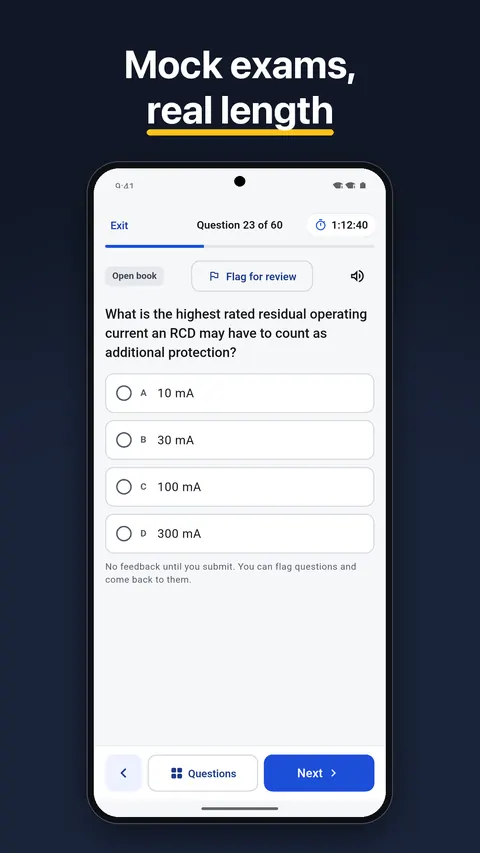
The Sparkwise app has all 33, each with an explanation. Across the whole 18th Edition there are 538 questions in 16 topics, plus timed 60-question mock exams of 2 hours.
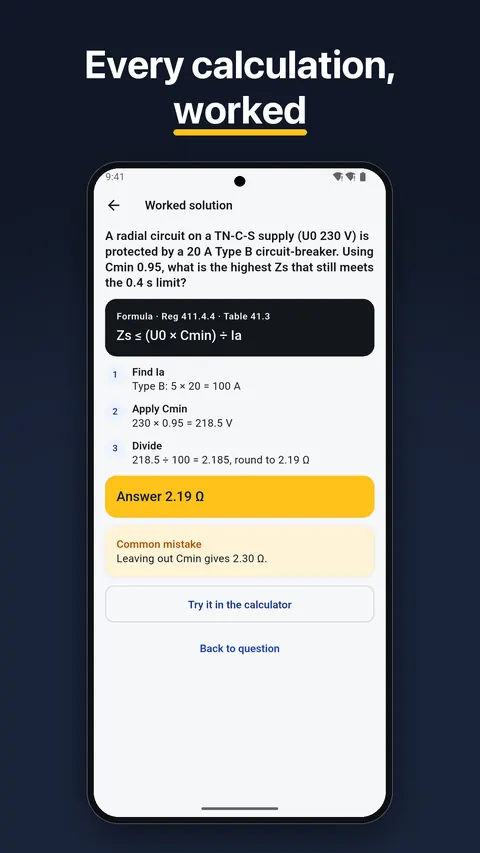
3 of them are free in the app, the rest come with Pro. Sparkwise Pro is £12.99 one-off and unlocks every question, every mock exam and every worked solution for both exams. No subscription.
Android now; iPhone version not yet available.
Revision notes
Exposed and extraneous parts
An exposed-conductive-part is a conductive part of equipment that can be touched and is not normally live, but could become live if basic insulation fails. The metal case of a Class I appliance is the classic example. An extraneous-conductive-part is not part of the electrical installation at all, but can bring in a potential, usually earth potential: incoming metal water or gas pipes and exposed structural steel are typical. Plastic pipes are not extraneous-conductive-parts. Main protective bonding connects extraneous-conductive-parts to the main earthing terminal.
Basic, fault and additional protection
Basic protection stops people touching live parts in normal, fault-free conditions, for example insulation, barriers and enclosures. Fault protection deals with a single fault, such as a line conductor touching a metal case; earthing, bonding and automatic disconnection provide it. Additional protection is a back-up in case basic or fault protection fails, or users are careless: a 30 mA RCD or supplementary bonding are the usual forms. Definitions of all three terms are in Part 2.
Ordinary, instructed and skilled persons
Part 2 recognises three kinds of person. A skilled person (electrically) has the training and experience to recognise the risks electricity creates and avoid the hazards. An instructed person (electrically) has been adequately advised or is supervised by a skilled person, so they can do the same. An ordinary person is neither skilled nor instructed: most members of the public. Some protective measures, such as obstacles or placing out of reach, may only be used where skilled or instructed persons control the installation.
Protective and earthing conductors
A circuit protective conductor (cpc) links exposed- conductive-parts of equipment back to the main earthing terminal (MET). The earthing conductor links the MET to the means of earthing, such as the supply cable sheath, the PME terminal or an earth electrode. A protective bonding conductor connects extraneous-conductive-parts to the MET. A PEN conductor combines the protective and neutral functions in one conductor. The MET is the terminal or bar where all these protective conductors, and any functional earthing conductors, come together.
Circuits and currents
A final circuit feeds current-using equipment or socket-outlets directly; a distribution circuit feeds a distribution board or switchgear. Design current (Ib) is what the circuit is expected to carry in normal service; nominal current (In) is the rating of the protective device; current-carrying capacity (Iz) is what the conductor can carry continuously under its installation conditions. Overcurrent is any current above the rated value. An overload is an overcurrent in a healthy circuit; a short-circuit current flows through a fault of negligible impedance between live conductors.
Extra-low voltage systems and voltage bands
Extra-low voltage (ELV) does not exceed 50 V AC or 120 V ripple-free DC. SELV is an ELV system electrically separated from earth and from other systems, so a single fault cannot cause a shock risk. PELV meets the same separation rules from other systems but is connected to earth. FELV is ELV used for functional reasons where SELV or PELV conditions are not all met. Band I covers ELV and circuits limited in voltage for operational reasons such as signalling; Band II covers normal low-voltage supplies to homes, shops and industry.
Newer terms
Recent amendments brought in new defined terms. An arc fault detection device (AFDD) detects dangerous arcing and disconnects the circuit to reduce fire risk. A residual direct current detecting device (RDC-DD) responds to smooth DC residual current, typically 6 mA, which can stop a Type A RCD working. A bidirectional protective device works correctly whichever way power flows through it. A prosumer is someone who both produces and uses electrical energy, and a prosumer's electrical installation (PEI) includes local generation or storage that can operate with or without the public network.
More 18th Edition topics
- Previous: Scope, object and fundamental principlesWhat BS 7671 covers and excludes, its legal status, departures, and the fundamental principles of Chapter 13.
- Next: Assessment of general characteristicsChapters 31 to 36: supplies and earthing systems, maximum demand, external influence codes, compatibility, maintainability, safety services and continuity of service.
- 18th Edition exam guideFormat, rules, booking and how to prepare

Practise both exams in the Sparkwise app
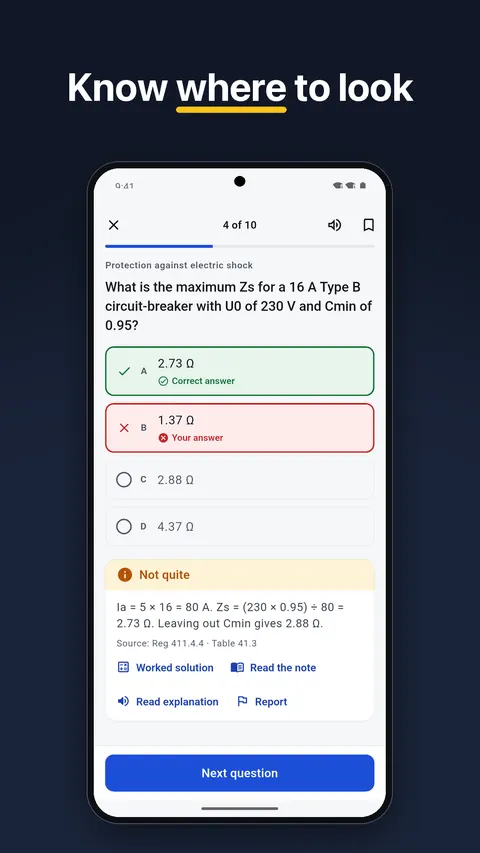
927 original questions across every Part of BS 7671:2018+A4:2026 and every ECS HS&E syllabus area, timed mock exams in the real format, worked solutions for calculations and explanations that show where to look in the book.
- 18th Edition: 538 questions, 60-question mock exams in 2 hours, a maximum Zs calculator and a guide to Amendment 4
- ECS HS&E: 389 questions and 50-question mock tests in 30 minutes
- Works offline. No ads, no account, no data collected.
Free: two full topics in each exam, three questions in every other topic, one full mock exam for each exam, the maximum Zs calculator and checklists.
Sparkwise Pro, £12.99 one-off: every question, every mock exam and every worked solution, for both exams. No subscription.
Android now; iPhone version not yet available. Sparkwise helps you prepare; it cannot promise a pass.