Not a government app. Sparkwise is an independent study app made by Kodfu Bilisim. It is not affiliated with or endorsed by the IET, BSI, City & Guilds, ECS or JIB. It does not contain the real exam questions and never reproduces BS 7671 text.
Assessment of general characteristics: free 18th Edition practice questions
Chapters 31 to 36: supplies and earthing systems, maximum demand, external influence codes, compatibility, maintainability, safety services and continuity of service.
10 original questions from the Sparkwise app, each with the answer and an explanation. Open book: have your copy of BS 7671:2018+A4:2026 ready and look each answer up, as you would in the exam. No sign-up, nothing saved. These are not the real exam questions: no app or website can show you those.
Question 1 · Choose one answer
Where would you find the requirement to assess maximum demand, taking diversity into account?
- Chapter 31
- Chapter 41
- Chapter 52
- Chapter 64
Show the answer
Answer A: Chapter 31
Chapter 31 (purpose, supplies and structure) covers maximum demand and diversity as part of assessing general characteristics.
Where to look: Reg 311.1
Question 2 · Choose one answer
In a TT system, how are the exposed-conductive-parts of the installation earthed?
- Through the metal sheath of the supply cable
- Through the PEN conductor of the supply
- Through the installation's own earth electrode
- Through the incoming metal water pipe
Show the answer
Answer C: Through the installation's own earth electrode
In TT the installation provides its own connection to earth, usually an earth rod, separate from the source earth.
Where to look: Reg 312.2.3
Question 3 · Choose one answer
Where might an IT system be chosen because continuity of supply matters more than immediate disconnection?
- A domestic kitchen ring final circuit
- A group 2 medical location, e.g. a theatre
- An outdoor garden socket-outlet circuit
- A shower circuit in a bathroom
Show the answer
Answer B: A group 2 medical location, e.g. a theatre
Medical IT systems are used in group 2 locations so a first insulation fault raises an alarm instead of cutting power to life-critical equipment.
Where to look: Reg 710.411.6
Question 4 · Choose one answer
In an external influence code, what does the first letter A stand for?
- Environment
- Utilisation
- Construction of buildings
- Ambient temperature only
Show the answer
Answer A: Environment
A covers environmental conditions, B utilisation and C construction of buildings.
Where to look: Chapter 32 · Appendix 5
Question 5 · Choose one answer
The external influence 'AE' describes:
- Presence of foreign solid bodies
- Presence of corrosive substances
- Presence of vibration
- Altitude above sea level
Show the answer
Answer A: Presence of foreign solid bodies
AE is foreign solid bodies, from small objects down to heavy dust. AF is corrosion, AH vibration and AC altitude.
Where to look: Appendix 5
Question 6 · Choose one answer
What does the second numeral 4 in an IP code mean?
- Splashing water from any direction
- Water jets from any direction
- Temporary immersion in water
- Vertically dripping water
Show the answer
Answer A: Splashing water from any direction
IPX4 is splashing water from any direction. IPX5 is jets and IPX8 continuous submersion.
Where to look: BS EN 60529 · IP code
Question 7 · Select TWO answers
Which TWO of these are recognised sources for safety services? Select TWO.
- Storage batteries
- A generator set independent of the normal supply
- A socket-outlet circuit from the same distribution board
- An extension lead from a neighbouring building
Show the answer
Answer A: Storage batteries, B: A generator set independent of the normal supply
Safety sources must be independent of the normal supply: batteries, primary cells, independent generators or an effectively independent feeder.
Where to look: Reg 351.1 · Reg 560.6.1
Question 8 · Choose one answer
Where in BS 7671 would you look for the requirement to divide an installation into circuits to limit the effect of faults?
- Chapter 31
- Chapter 36
- Chapter 46
- Chapter 52
Show the answer
Answer A: Chapter 31
Section 314, in Chapter 31, covers division of an installation into circuits.
Where to look: Chapter 31
Question 9 · Choose one answer
What is the lowest voltage permitted at the supply terminals of a 230 V single-phase low voltage supply under ESQCR 2002?
- 216.2 V
- 207.0 V
- 218.5 V
- 225.4 V
Show the answer
Answer A: 216.2 V
ESQCR regulation 27 declares 230 V with a permitted variation of 10% above and 6% below, so 230 × 0.94 = 216.2 V. 207.0 V wrongly takes 10% off, and 218.5 V is 230 × 0.95, the Cmin product used for Zs, not the supply tolerance.
Worked solution. Formula: Lowest voltage = 230 × (1 − 0.06)
- Find the tolerance: ESQCR allows +10% and −6% on the declared 230 V
- Apply the lower limit: 230 × 0.94 = 216.2 V
Common mistake: Taking 10% off gives 207.0 V; the 10% applies only above 230 V, giving the upper limit of 253 V.
Where to look: ESQCR 2002 reg 27 · Reg 313.1
Question 10 · Choose one answer
A floodlight enclosure is marked IP65. What does the first numeral 6 tell you?
- It is fully dust-tight
- It is dust-protected only
- It resists powerful jets
- It keeps out 1 mm wires
Show the answer
Answer A: It is fully dust-tight
The first numeral covers solid objects and dust: 6 means dust-tight, with no ingress, while 5 means dust-protected, where some dust may enter without harm. Water is covered by the second numeral, here 5 for jets. Keeping out 1 mm wires is first numeral 4.
Where to look: BS EN 60529 · IP code
You’ve seen 10 of 45 questions in this topic
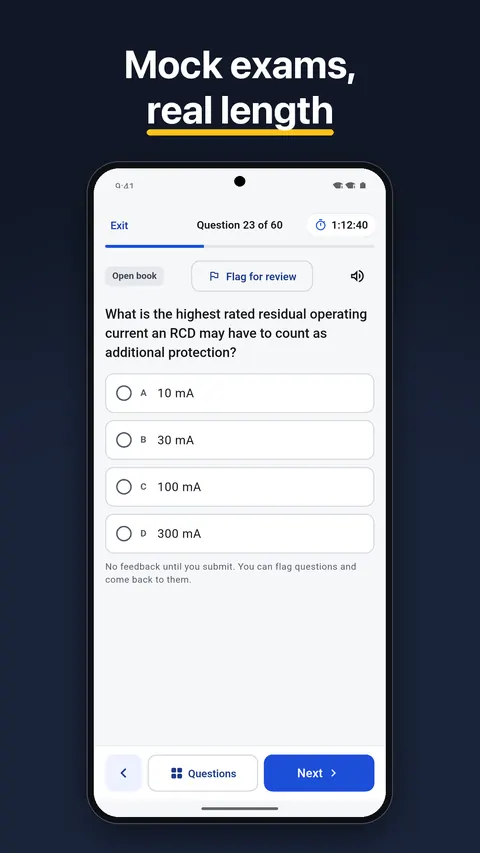
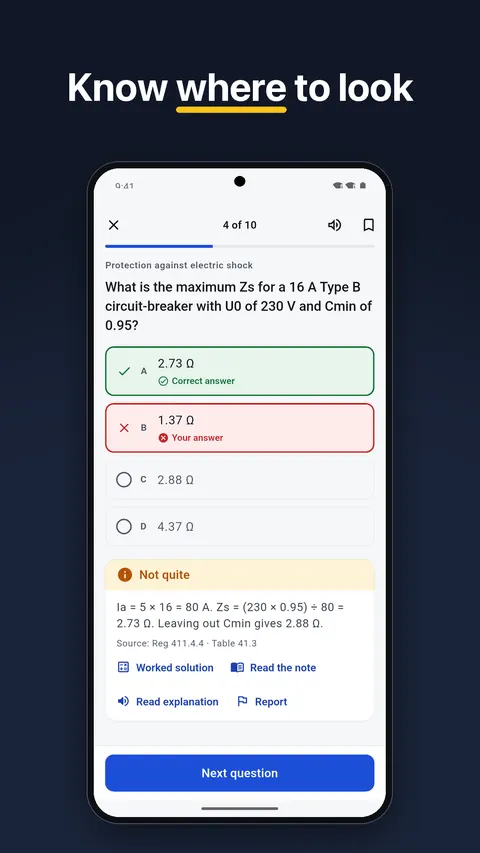
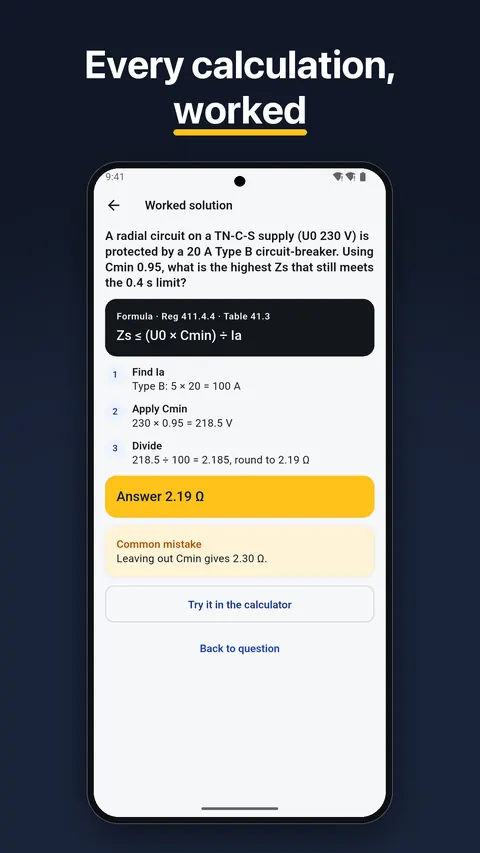
The Sparkwise app has all 45, each with an explanation, and 1 with a step-by-step worked solution. Across the whole 18th Edition there are 538 questions in 16 topics, plus timed 60-question mock exams of 2 hours.
3 of them are free in the app, the rest come with Pro. Sparkwise Pro is £12.99 one-off and unlocks every question, every mock exam and every worked solution for both exams. No subscription.
Android now; iPhone version not yet available.
Revision notes
Purpose, supplies and structure
Chapter 31 asks the designer to assess the installation before choosing anything. Maximum demand must be worked out, and diversity may be taken into account. For each supply the designer needs the nature of current and frequency, the nominal voltage, the prospective short-circuit current at the origin, the external earth fault loop impedance (Ze), the suitability of the supply for the demand, and the type and rating of the protective device at the origin. The number and type of live conductors and the type of system earthing are also identified.
Reading the earthing system letters
The first letter describes how the source relates to earth: T means one point is connected directly to earth; I means the live parts are isolated from earth or connected through a high impedance. The second letter describes the exposed-conductive-parts: T means they are connected to earth independently, through the installation's own electrode; N means they are connected to the earthed point of the source through a protective conductor. Any further letters show whether neutral and protective functions are separate (S) or combined (C).
TN-S, TN-C-S, TT and IT
In TN-S the protective conductor is separate throughout, often the metal sheath of the supply cable. In TN-C-S the supply uses a combined PEN conductor, split into separate neutral and protective conductors in the installation; protective multiple earthing (PME) is the common UK form, and A4 also recognises protective neutral bonding (PNB), used where only a few consumers share a supply. In TT the installation has its own earth electrode. In IT the source is isolated from earth or earthed through high impedance, so a first fault need not cause disconnection. TN-C throughout is not allowed in consumer installations.
Dividing the installation into circuits
Section 314 asks for the installation to be split into circuits so that a fault causes as little danger and inconvenience as possible. Good division makes inspection, testing and maintenance safe, allows for the hazards of losing a single circuit such as lighting, reduces unwanted RCD tripping from normal protective conductor currents, limits electromagnetic interference and stops a circuit being energised indirectly when it is meant to be isolated. Parts that need separate control should have separate circuits that are not affected by faults on other circuits.
External influence codes
Chapter 32 and Appendix 5 classify the conditions an installation faces using a two-letter, one-number code. The first letter is the category: A for the environment, B for how the premises are used, and C for the construction of the building. The second letter names the influence, for example AD presence of water, AE foreign solid bodies, AG impact, BA capability of persons, BE processed or stored materials, CA construction materials. The number gives the severity, such as AD4 for splashes and AD5 for jets.
IP codes in practice
The IP code from BS EN 60529 shows how well an enclosure keeps out solid objects and water. The first numeral covers solids: 2 keeps out fingers (12.5 mm), 4 keeps out wires of 1 mm and 5 or 6 deal with dust. The second numeral covers water: 4 is splashing from any direction, 5 is water jets, 7 is temporary immersion and 8 is continuous submersion. An X means that characteristic is not specified. Letters such as IPXXB (finger) and IPXXD (wire) describe protection against access to hazardous parts.
Compatibility and maintainability
Chapter 33 asks the designer to identify equipment characteristics that could harm other equipment or the supply: transient overvoltages, undervoltage, unbalanced or rapidly fluctuating loads, starting currents, harmonic currents, DC feedback, high-frequency oscillations and protective conductor currents. Chapter 34 asks for an assessment of how often, and how well, the installation is likely to be maintained during its life, so that inspection, testing, maintenance and repair can be done safely and protective measures stay effective.
Safety services and continuity of service
Chapter 35 covers safety services such as emergency lighting and fire alarms. Recognised sources include storage batteries, primary cells, generator sets independent of the normal supply, and a separate feeder from the network that is effectively independent of the normal feeder. Supplies are classed by changeover time, from no-break through to long break of more than 15 s. Chapter 36 asks for an assessment of each circuit's need for continuity of service if a fault occurs, which affects choices such as selectivity and duplicate supplies.
More 18th Edition topics
- Previous: DefinitionsThe key terms of Part 2 in plain English: conductive parts, persons, protection types, systems and devices.
- Next: Protection against electric shockChapter 41: automatic disconnection, disconnection times, maximum Zs, RCD additional protection, SELV, PELV, double insulation and separation.
- 18th Edition exam guideFormat, rules, booking and how to prepare

Practise both exams in the Sparkwise app
927 original questions across every Part of BS 7671:2018+A4:2026 and every ECS HS&E syllabus area, timed mock exams in the real format, worked solutions for calculations and explanations that show where to look in the book.
- 18th Edition: 538 questions, 60-question mock exams in 2 hours, a maximum Zs calculator and a guide to Amendment 4
- ECS HS&E: 389 questions and 50-question mock tests in 30 minutes
- Works offline. No ads, no account, no data collected.
Free: two full topics in each exam, three questions in every other topic, one full mock exam for each exam, the maximum Zs calculator and checklists.
Sparkwise Pro, £12.99 one-off: every question, every mock exam and every worked solution, for both exams. No subscription.
Android now; iPhone version not yet available. Sparkwise helps you prepare; it cannot promise a pass.