Not a government app. Sparkwise is an independent study app made by Kodfu Bilisim. It is not affiliated with or endorsed by the IET, BSI, City & Guilds, ECS or JIB. It does not contain the real exam questions and never reproduces BS 7671 text.
Protection against electric shock: free 18th Edition practice questions
Chapter 41: automatic disconnection, disconnection times, maximum Zs, RCD additional protection, SELV, PELV, double insulation and separation.
10 original questions from the Sparkwise app, each with the answer and an explanation. Open book: have your copy of BS 7671:2018+A4:2026 ready and look each answer up, as you would in the exam. No sign-up, nothing saved. These are not the real exam questions: no app or website can show you those.
Question 1 · Choose one answer
What is the maximum disconnection time for a 32 A socket-outlet final circuit in a TN system with U0 of 230 V?
- 0.2 s
- 0.4 s
- 1 s
- 5 s
Show the answer
Answer B: 0.4 s
Table 41.1 gives 0.4 s for TN final circuits at U0 230 V within the 63 A (sockets) and 32 A (fixed equipment) limits.
Where to look: Table 41.1
Question 2 · Select TWO answers
Which TWO circuits must meet the Table 41.1 disconnection times? Select TWO.
- A 40 A radial circuit supplying socket-outlets
- A 20 A circuit supplying a fixed water heater
- A 100 A distribution circuit to a sub-main board
- A 45 A circuit supplying only a fixed cooker
Show the answer
Answer A: A 40 A radial circuit supplying socket-outlets, B: A 20 A circuit supplying a fixed water heater
Table 41.1 applies to final circuits up to 63 A with sockets and up to 32 A supplying only fixed equipment. The others may use 5 s (TN).
Where to look: Reg 411.3.2.2
Question 3 · Choose one answer
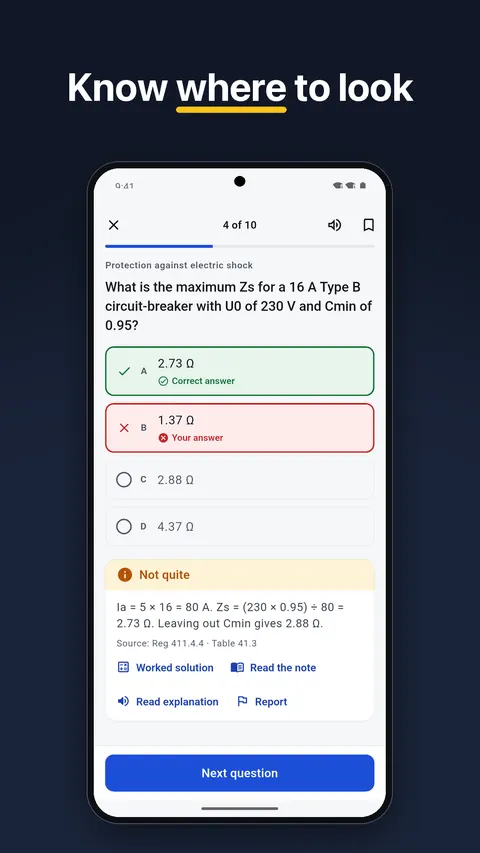
What is the maximum Zs for a 16 A Type B circuit-breaker with U0 of 230 V and Cmin of 0.95?
- 1.37 Ω
- 2.73 Ω
- 2.88 Ω
- 4.37 Ω
Show the answer
Answer B: 2.73 Ω
Ia = 5 × 16 = 80 A. Zs = (230 × 0.95) ÷ 80 = 2.73 Ω. Leaving out Cmin gives 2.88 Ω.
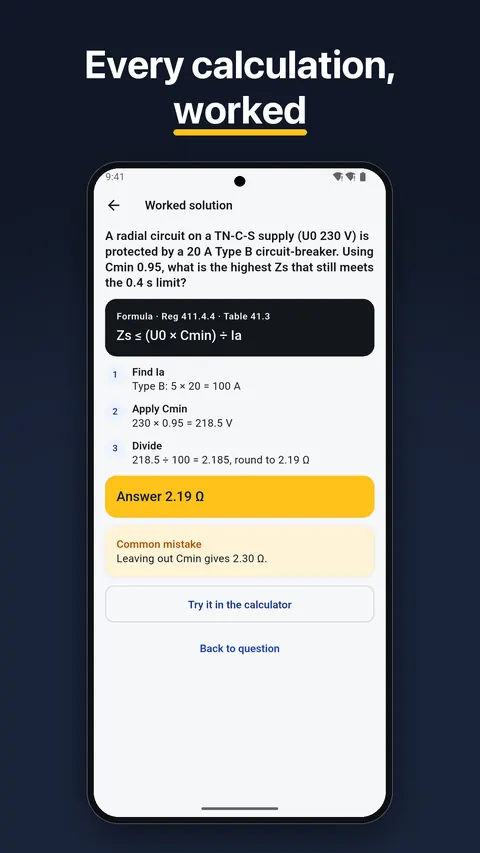
Worked solution. Formula: Zs ≤ (U0 × Cmin) ÷ Ia
- Find Ia: Type B: 5 × 16 = 80 A
- Apply Cmin: 230 × 0.95 = 218.5 V
- Divide: 218.5 ÷ 80 = 2.73 Ω
Common mistake: Leaving out Cmin gives 2.88 Ω.
Where to look: Reg 411.4.4 · Table 41.3
Question 4 · Choose one answer
In domestic premises, which circuits need 30 mA RCD additional protection under Regulation 411.3.4?
- Only circuits supplying outdoor equipment
- AC final circuits supplying luminaires
- Only the cooker and shower circuits
- Distribution circuits to sub-boards
Show the answer
Answer B: AC final circuits supplying luminaires
Within domestic premises, AC final circuits supplying luminaires must have additional protection by an RCD of 30 mA or less.
Where to look: Reg 411.3.4
Question 5 · Choose one answer
Where must a circuit protective conductor be run and terminated?
- Only at socket-outlets and spurs
- Every point and accessory, with one exception
- Only at accessories with metal faceplates
- Only where Class I equipment is fitted
Show the answer
Answer B: Every point and accessory, with one exception
A cpc goes to every point and accessory. The exception is a lampholder with no exposed-conductive-parts suspended from such a point.
Where to look: Reg 411.3.1.1
Question 6 · Choose one answer
FELV is used where extra-low voltage is needed for functional reasons. How is protection provided?
- Exactly as for a SELV system
- As for the primary circuit's voltage
- None is needed below 50 V AC
- By placing out of reach only
Show the answer
Answer B: As for the primary circuit's voltage
FELV does not meet all SELV or PELV conditions, so it is protected as though it were at the voltage of the primary circuit.
Where to look: Reg 411.7
Question 7 · True or false?
Protection by automatic disconnection of supply relies on protective earthing and protective equipotential bonding as well as a device that disconnects.
- True
- False
Show the answer
Answer A: True
Fault protection under ADS is made up of protective earthing, protective equipotential bonding and automatic disconnection in case of a fault.
Where to look: Reg 411.1
Question 8 · Choose one answer
Where in BS 7671 would you look for the requirements for electrical separation supplying one item of equipment?
- Section 412
- Section 413
- Section 415
- Section 417
Show the answer
Answer B: Section 413
Section 413 covers electrical separation for one item. Separation for more than one item is in Section 418.
Where to look: Section 413
Question 9 · Choose one answer
A 16 A Type B radial circuit has a measured Zs of 2.90 Ω (U0 230 V, Cmin 0.95). Does it meet the maximum Zs?
- Yes, the limit is 4.37 Ω
- No, the limit is 2.73 Ω
- Yes, the limit is 2.88 Ω
- No, the limit is 1.37 Ω
Show the answer
Answer B: No, the limit is 2.73 Ω
Ia = 5 × 16 = 80 A and the limit is 218.5 ÷ 80 = 2.73 Ω. 2.90 Ω is too high, so disconnection in time is not assured.
Worked solution. Formula: Zs ≤ (U0 × Cmin) ÷ Ia
- Find the operating current: Ia = 5 × 16 = 80 A
- Find the limit: Zs(max) = 218.5 ÷ 80 = 2.73 Ω
- Compare: 2.90 Ω is more than 2.73 Ω, so it does not comply
Common mistake: Forgetting Cmin gives 2.88 Ω, which still fails but hides the real margin.
Where to look: Reg 411.4.4 · Table 41.3
Question 10 · Choose one answer
A distribution board cover provides basic protection and must be openable. Which arrangement meets BS 7671 for opening it?
- Opening it needs a key or a tool
- A danger label is fixed to the cover
- The cover is held by a magnetic catch
- The board is fixed more than 2 m up
Show the answer
Answer A: Opening it needs a key or a tool
Regulation 416.2.4 allows an enclosure to be opened only with a key or tool, only after the supply to the live parts is disconnected, or where an inner barrier that itself needs a tool to remove prevents contact. A warning label or a catch alone does not stop an ordinary person reaching live parts.
Where to look: Reg 416.2.4
You’ve seen 10 of 56 questions in this topic
The Sparkwise app has all 56, each with an explanation, and 6 with a step-by-step worked solution. Across the whole 18th Edition there are 538 questions in 16 topics, plus timed 60-question mock exams of 2 hours.
3 of them are free in the app, the rest come with Pro. Sparkwise Pro is £12.99 one-off and unlocks every question, every mock exam and every worked solution for both exams. No subscription.
Android now; iPhone version not yet available.
Revision notes
Protective measures in Chapter 41
Chapter 41 offers several protective measures. Those generally permitted are automatic disconnection of supply (ADS), double or reinforced insulation, electrical separation for one item of current-using equipment, and extra-low voltage by SELV or PELV. ADS is by far the most common. Obstacles and placing out of reach may only be used where skilled or instructed persons control the installation. A non-conducting location, earth-free local bonding and electrical separation for more than one item are reserved for installations under the supervision of skilled or instructed persons.
How automatic disconnection works
ADS combines basic protection, such as insulation or enclosures, with fault protection made up of protective earthing, protective equipotential bonding and automatic disconnection when a fault occurs. Every exposed-conductive-part is connected to a cpc, and a cpc is run to every point and accessory (except a lampholder with no exposed metal hanging from that point). Extraneous-conductive-parts such as metal water, gas and other service pipes, central heating and structural steel are connected to the main earthing terminal by main protective bonding conductors.
Disconnection times
Table 41.1 sets maximum disconnection times for final circuits up to 63 A with socket-outlets and up to 32 A supplying only fixed equipment. With U0 of 230 V, the limit is 0.4 s in a TN system and 0.2 s in a TT system. Higher U0 values need faster times: above 230 V up to 400 V, TN 0.2 s and TT 0.07 s. Distribution circuits and final circuits outside those ratings are allowed up to 5 s in TN and 1 s in TT. Remember that a UK 400 V three-phase supply still has U0 of 230 V.
Maximum earth fault loop impedance
For a TN system the earth fault loop impedance must be low enough for the protective device to operate in time: Zs multiplied by Ia must not exceed U0 multiplied by Cmin. Ia is the current that makes the device operate within the required time and Cmin, the minimum voltage factor, is 0.95. For circuit-breakers to BS EN 60898, Ia is 5 times In for Type B, 10 times In for Type C and 20 times In for Type D. Tables 41.2 to 41.4 list the resulting maximum Zs values.
TT systems and RCDs
In a TT system the earth electrode resistance is usually too high for an overcurrent device to disconnect quickly, so an RCD is normally used. The condition is that RA multiplied by IΔn does not exceed 50 V, where RA is the resistance of the electrode plus its protective conductor. Table 41.5 gives the limits: 1667 Ω for 30 mA, 500 Ω for 100 mA, 167 Ω for 300 mA and 100 Ω for 500 mA. A note warns that electrode resistances above 200 Ω may not be stable.
Additional protection by 30 mA RCD
An RCD with a rated residual operating current not exceeding 30 mA provides additional protection, but never as the only protective measure. It is required for socket-outlets rated up to 32 A, for mobile equipment up to 32 A used outdoors, for AC final circuits supplying luminaires in domestic premises, for many cables concealed in walls and partitions, and for circuits in bathrooms. In installations other than dwellings, a documented risk assessment can, in limited cases, justify leaving it off certain socket-outlets.
Double insulation and electrical separation
Double or reinforced insulation (Class II) prevents a single insulation failure from making accessible parts live. Used as the sole measure for a whole circuit, it needs effective supervision so that nobody can later fit Class I equipment, so it is unsuitable for circuits with socket-outlets. Electrical separation for one item uses a source with at least simple separation, a separated circuit not exceeding 500 V, and no connection between the separated circuit, the equipment's exposed-conductive-parts and earth.
SELV, PELV, FELV and reduced low voltage
SELV and PELV rely on extra-low voltage from a safe source, such as a safety isolating transformer to BS EN 61558-2-6. SELV live parts and exposed parts are not connected to earth; SELV plugs must not fit other sockets and have no protective conductor contact. FELV is ELV used for functional reasons without full SELV or PELV safeguards, so it is protected like the primary circuit. Reduced low voltage provides 110 V between lines, centre-tapped so the voltage to earth is 55 V single-phase or 63.5 V three-phase.
Basic protection and supplementary bonding
Basic insulation must only be removable by destruction. Barriers and enclosures must be at least IPXXB or IP2X, with readily accessible horizontal top surfaces at least IPXXD or IP4X, and removable only with a key or tool, after isolation, or behind an inner barrier. Where disconnection times cannot be met, supplementary bonding may be used. Its resistance R between simultaneously accessible parts must not exceed 50 V divided by Ia, the current that operates the protective device.
More 18th Edition topics
- Previous: Assessment of general characteristicsChapters 31 to 36: supplies and earthing systems, maximum demand, external influence codes, compatibility, maintainability, safety services and continuity of service.
- Next: Thermal effects and overcurrentChapters 42 and 43: fire and burns, AFDDs, escape routes, overload and fault current protection and device coordination.
- 18th Edition exam guideFormat, rules, booking and how to prepare

Practise both exams in the Sparkwise app
927 original questions across every Part of BS 7671:2018+A4:2026 and every ECS HS&E syllabus area, timed mock exams in the real format, worked solutions for calculations and explanations that show where to look in the book.
- 18th Edition: 538 questions, 60-question mock exams in 2 hours, a maximum Zs calculator and a guide to Amendment 4
- ECS HS&E: 389 questions and 50-question mock tests in 30 minutes
- Works offline. No ads, no account, no data collected.
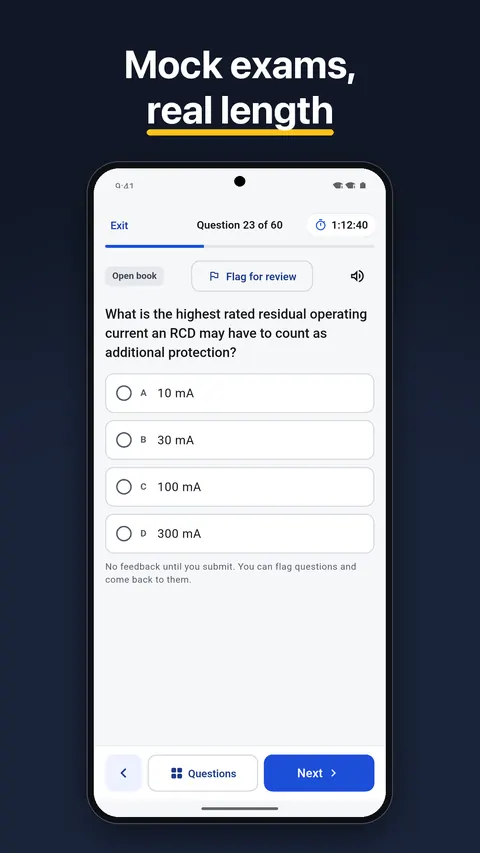
Free: two full topics in each exam, three questions in every other topic, one full mock exam for each exam, the maximum Zs calculator and checklists.
Sparkwise Pro, £12.99 one-off: every question, every mock exam and every worked solution, for both exams. No subscription.
Android now; iPhone version not yet available. Sparkwise helps you prepare; it cannot promise a pass.