Not a government app. Sparkwise is an independent study app made by Kodfu Bilisim. It is not affiliated with or endorsed by the IET, BSI, City & Guilds, ECS or JIB. It does not contain the real exam questions and never reproduces BS 7671 text.
Thermal effects and overcurrent: free 18th Edition practice questions
Chapters 42 and 43: fire and burns, AFDDs, escape routes, overload and fault current protection and device coordination.
10 original questions from the Sparkwise app, each with the answer and an explanation. Open book: have your copy of BS 7671:2018+A4:2026 ready and look each answer up, as you would in the exam. No sign-up, nothing saved. These are not the real exam questions: no app or website can show you those.
Question 1 · Choose one answer
In domestic premises, what does BS 7671 require of a consumer unit enclosure?
- It must be made from flame-retardant plastic
- Made of, or housed in, non-combustible material
- It must be rated IP65 or better indoors
- It must be mounted outside the dwelling
Show the answer
Answer B: Made of, or housed in, non-combustible material
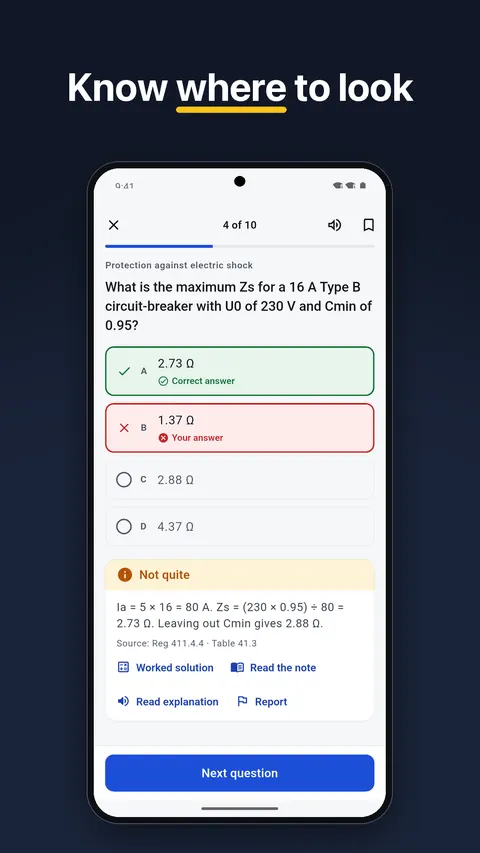
Consumer units in domestic premises need a non-combustible enclosure, or must sit in a non-combustible cabinet, to contain a fire.
Where to look: Reg 421.1.201
Question 2 · Choose one answer
For a socket-outlet circuit in an ordinary two-storey house, what does BS 7671 say about AFDDs?
- They are prohibited
- They are required
- They are recommended
- They are only allowed with Type B RCDs
Show the answer
Answer C: They are recommended
Outside the four listed premises types, AFDDs are recommended for such circuits rather than required.
Where to look: Reg 421.1.7
Question 3 · Choose one answer
Which section deals with locations constructed of combustible materials, such as timber buildings?
- Section 421
- Section 422
- Section 433
- Section 443
Show the answer
Answer B: Section 422
Section 422 covers particular fire risks, including combustible constructional materials (CA2) and fire-propagating structures (CB2).
Where to look: Reg 422.4
Question 4 · Choose one answer
In the relationship Ib ≤ In ≤ Iz, what does Iz represent?
- The design current of the circuit
- The rated current of the device
- The cable's current-carrying capacity
- The prospective fault current
Show the answer
Answer C: The cable's current-carrying capacity
Iz is the current the conductor can carry continuously in its actual conditions. Ib is the design current and In the device rating.
Where to look: Reg 433.1.1
Question 5 · Choose one answer
Where must an overload protective device normally be placed?
- At the far end of each circuit run
- Where the cable's capacity is reduced
- Next to the largest load on the circuit
- At least 3 m from the point of supply
Show the answer
Answer B: Where the cable's capacity is reduced
A device goes where Iz is reduced, for example by a change in cross-sectional area, installation method or environment.
Where to look: Reg 433.2.1
Question 6 · Choose one answer
A circuit-breaker's breaking capacity is lower than the prospective fault current at its position. When is this acceptable?
- Never, in any circumstances
- With coordinated back-up from upstream
- When the circuit is under 10 m long
- When the circuit also has an RCD
Show the answer
Answer B: With coordinated back-up from upstream
Lower breaking capacity is allowed only with back-up protection from an upstream device that can break the fault and limits energy to what the downstream devices withstand.
Where to look: Reg 434.5.1
Question 7 · Choose one answer
A motor circuit has a high inrush current that keeps tripping a Type B device. Which type of circuit-breaker is generally better suited?
- Type A
- Type B of lower rating
- Type C or D
- Type AC
Show the answer
Answer C: Type C or D
Type C and D need higher multiples of In to trip instantly, so they ride through inrush. Check the lower maximum Zs that results.
Where to look: BS EN 60898 · Types C and D
Question 8 · Choose one answer
Where in BS 7671 would you look for precautions for locations with combustible stored materials (BE2)?
- Section 421
- Section 422
- Section 423
- Section 424
Show the answer
Answer B: Section 422
Section 422 covers locations with particular fire risks, including BE2, CA2 and CB2.
Where to look: Section 422
Question 9 · Choose one answer
A 20 A circuit-breaker (I2 = 1.45 × In) protects a cable with Iz of 21 A. Is I2 ≤ 1.45 × Iz satisfied?
- Yes, 29.0 A ≤ 30.5 A
- No, 29.0 A > 21.0 A
- No, 30.5 A > 29.0 A
- Yes, 20.0 A ≤ 21.0 A
Show the answer
Answer A: Yes, 29.0 A ≤ 30.5 A
I2 = 1.45 × 20 = 29 A and 1.45 × Iz = 1.45 × 21 = 30.45 A, so the condition holds. Ib ≤ In ≤ Iz is a separate check.
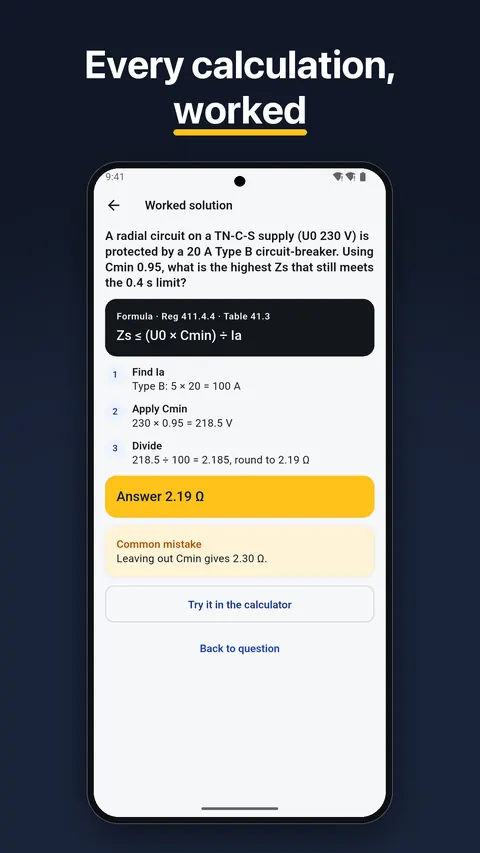
Worked solution. Formula: I2 ≤ 1.45 × Iz
- Find I2: For this device I2 = 1.45 × In = 1.45 × 20 = 29.0 A
- Find the cable limit: 1.45 × Iz = 1.45 × 21 = 30.45 A
- Compare: 29.0 A is less than 30.45 A, so it complies
Common mistake: Comparing I2 directly with Iz (29 A against 21 A) wrongly suggests a failure.
Where to look: Reg 433.1.1
Question 10 · Choose one answer
Under A4, which of these may be installed in a fire-fighting shaft or a protected stairway of a protected escape route?
- Sockets for cleaning or maintenance
- A distribution board for the flats above
- Sub-main cables to individual flats
- Electric storage heaters for comfort
Show the answer
Answer A: Sockets for cleaning or maintenance
New Regulation 422.2.201 keeps cables and equipment out of fire-fighting shafts and protected stairways unless they serve an essential fire safety system, general needs lighting or socket-outlets for cleaning and maintenance. Fire-rated cables in a suitable fire-resisting enclosure may be acceptable under 422.2.202, being treated as outside the route.
Where to look: Reg 422.2.201 · Reg 422.2.202 (A4)
You’ve seen 10 of 39 questions in this topic
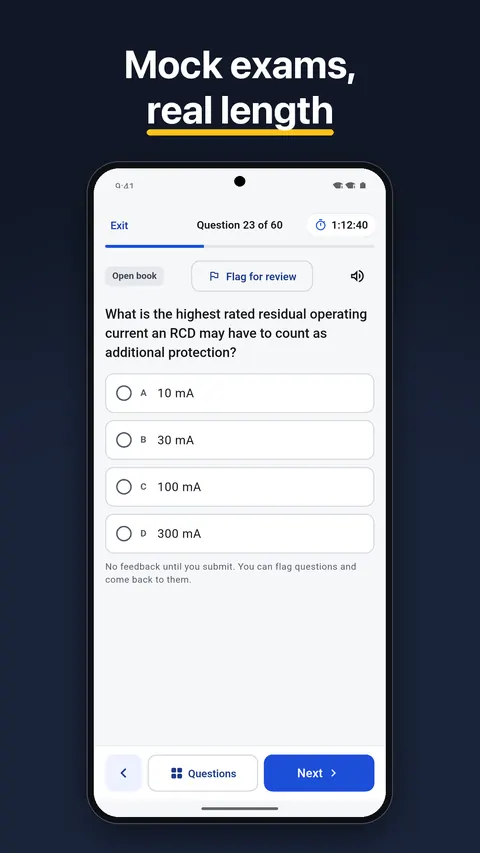
The Sparkwise app has all 39, each with an explanation, and 2 with a step-by-step worked solution. Across the whole 18th Edition there are 538 questions in 16 topics, plus timed 60-question mock exams of 2 hours.
3 of them are free in the app, the rest come with Pro. Sparkwise Pro is £12.99 one-off and unlocks every question, every mock exam and every worked solution for both exams. No subscription.
Android now; iPhone version not yet available.
Revision notes
Fire and heat from fixed equipment
Chapter 42 protects people, livestock and property from the heat electrical equipment produces. Fixed equipment must be chosen and installed so its temperature cannot ignite nearby materials: mount it on or in materials that withstand the heat, screen it, or keep a safe distance. Equipment that focuses heat, such as spotlights, needs enough distance from combustible surfaces. In domestic premises, consumer units and similar switchgear assemblies must be to BS EN 61439-3 and have a non-combustible enclosure, or be housed in a non-combustible cabinet.
Arc fault detection devices
Regulation 421.1.7 requires AFDDs to BS EN 62606 on single-phase AC final circuits supplying socket-outlets rated up to 32 A in high-rise residential buildings (HRRBs), houses in multiple occupation, purpose-built student accommodation and care homes. In all other premises they are recommended for such circuits, not required. Amendment 4 changed the wording from 'higher risk' to 'high-rise' residential buildings without changing the requirement. For this purpose an HRRB is one over 18 m tall or with more than six storeys.
Locations with particular fire risks
Section 422 adds precautions where fire risk is higher. Where evacuation would be difficult (BD codes), wiring in escape routes is limited and protected. In locations with combustible processed or stored materials (BE2), such as barns or woodworking shops, wiring other than mineral insulated cable, busbar trunking or powertrack must be protected by an RCD of no more than 300 mA, and 30 mA where resistive faults could start a fire, such as heating films. Combustible construction (CA2) and fire-propagating structures (CB2) have their own rules.
Burns and overheating
Table 42.1 limits the temperature of accessible parts within arm's reach. Hand-held parts may reach 55 °C if metallic and 65 °C if non-metallic. Parts touched but not held may reach 70 °C (metallic) and 80 °C (non-metallic). Parts that need not be touched in normal use may reach 80 °C and 90 °C. Section 424 covers overheating: forced air heaters must not heat until airflow is established and need independent temperature limiters, and appliances producing hot water or steam need protection against overheating.
Overload protection
Chapter 43 requires protective devices to break any overload before it damages insulation, joints or surroundings. The basic rule is Ib ≤ In ≤ Iz: design current no more than the device rating, which is no more than the cable's current-carrying capacity. The device must also operate reliably at I2 ≤ 1.45 × Iz. A semi-enclosed fuse to BS 3036 needs In ≤ 0.725 × Iz. A 2.5 mm² ring final circuit on a 30 A or 32 A device is accepted if the cable's Iz is at least 20 A.
Position and omission of overload devices
An overload device normally goes where the current-carrying capacity falls, for example where the cable size, installation method or conditions change. It may be placed further along if no branch circuits or outlets sit between, or up to 3 m along if the risk of fault, fire and danger is minimised. Overload protection may be omitted where breaking the circuit would itself be dangerous, such as circuits for lifting magnets, exciter circuits of machines, current transformer secondaries and fire extinguishing equipment.
Fault current protection
The prospective fault current must be determined at every relevant point. Each device must be able to break the maximum fault current at its position, unless an upstream device with enough breaking capacity backs it up and the two are coordinated. The fault must also be cleared before the conductors overheat; the adiabatic relationship t = k²S²/I² applies for times up to 5 s. Domestic consumer units to BS EN 61439-3 have a conditional short-circuit rating, commonly 16 kA, when protected by a suitable supply cut-out fuse.
Circuit-breakers, fuses and selectivity
Circuit-breakers to BS EN 60898 come in Types B, C and D. A Type B trips instantaneously between 3 and 5 times In, a Type C between 5 and 10 times, and a Type D between 10 and 20 times, so Type C and D suit high inrush loads. Fuses include BS 88-2, BS 88-3 and the older BS 3036 rewirable type. Selectivity, formerly called discrimination, means only the device nearest a fault operates, leaving the rest of the installation working.
More 18th Edition topics
- Previous: Protection against electric shockChapter 41: automatic disconnection, disconnection times, maximum Zs, RCD additional protection, SELV, PELV, double insulation and separation.
- Next: Voltage disturbances, isolation and switchingChapters 44 and 46: overvoltage categories and surge protection, electromagnetic disturbances, isolation, switching off for maintenance and emergency switching.
- 18th Edition exam guideFormat, rules, booking and how to prepare

Practise both exams in the Sparkwise app
927 original questions across every Part of BS 7671:2018+A4:2026 and every ECS HS&E syllabus area, timed mock exams in the real format, worked solutions for calculations and explanations that show where to look in the book.
- 18th Edition: 538 questions, 60-question mock exams in 2 hours, a maximum Zs calculator and a guide to Amendment 4
- ECS HS&E: 389 questions and 50-question mock tests in 30 minutes
- Works offline. No ads, no account, no data collected.
Free: two full topics in each exam, three questions in every other topic, one full mock exam for each exam, the maximum Zs calculator and checklists.
Sparkwise Pro, £12.99 one-off: every question, every mock exam and every worked solution, for both exams. No subscription.
Android now; iPhone version not yet available. Sparkwise helps you prepare; it cannot promise a pass.