Not a government app. Sparkwise is an independent study app made by Kodfu Bilisim. It is not affiliated with or endorsed by the IET, BSI, City & Guilds, ECS or JIB. It does not contain the real exam questions and never reproduces BS 7671 text.
Voltage disturbances, isolation and switching: free 18th Edition practice questions
Chapters 44 and 46: overvoltage categories and surge protection, electromagnetic disturbances, isolation, switching off for maintenance and emergency switching.
10 original questions from the Sparkwise app, each with the answer and an explanation. Open book: have your copy of BS 7671:2018+A4:2026 ready and look each answer up, as you would in the exam. No sign-up, nothing saved. These are not the real exam questions: no app or website can show you those.
Question 1 · Choose one answer
What are the two main origins of transient overvoltages considered by Section 443?
- Atmospheric (lightning) and switching
- Harmonics and excessive voltage drop
- Earth leakage and circuit overload
- Static build-up and induction heating
Show the answer
Answer A: Atmospheric (lightning) and switching
Section 443 deals with transients from lightning and from switching operations in the network or installation.
Where to look: Reg 443.1
Question 2 · Choose one answer
Which overvoltage category applies to equipment at the origin, such as the electricity meter?
- Category I
- Category II
- Category III
- Category IV
Show the answer
Answer D: Category IV
Category IV equipment at or near the origin must withstand the highest impulse, 6 kV for a 230/400 V system.
Where to look: Table 443.2
Question 3 · Choose one answer
A distribution board and its fixed socket-outlets belong to which overvoltage category?
- Category I
- Category II
- Category III
- Category IV
Show the answer
Answer C: Category III
Fixed installation equipment such as distribution boards, switches and socket-outlets is category III, withstanding 4 kV.
Where to look: Table 443.2
Question 4 · Choose one answer
Where none of the listed serious consequences apply, what does Regulation 443.4.1 require?
- No surge protection is needed at all
- SPDs required unless the owner declines
- A lightning protection system must be fitted
- An AFDD must be fitted to every circuit
Show the answer
Answer B: SPDs required unless the owner declines
In all other cases SPDs must still be fitted unless the owner of the installation declares they are not needed, accepting any loss or damage as tolerable. The old exemption for low-value single dwellings was removed in Amendment 2.
Where to look: Reg 443.4.1
Question 5 · Choose one answer
Which practice helps limit electromagnetic disturbance in an installation?
- Bundling power and data cables together
- Running cables to form large inductive loops
- Separating power and signal cables, no big loops
- Removing bonding from metal cable trays
Show the answer
Answer C: Separating power and signal cables, no big loops
Keeping power and signal cables apart and avoiding inductive loops reduces induced interference.
Where to look: Reg 444.4
Question 6 · Choose one answer
Which of these must NOT be used as an isolating device?
- A linked switch with visible contact indication
- A semiconductor device
- A circuit-breaker suitable for isolation
- A fuse carrier that can be removed
Show the answer
Answer B: A semiconductor device
Semiconductor devices do not provide a reliable physical gap, so they must not be used for isolation.
Where to look: Reg 537.2
Question 7 · True or false?
A device used for isolation must clearly and reliably show when its contacts are open.
- True
- False
Show the answer
Answer A: True
The open position must be clearly indicated so the person relying on it knows the circuit is isolated.
Where to look: Reg 537.2
Question 8 · Choose one answer
What is the purpose of emergency switching?
- To switch lighting on and off normally
- To remove an unexpected danger quickly
- To allow safe testing of circuits
- To reduce energy use out of hours
Show the answer
Answer B: To remove an unexpected danger quickly
Emergency switching quickly removes an unexpected danger, ideally with a single action acting directly on the supply.
Where to look: Reg 465.1
Question 9 · Choose one answer
Which chapter of Part 4 covers isolation and switching?
- Chapter 41
- Chapter 43
- Chapter 44
- Chapter 46
Show the answer
Answer D: Chapter 46
Chapter 46 covers isolation and switching. Chapter 53 covers the selection and erection of the devices themselves.
Where to look: Chapter 46
Question 10 · Choose one answer
Where in BS 7671 would you look for the rated impulse withstand voltages for each overvoltage category?
- Table 41.1
- Table 443.2
- Table 52.3
- Table 64
Show the answer
Answer B: Table 443.2
Table 443.2 lists the required impulse withstand voltages for categories I to IV.
Where to look: Table 443.2
You’ve seen 10 of 28 questions in this topic
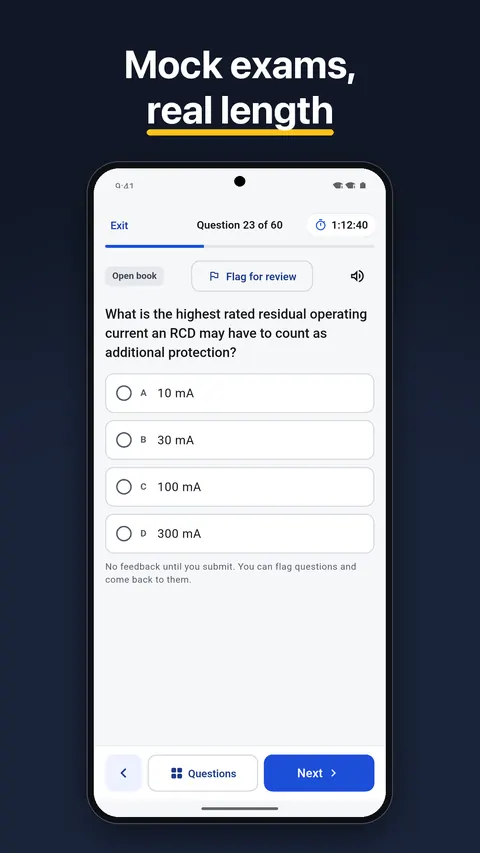
The Sparkwise app has all 28, each with an explanation. Across the whole 18th Edition there are 538 questions in 16 topics, plus timed 60-question mock exams of 2 hours.
3 of them are free in the app, the rest come with Pro. Sparkwise Pro is £12.99 one-off and unlocks every question, every mock exam and every worked solution for both exams. No subscription.
Android now; iPhone version not yet available.
Revision notes
Overvoltage categories
Transient overvoltages come from lightning (atmospheric origin) and from switching. Chapter 44 groups equipment by the impulse voltage it must withstand. For a 230/400 V system, category IV equipment at or near the origin, such as meters and the main protective device, withstands 6 kV; category III fixed installation equipment, such as distribution boards, switches and socket-outlets, 4 kV; category II equipment such as household appliances and portable tools, 2.5 kV; and category I sensitive equipment, 1.5 kV. Surge protective devices keep transients below these levels.
When surge protection is required
Section 443 requires protection against transient overvoltages where the consequences could cause serious injury or loss of life, interrupt public services or damage cultural heritage, interrupt commercial or industrial activity, or affect a large number of co-located people. In all other cases SPDs must still be fitted unless the owner of the installation declares them unnecessary and accepts the risk. Amendment 2 deleted the old calculated risk level (CRL) method and the low-value dwelling exception.
Other voltage disturbances
Section 442 deals with temporary overvoltages caused by earth faults in the high-voltage system or faults in the low-voltage supply. Section 444 covers electromagnetic disturbances: avoid large inductive loops, separate power and data cabling, provide bonding networks and prefer a TN-S arrangement downstream of the origin where there is a lot of IT equipment. Section 445 covers undervoltage: where a voltage drop and later restoration could cause danger, for example a motor restarting unexpectedly, suitable precautions such as no-volt release starters are needed.
Isolation
Isolation cuts off the supply from every source so that work can be done safely. Every circuit must be capable of being isolated from each live supply conductor, though in TN systems the neutral need not be isolated where it is reliably at earth potential. In TT and IT systems all live conductors, including the neutral, are isolated. Isolating devices must show clearly when they are open, be secured against unintentional closing, for example by locking off, and must not be semiconductor devices. In a single-phase household installation the main switch breaks both line and neutral.
Switching off for mechanical maintenance
This switching protects people doing non-electrical work, such as cleaning, replacing parts or changing lamps, where the equipment could cause burns or injury from mechanical movement. The device must be suitably placed, readily identifiable, and arranged so that it cannot be switched back on by accident, for example by locking it off or keeping it under the worker's control. It is different from isolation, which protects people working on live parts of the electrical installation.
Emergency and functional switching
Emergency switching removes an unexpected danger quickly, ideally with a single action acting directly on the supply. Emergency switches and stop buttons should be readily accessible where danger could arise and are usually red on a contrasting background. Functional switching controls equipment in normal operation, such as a light switch or a thermostat; it does not have to break all live conductors. Firefighter's switches for high-voltage signs and certain outdoor installations are a special case covered in Chapter 53.
More 18th Edition topics
- Previous: Thermal effects and overcurrentChapters 42 and 43: fire and burns, AFDDs, escape routes, overload and fault current protection and device coordination.
- Next: Common rules and wiring systemsChapters 51 and 52: identification and notices, cable colours, external influences, current-carrying capacity, concealed cables, segregation and connections.
- 18th Edition exam guideFormat, rules, booking and how to prepare

Practise both exams in the Sparkwise app
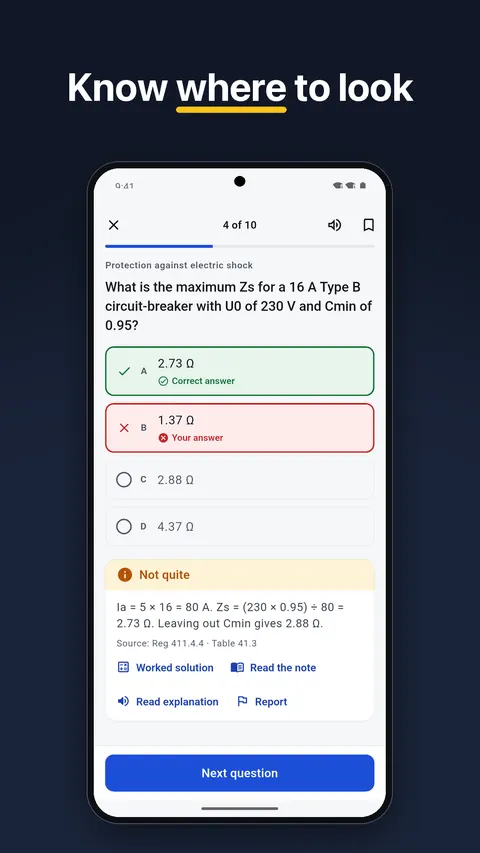
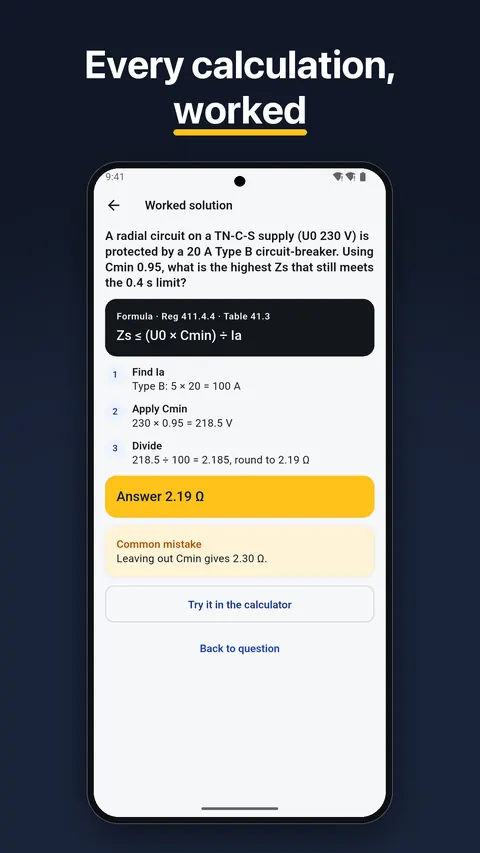
927 original questions across every Part of BS 7671:2018+A4:2026 and every ECS HS&E syllabus area, timed mock exams in the real format, worked solutions for calculations and explanations that show where to look in the book.
- 18th Edition: 538 questions, 60-question mock exams in 2 hours, a maximum Zs calculator and a guide to Amendment 4
- ECS HS&E: 389 questions and 50-question mock tests in 30 minutes
- Works offline. No ads, no account, no data collected.
Free: two full topics in each exam, three questions in every other topic, one full mock exam for each exam, the maximum Zs calculator and checklists.
Sparkwise Pro, £12.99 one-off: every question, every mock exam and every worked solution, for both exams. No subscription.
Android now; iPhone version not yet available. Sparkwise helps you prepare; it cannot promise a pass.