Not a government app. Sparkwise is an independent study app made by Kodfu Bilisim. It is not affiliated with or endorsed by the IET, BSI, City & Guilds, ECS or JIB. It does not contain the real exam questions and never reproduces BS 7671 text.
Common rules and wiring systems: free 18th Edition practice questions
Chapters 51 and 52: identification and notices, cable colours, external influences, current-carrying capacity, concealed cables, segregation and connections.
10 original questions from the Sparkwise app, each with the answer and an explanation. Open book: have your copy of BS 7671:2018+A4:2026 ready and look each answer up, as you would in the exam. No sign-up, nothing saved. These are not the real exam questions: no app or website can show you those.
Question 1 · Choose one answer
In a single-phase circuit, what colour identifies the line conductor?
- Blue
- Brown
- Black
- Grey
Show the answer
Answer B: Brown
Table 51 uses brown for the line conductor of a single-phase circuit and blue for neutral.
Where to look: Table 51
Question 2 · Choose one answer
In a two-wire DC circuit, which colours identify positive and negative?
- Red positive, black negative
- Brown positive, grey negative
- Brown positive, blue negative
- Grey positive, brown negative
Show the answer
Answer B: Brown positive, grey negative
Table 51 uses brown for positive and grey for negative in two-wire DC circuits.
Where to look: Table 51
Question 3 · Choose one answer
Where should the periodic inspection notice be placed?
- On the inside of the front door
- At or near the installation's origin
- On every socket-outlet faceplate
- On the meter cupboard door key
Show the answer
Answer B: At or near the installation's origin
The notice, showing the date of the last inspection and the recommended date of the next, goes in a prominent position at or near the origin.
Where to look: Reg 514.12.1
Question 4 · Choose one answer
How far from the top of a wall (at the ceiling) does the horizontal safe zone extend?
- 50 mm
- 100 mm
- 150 mm
- 300 mm
Show the answer
Answer C: 150 mm
Safe zones extend 150 mm from the top of a wall or from a corner where two walls meet.
Where to look: Reg group 522.6 · Table 52.1 (A4)
Question 5 · Choose one answer
Where would you find tables of current-carrying capacity and voltage drop for cables?
- Appendix 2
- Appendix 4
- Appendix 5
- Appendix 8
Show the answer
Answer B: Appendix 4
Appendix 4 gives current-carrying capacities, voltage drop values and rating factors for cables.
Where to look: Appendix 4
Question 6 · Select TWO answers
Which TWO connections need NOT be accessible for inspection? Select TWO.
- A joint designed to be buried in the ground
- An accessory marked as maintenance-free (MF)
- A screw terminal in a junction box under floorboards
- A connector block buried in plaster
Show the answer
Answer A: A joint designed to be buried in the ground, B: An accessory marked as maintenance-free (MF)
Exceptions include joints designed to be buried, compound-filled or encapsulated joints and MF-marked accessories. Ordinary screw terminals must stay accessible.
Where to look: Reg 526.3
Question 7 · True or false?
Where wiring of a circuit is close to non-electrical services, such as hot water pipes, it must be protected from harmful effects such as heat.
- True
- False
Show the answer
Answer A: True
Wiring must be arranged or protected so that other services, for example heat from pipes, cannot damage it.
Where to look: Reg 528.3
Question 8 · Choose one answer
Where in BS 7671 would you look for the voltage drop limits from the origin to the load?
- Appendix 3
- Appendix 4
- Appendix 14
- Table 41.1
Show the answer
Answer B: Appendix 4
Section 525 refers to Appendix 4, which gives the 3% and 5% (or 6% and 8%) limits.
Where to look: Appendix 4
Question 9 · Choose one answer
Where in BS 7671 would you look for rating factors for cables grouped together?
- Appendix 3
- Appendix 4
- Appendix 5
- Appendix 10
Show the answer
Answer B: Appendix 4
Appendix 4 holds the grouping, ambient temperature and thermal insulation rating factors.
Where to look: Appendix 4
Question 10 · Choose one answer
A4 added a note to Regulation 521.10.202 on supporting wiring against collapse in a fire. What does the note say the regulation is NOT intended to do?
- Keep safety circuits working in a fire
- Stop cables falling across escape routes
- Protect firefighters from falling wiring
- Prevent wiring hindering safe evacuation
Show the answer
Answer A: Keep safety circuits working in a fire
The A4 note explains that 521.10.202 aims to stop wiring systems collapsing in a fire and hindering evacuation, rescue or firefighters. It does not set out to keep circuits working for life safety or firefighting; those needs are covered by Chapter 56 and standards such as BS 5266, BS 5839 and BS 8519.
Where to look: Reg 521.10.202 (A4 note) · Chapter 56
You’ve seen 10 of 42 questions in this topic
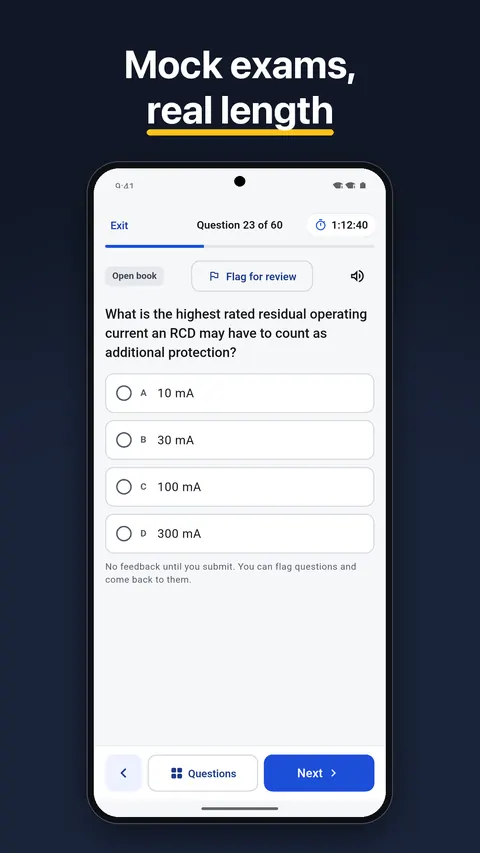
The Sparkwise app has all 42, each with an explanation. Across the whole 18th Edition there are 538 questions in 16 topics, plus timed 60-question mock exams of 2 hours.
3 of them are free in the app, the rest come with Pro. Sparkwise Pro is £12.99 one-off and unlocks every question, every mock exam and every worked solution for both exams. No subscription.
Android now; iPhone version not yet available.
Revision notes
Conductor colours
Table 51 sets the identification colours. Single-phase: brown line, blue neutral. Three-phase: brown L1, black L2, grey L3 and blue neutral. Protective conductors are green-and-yellow, and that combination must not be used for anything else. Two-wire DC circuits use brown for positive and grey for negative. Functional earthing conductors are pink. Older UK colours (red, yellow, blue and black) are still found in existing installations, and Section 514 calls for a warning notice where old and new colours meet.
Notices and labels
Section 514 lists the notices an installation needs. A periodic inspection notice goes at or near the origin; an RCD test notice reminds users to test RCDs regularly; a warning is needed where a voltage over 230 V exists that people would not expect, such as 400 V between socket-outlets on different phases. Earthing and bonding connections carry a 'Safety Electrical Connection - Do Not Remove' label. Where alternative or additional sources exist, such as PV or batteries, warning notices go at the origin, meter position, distribution boards and isolators.
Diagrams and documentation
Section 514.9 requires diagrams, charts or tables, or an equivalent form of information, to be provided. They must show the type and composition of each circuit (points served, number and size of conductors, type of wiring), the method used for fault protection, how each protective, isolating and switching device is identified and where it is, and any circuits or equipment vulnerable to a typical test. For simple installations, the schedule of circuit details on the certificate may serve.
Concealed cables and safe zones
A cable concealed in a wall or partition at less than 50 mm from the surface needs protection unless it has an earthed metallic covering, is enclosed in earthed conduit or trunking, or has mechanical protection against nails and screws. If it runs within a safe zone, a 30 mA RCD provides the additional protection instead. Safe zones are within 150 mm of the top of a wall or a corner, and horizontal or vertical runs in line with an accessory. Partitions with metal parts need RCD protection whatever the depth.
Current-carrying capacity and rating factors
Section 523 and Appendix 4 set how much current a cable can carry without overheating. Tabulated values assume reference conditions, so rating factors are applied for the real installation: Ca for ambient temperature, Cg for grouping with other circuits, Ci for thermal insulation (0.5 for a cable surrounded by insulation for more than 0.5 m), and Cc for a BS 3036 fuse (0.725) or for cables buried in the ground. The installation method, identified by a reference method letter, also matters.
Minimum sizes and voltage drop
A table in Chapter 52 sets minimum conductor sizes for fixed wiring, flexible cables and signalling and control circuits, which may be as small as 0.5 mm² copper. Section 525 and Appendix 4 limit voltage drop. From a public low-voltage supply the drop from the origin to the load should not exceed 3% for lighting and 5% for other uses. From a private supply the limits are 6% and 8%.
Connections, fire sealing and segregation
Connections must be accessible for inspection, testing and maintenance, except joints designed to be buried, compound-filled or encapsulated joints, and accessories marked as maintenance-free (MF). Where wiring passes through fire-resisting floors, walls or ceilings, the openings must be sealed to restore the original fire resistance. Band I and Band II circuits must be segregated or insulated for the highest voltage present. Wiring systems must be supported so they will not collapse early in a fire and block escape or entangle firefighters.
More 18th Edition topics
- Previous: Voltage disturbances, isolation and switchingChapters 44 and 46: overvoltage categories and surge protection, electromagnetic disturbances, isolation, switching off for maintenance and emergency switching.
- Next: Protective devices, earthing and bondingChapters 53 and 54: RCDs, AFDDs and SPDs, isolation devices, earth electrodes, earthing conductors, protective conductors and bonding sizes.
- 18th Edition exam guideFormat, rules, booking and how to prepare

Practise both exams in the Sparkwise app
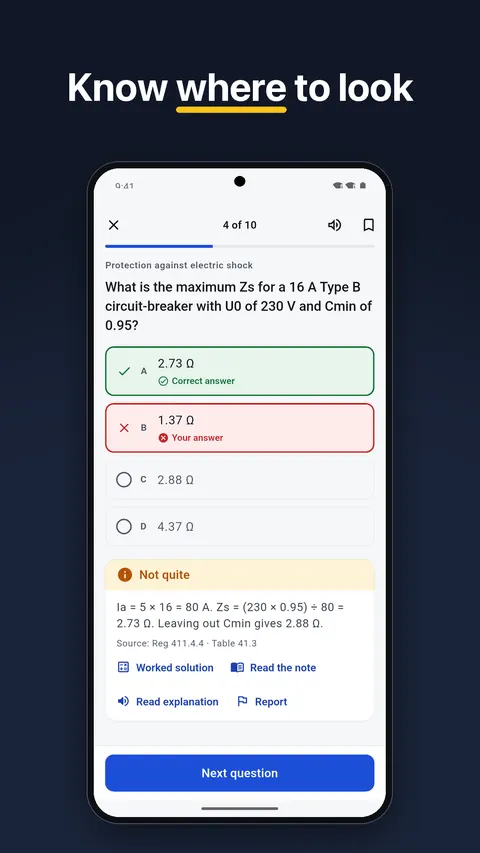
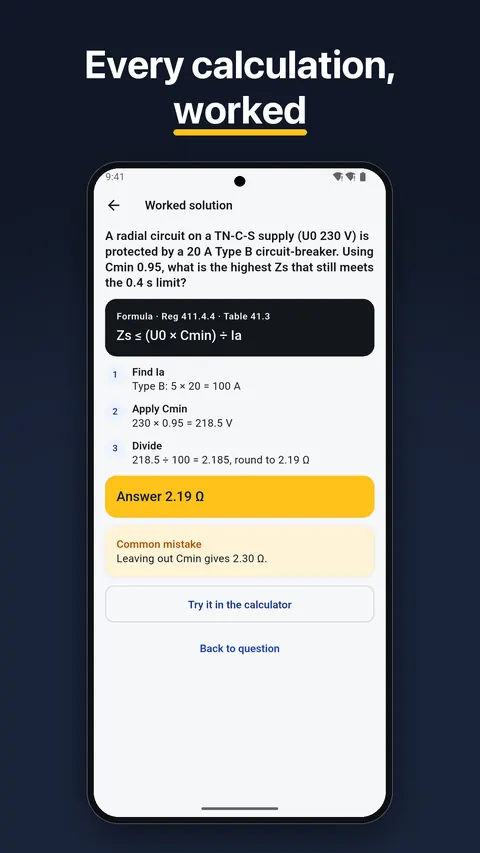
927 original questions across every Part of BS 7671:2018+A4:2026 and every ECS HS&E syllabus area, timed mock exams in the real format, worked solutions for calculations and explanations that show where to look in the book.
- 18th Edition: 538 questions, 60-question mock exams in 2 hours, a maximum Zs calculator and a guide to Amendment 4
- ECS HS&E: 389 questions and 50-question mock tests in 30 minutes
- Works offline. No ads, no account, no data collected.
Free: two full topics in each exam, three questions in every other topic, one full mock exam for each exam, the maximum Zs calculator and checklists.
Sparkwise Pro, £12.99 one-off: every question, every mock exam and every worked solution, for both exams. No subscription.
Android now; iPhone version not yet available. Sparkwise helps you prepare; it cannot promise a pass.