Not a government app. Sparkwise is an independent study app made by Kodfu Bilisim. It is not affiliated with or endorsed by the IET, BSI, City & Guilds, ECS or JIB. It does not contain the real exam questions and never reproduces BS 7671 text.
Protective devices, earthing and bonding: free 18th Edition practice questions
Chapters 53 and 54: RCDs, AFDDs and SPDs, isolation devices, earth electrodes, earthing conductors, protective conductors and bonding sizes.
10 original questions from the Sparkwise app, each with the answer and an explanation. Open book: have your copy of BS 7671:2018+A4:2026 ready and look each answer up, as you would in the exam. No sign-up, nothing saved. These are not the real exam questions: no app or website can show you those.
Question 1 · Choose one answer
Which RCD type responds only to sinusoidal AC residual currents?
- Type A
- Type AC
- Type B
- Type F
Show the answer
Answer B: Type AC
Type AC detects sinusoidal AC residual current only. Types A, F and B detect progressively more waveforms.
Where to look: Reg 531.3.3
Question 2 · Choose one answer
What level of smooth DC residual current is an RDC-DD typically designed to detect?
- 0.5 mA
- 6 mA
- 30 mA
- 300 mA
Show the answer
Answer B: 6 mA
An RDC-DD responds to smooth DC residual current of 6 mA, protecting a Type A RCD from being blinded, for example in EV charging.
Where to look: Reg 722.531.3.101 · RDC-DD
Question 3 · Choose one answer
Which SPD type is most commonly fitted at the consumer unit of a dwelling without a lightning protection system?
- Type 1
- Type 2
- Type 3
- Type B
Show the answer
Answer B: Type 2
A Type 2 SPD at the origin or consumer unit is the typical choice where no lightning protection system is present.
Where to look: Reg 534.4.1
Question 4 · Choose one answer
Which of these may be used as an earth electrode?
- A buried metal gas pipe
- A buried metal water pipe
- A driven copper-clad earth rod
- Buried central heating pipework
Show the answer
Answer C: A driven copper-clad earth rod
Rods, tapes, plates and foundation metalwork are acceptable. Service pipes must never be used as an earth electrode.
Where to look: Reg 542.2.3 · Reg 542.2.6
Question 5 · Choose one answer
A separate protective conductor, not part of a cable or enclosure, has no mechanical protection. What minimum copper size applies?
- 1.5 mm²
- 2.5 mm²
- 4 mm²
- 6 mm²
Show the answer
Answer C: 4 mm²
A separate protective conductor must be at least 2.5 mm² copper if mechanically protected, or 4 mm² if not.
Where to look: Reg 543.1.1
Question 6 · Choose one answer
On a TN-S supply, the copper earthing conductor is 10 mm². What is the minimum main protective bonding conductor size?
- 4 mm²
- 5 mm²
- 6 mm²
- 10 mm²
Show the answer
Answer C: 6 mm²
For non-PME supplies, main bonding is at least half the earthing conductor. Half of 10 mm² is 5 mm², but the absolute minimum is 6 mm².
Worked solution. Formula: Main bonding ≥ ½ × earthing conductor, minimum 6 mm²
- Halve the earthing conductor: 10 ÷ 2 = 5 mm²
- Apply the minimum: 5 mm² is below the 6 mm² minimum, so 6 mm²
Common mistake: Stopping at half the earthing conductor (5 mm²) ignores the minimum size.
Where to look: Reg 544.1.1
Question 7 · True or false?
A switching device may be inserted in a protective conductor so that equipment can be disconnected from earth for testing.
- True
- False
Show the answer
Answer B: False
No switching device may be placed in a protective conductor. Joints that can be disconnected for testing using a tool are allowed.
Where to look: Reg 543.3.4
Question 8 · Choose one answer
Where in BS 7671 would you look for the requirements for firefighter's switches?
- Section 465
- Section 534
- Section 537
- Section 560
Show the answer
Answer C: Section 537
Section 537 covers isolation and switching devices, including firefighter's switches (537.4).
Where to look: Section 537
Question 9 · Choose one answer
A protective conductor must carry a fault current of 1200 A for 0.4 s, with k = 115. Which is the smallest standard copper size that meets the adiabatic equation?
- 10 mm²
- 6 mm²
- 4 mm²
- 16 mm²
Show the answer
Answer A: 10 mm²
S = √(I²t) ÷ k = √(1200² × 0.4) ÷ 115 = 758.9 ÷ 115 = 6.60 mm². The result is a minimum, so round up to the next standard size, 10 mm². Choosing 6 mm² rounds down below the calculated minimum.
Worked solution. Formula: S = √(I² × t) ÷ k
- Square the current: 1200² = 1 440 000
- Multiply by time: 1 440 000 × 0.4 = 576 000
- Square root, then divide by k: √576 000 = 758.9; 758.9 ÷ 115 = 6.60 mm²
- Choose a standard size: Round up to the next size: 10 mm²
Common mistake: Rounding 6.60 mm² down to 6 mm² gives a conductor smaller than the minimum.
Where to look: Reg 543.1.3
Question 10 · Choose one answer
A TN-S installation has a 70 mm² copper earthing conductor. What minimum size of copper main protective bonding conductor is needed?
- 25 mm²
- 35 mm²
- 16 mm²
- 10 mm²
Show the answer
Answer A: 25 mm²
For supplies other than PME, Regulation 544.1.1 asks for main bonding of at least half the earthing conductor size, with a 6 mm² minimum, but copper need not exceed 25 mm². Half of 70 mm² is 35 mm², so the 25 mm² cap applies. Table 54.8 is used only for PME supplies.
Worked solution. Formula: Main bonding ≥ ½ × earthing conductor (minimum 6 mm²; copper need not exceed 25 mm²)
- Halve the earthing conductor: 70 ÷ 2 = 35 mm²
- Apply the cap: Copper main bonding need not exceed 25 mm², so 25 mm²
Common mistake: Stopping at half the earthing conductor gives 35 mm² and ignores the 25 mm² cap.
Where to look: Reg 544.1.1
You’ve seen 10 of 41 questions in this topic
The Sparkwise app has all 41, each with an explanation, and 4 with a step-by-step worked solution. Across the whole 18th Edition there are 538 questions in 16 topics, plus timed 60-question mock exams of 2 hours.
3 of them are free in the app, the rest come with Pro. Sparkwise Pro is £12.99 one-off and unlocks every question, every mock exam and every worked solution for both exams. No subscription.
Android now; iPhone version not yet available.
Revision notes
RCD types
RCDs are typed by the residual currents they respond to. Type AC detects only sinusoidal AC residual current. Type A also detects pulsating DC, which electronic equipment can produce. Type F adds mixed-frequency currents, as from single-phase variable speed drives. Type B also detects smooth DC, needed for some three-phase drives, inverters and EV chargers. Smooth DC above a few milliamps can blind Type AC and Type A devices, which is why a residual direct current detecting device (RDC-DD), responding at 6 mA DC, is sometimes paired with a Type A RCD.
Bidirectional and unidirectional devices
With batteries, PV and other local sources, current can flow through a protective device in either direction. A unidirectional device is marked with line and load terminals and is only designed to work with power flowing one way; it must not be used where reverse flow can occur. A bidirectional device works correctly whichever way power flows. Amendment 3 introduced this requirement and Amendment 4 carries it forward, alongside rules that a source must not normally be connected on the load side of an RCD in a way that stops it working.
AFDDs and surge protective devices
AFDDs to BS EN 62606 are fitted at the origin of the final circuit they protect. SPDs come in three types. Type 1 handles partial lightning currents and is used where the building has a lightning protection system or a risk of direct strikes to the supply. Type 2 is the usual choice at the origin or distribution board. Type 3 sits near sensitive equipment and needs a Type 2 upstream. SPD connecting leads must be as short and straight as possible, because extra length adds voltage to the protection level.
Isolation devices and firefighter's switches
Devices used for isolation must have a reliable contact gap, show their position clearly and be securable in the off position. A4 redrafted Regulation 537.4.2: firefighter's switches are now provided where the fire engineer's fire strategy calls for them, with examples such as outdoor high-voltage lighting and indoor discharge lighting. They must be placed where firefighters can reach and recognise them, so check the location and marking rules in Regulation group 537.4.
Earth electrodes and earthing conductors
Acceptable earth electrodes include rods, tapes, plates, underground structural metalwork in foundations and welded reinforcement in concrete. Metal pipes for gas, water or other services must not be used as an earth electrode, though they may still need bonding. A buried earthing conductor protected against corrosion but not mechanical damage must be at least 16 mm² copper; one not protected against corrosion needs 25 mm² copper or 50 mm² steel. The connection to the electrode must be accessible and labelled.
Protective conductor sizes
Protective conductors are sized either by the adiabatic equation S = √(I²t) ÷ k or from Table 54.7. Using the table, a line conductor up to 16 mm² needs a protective conductor of the same size; from 16 mm² to 35 mm² it needs 16 mm²; above 35 mm² it needs half the line size. A separate protective conductor that is not part of a cable must be at least 2.5 mm² copper if mechanically protected and 4 mm² if not. Metal conduit, trunking and armour can act as protective conductors if continuous and adequate.
Main and supplementary bonding sizes
For a PME supply, Table 54.8 sets main bonding by the size of the supply neutral: up to 35 mm² needs 10 mm² copper, over 35 to 50 mm² needs 16 mm², over 50 to 95 mm² needs 25 mm², over 95 to 150 mm² needs 35 mm² and above 150 mm² needs 50 mm². For other supplies, main bonding is at least half the earthing conductor size, with a 6 mm² minimum and no need to exceed 25 mm². Supplementary bonding is at least 2.5 mm² copper with mechanical protection, or 4 mm² without.
High protective conductor currents and functional earthing
Equipment such as IT racks can produce protective conductor currents in normal use. Where a circuit's protective conductor current is likely to exceed 10 mA, a high-integrity arrangement is needed: for example a single copper protective conductor of at least 10 mm², two separate protective conductors, or a ring arrangement. Amendment 4 added Section 545 on functional earthing and functional bonding for ICT equipment. Functional earthing is for correct operation and interference control, not protection against shock, and is identified in pink.
More 18th Edition topics
- Previous: Common rules and wiring systemsChapters 51 and 52: identification and notices, cable colours, external influences, current-carrying capacity, concealed cables, segregation and connections.
- Next: Other equipment, safety services and batteriesChapters 55, 56 and 57: generating sets, accessories, luminaires, safety services and stationary secondary batteries.
- 18th Edition exam guideFormat, rules, booking and how to prepare

Practise both exams in the Sparkwise app
927 original questions across every Part of BS 7671:2018+A4:2026 and every ECS HS&E syllabus area, timed mock exams in the real format, worked solutions for calculations and explanations that show where to look in the book.
- 18th Edition: 538 questions, 60-question mock exams in 2 hours, a maximum Zs calculator and a guide to Amendment 4
- ECS HS&E: 389 questions and 50-question mock tests in 30 minutes
- Works offline. No ads, no account, no data collected.
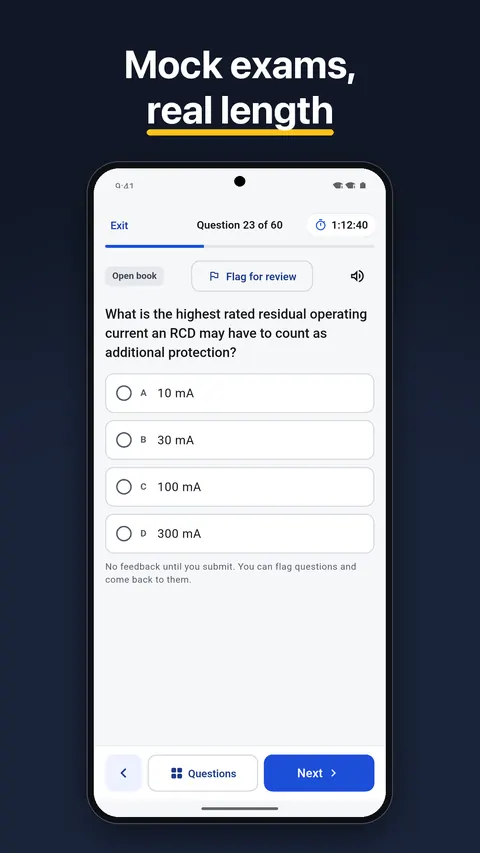
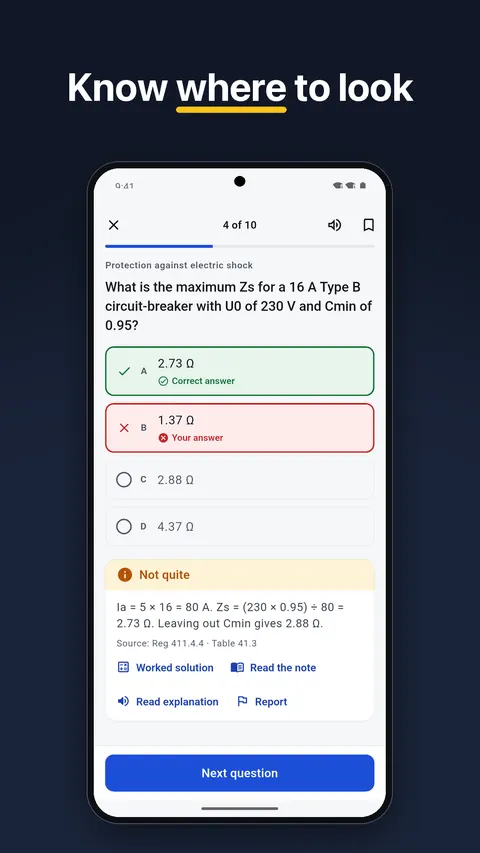
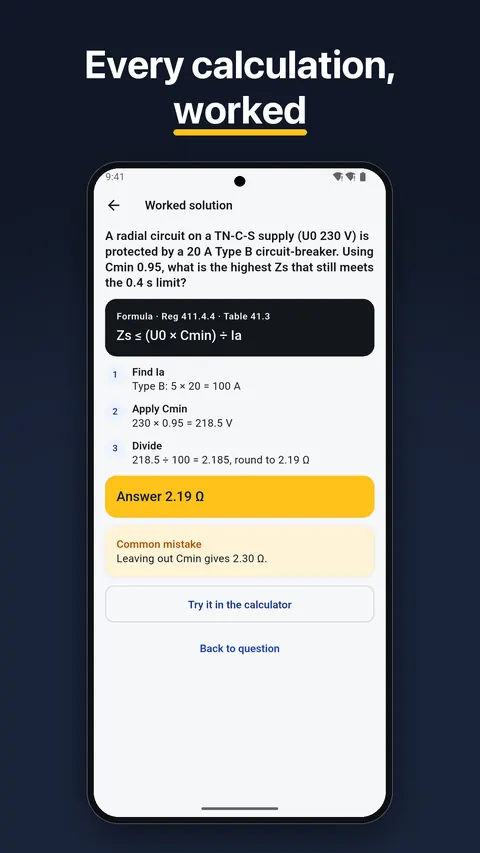
Free: two full topics in each exam, three questions in every other topic, one full mock exam for each exam, the maximum Zs calculator and checklists.
Sparkwise Pro, £12.99 one-off: every question, every mock exam and every worked solution, for both exams. No subscription.
Android now; iPhone version not yet available. Sparkwise helps you prepare; it cannot promise a pass.