Not a government app. Sparkwise is an independent study app made by Kodfu Bilisim. It is not affiliated with or endorsed by the IET, BSI, City & Guilds, ECS or JIB. It does not contain the real exam questions and never reproduces BS 7671 text.
Other equipment, safety services and batteries: free 18th Edition practice questions
Chapters 55, 56 and 57: generating sets, accessories, luminaires, safety services and stationary secondary batteries.
10 original questions from the Sparkwise app, each with the answer and an explanation. Open book: have your copy of BS 7671:2018+A4:2026 ready and look each answer up, as you would in the exam. No sign-up, nothing saved. These are not the real exam questions: no app or website can show you those.
Question 1 · Choose one answer
A standby generator supplies a house through a changeover arrangement. What must the arrangement prevent?
- The generator running outside daytime hours
- Parallel operation with the public supply
- Any RCD being installed downstream
- The generator frame being earthed
Show the answer
Answer B: Parallel operation with the public supply
A standby set must not be able to connect in parallel with the public network, which would back-feed the network and endanger line workers.
Where to look: Reg 551.6.1
Question 2 · Choose one answer
Above what rating must a motor have control equipment that includes overload protection for the motor?
- 0.25 kW
- 0.37 kW
- 1 kW
- 3 kW
Show the answer
Answer B: 0.37 kW
Motors rated above 0.37 kW need overload protection in their control equipment, unless built into equipment meeting its own standard.
Where to look: Reg 552.1.2
Question 3 · Choose one answer
A conveyor motor stops when the voltage dips. What must prevent it restarting on its own if that could be dangerous?
- A larger fuse in the motor circuit
- A starter blocking automatic restart
- A Type B RCD on the motor circuit
- An SPD at the motor terminals
Show the answer
Answer B: A starter blocking automatic restart
Where unexpected restarting after a voltage drop could cause danger, the control gear must prevent automatic restarting.
Where to look: Reg 552.1.3
Question 4 · Choose one answer
Where mobile equipment is likely to be used, where should socket-outlets be provided?
- At least 3 m from the appliance
- Within reach of the normal cord
- Only at high level on the wall
- Only in hallways and landings
Show the answer
Answer B: Within reach of the normal cord
Socket-outlets should be adjacent and conveniently placed, allowing for the cord length normally fitted to portable appliances.
Where to look: Reg 553.1.7
Question 5 · Choose one answer
Which section covers electrode boilers and water heaters?
- Section 551
- Section 554
- Section 559
- Section 560
Show the answer
Answer B: Section 554
Section 554 covers current-using equipment such as electrode boilers, water heaters and heating cables.
Where to look: Section 554
Question 6 · Choose one answer
How must the circuits of safety services relate to other circuits?
- They may share cables with general circuits
- They must be independent of other circuits
- They must share the lighting circuit's RCD
- They must be fed from socket-outlets
Show the answer
Answer B: They must be independent of other circuits
Safety circuits are kept independent so that a fault, modification or maintenance on another circuit cannot stop them working.
Where to look: Reg 560.7.1
Question 7 · Select TWO answers
Which TWO requirements apply to a safety source such as a central battery for emergency lighting? Select TWO.
- Fixed, so a mains failure cannot affect it
- Reachable only by skilled or instructed persons
- Plugged into a socket for easy replacement
- Also used to supply general power loads
Show the answer
Answer A: Fixed, so a mains failure cannot affect it, B: Reachable only by skilled or instructed persons
Safety sources are fixed, unaffected by failure of the normal source, and accessible only to skilled or instructed persons.
Where to look: Reg 560.6.1 · Reg 560.6.3
Question 8 · Choose one answer
Why does Chapter 57 require attention to ventilation of a battery installation?
- To keep the battery enclosure clean
- To stop heat and gases building up
- To reduce voltage drop in the cables
- To reduce the overcurrent devices needed
Show the answer
Answer B: To stop heat and gases building up
Batteries produce heat and some chemistries release gases, so ventilation must stop dangerous accumulations.
Where to look: Chapter 57 (A4)
Question 9 · True or false?
Under Chapter 57, a battery storage system needs no means of isolation because it is only charged from the mains.
- True
- False
Show the answer
Answer B: False
A battery can supply energy, so it needs suitable isolation and overcurrent protection like any other source.
Where to look: Chapter 57 (A4)
Question 10 · Choose one answer
Where in BS 7671 would you look for the sources and circuits for emergency lighting and fire alarm supplies?
- Chapter 35
- Chapter 46
- Chapter 56
- Chapter 57
Show the answer
Answer C: Chapter 56
Chapter 56 covers selection and erection for safety services. Chapter 35 is the initial assessment.
Where to look: Chapter 56
You’ve seen 10 of 24 questions in this topic
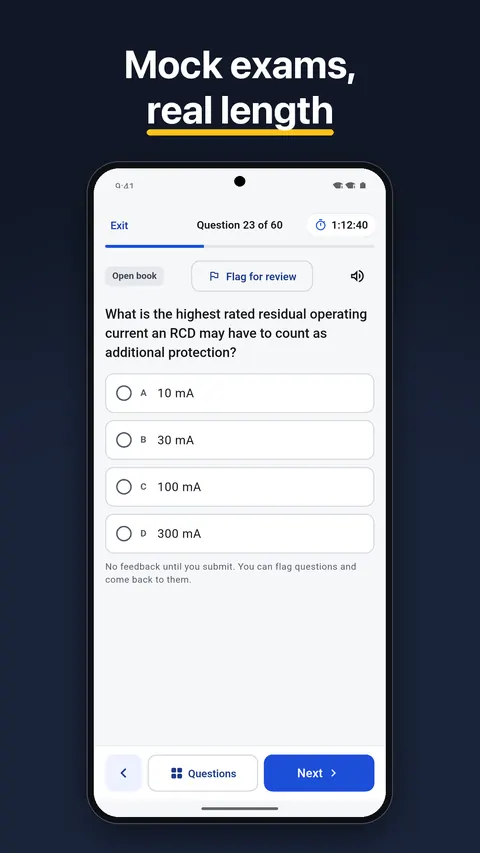
The Sparkwise app has all 24, each with an explanation. Across the whole 18th Edition there are 538 questions in 16 topics, plus timed 60-question mock exams of 2 hours.
3 of them are free in the app, the rest come with Pro. Sparkwise Pro is £12.99 one-off and unlocks every question, every mock exam and every worked solution for both exams. No subscription.
Android now; iPhone version not yet available.
Revision notes
Generating sets
Section 551 covers low-voltage generating sets, whether they supply an installation on their own, act as a standby, or run in parallel with the public network. A standby set must be arranged so it cannot run in parallel with the public supply, using an interlock or changeover switch. A set that can run in parallel needs automatic disconnection from the network if that supply is lost or its voltage or frequency moves outside declared limits, and a means of isolation the distributor can reach. The distributor must agree to parallel connection.
Motors
Section 552 covers rotating machines. Every part of a motor circuit, including cables, must be suitable for the currents involved in starting, accelerating and running the motor. A motor rated above 0.37 kW needs control equipment with overload protection for the motor, unless it is part of equipment complying with its own standard. Where a motor stopping because of a voltage drop and then restarting by itself could cause danger, the starter must prevent automatic restarting, for example by a no-volt release.
Accessories and socket-outlets
Section 553 covers accessories. Socket-outlets for household and similar use must be shuttered, and BS 1363 types are preferred for AC installations. Sockets should be mounted at a height, above the floor or a worktop, that keeps the risk of mechanical damage low when plugs are inserted, used and withdrawn. Where mobile equipment is likely to be used, a socket-outlet should be close enough that the appliance's normal flexible cord reaches it without extension leads.
Heaters and water heaters
Section 554 covers current-using equipment such as electrode boilers, heaters for liquids with immersed elements, water heaters with uninsulated elements and heating cables. Any heater for liquids or other substances must include, or be provided with, an automatic device that prevents a dangerous rise in temperature. Water heaters whose elements are immersed and uninsulated need extra measures, such as connecting metal parts in contact with the water to the earthed metal water pipework.
Luminaires and lighting points
Section 559 covers luminaires and lighting installations. A luminaire is connected to fixed wiring by a suitable device such as a ceiling rose, luminaire supporting coupler, device for connecting a luminaire (DCL), batten lampholder, connection unit or socket-outlet. Fixings must carry the luminaire's weight. A ceiling rose must not be used on circuits normally above 250 V, nor for more than one flexible cord unless designed for it. Spotlights need minimum distances from combustible materials that increase with lamp power.
Safety services
Chapter 56 covers supplies for safety services such as emergency lighting, fire alarms and fire-fighting lifts. Safety sources must be fixed, installed so a failure of the normal supply cannot affect them, and placed where only skilled or instructed persons can reach them. Safety service circuits must be independent of other circuits, so that a fault or maintenance work elsewhere does not affect them. Wiring that must keep working during a fire needs to be fire-resistant for the time required.
Stationary secondary batteries (Chapter 57, new in A4)
Amendment 4 added Chapter 57 for stationary secondary batteries used to store and supply energy in an installation, such as home battery energy storage. The battery system is treated as a source, much like a generating set, rather than as a load. It needs suitable means of isolation and protection against overcurrent and short circuit, and the installation must manage heat and, depending on the battery chemistry, gases through ventilation. In dwellings, Regulation 570.6.7.203 requires batteries to be installed in line with PAS 63100, which covers siting, fire separation and detection.
More 18th Edition topics
- Previous: Protective devices, earthing and bondingChapters 53 and 54: RCDs, AFDDs and SPDs, isolation devices, earth electrodes, earthing conductors, protective conductors and bonding sizes.
- Next: Inspection and testingInitial verification and periodic inspection: test sequence, insulation resistance values, RCD and loop tests, certificates, reports and observation codes.
- 18th Edition exam guideFormat, rules, booking and how to prepare

Practise both exams in the Sparkwise app
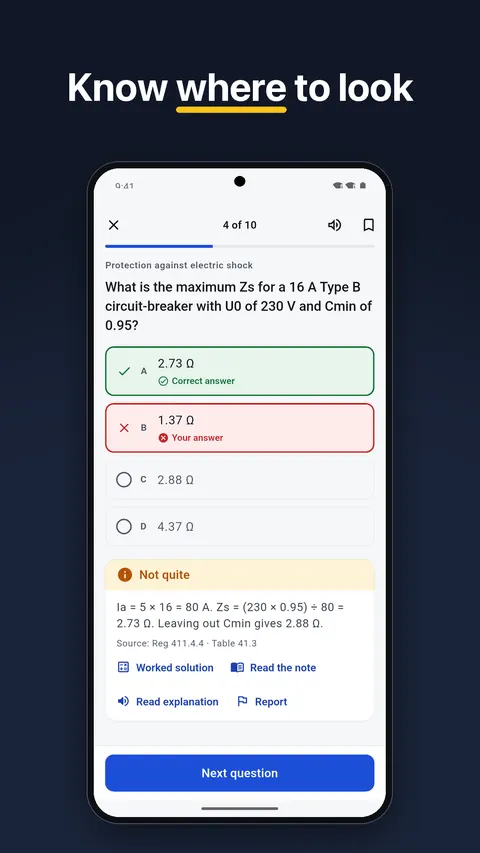
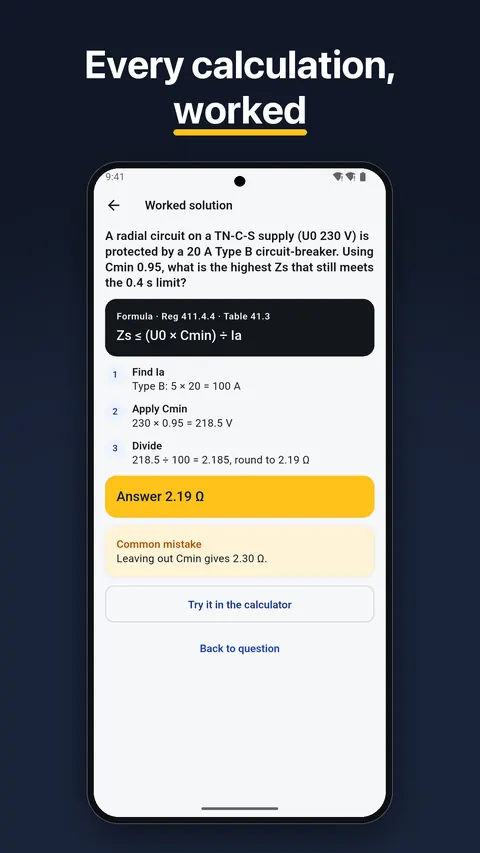
927 original questions across every Part of BS 7671:2018+A4:2026 and every ECS HS&E syllabus area, timed mock exams in the real format, worked solutions for calculations and explanations that show where to look in the book.
- 18th Edition: 538 questions, 60-question mock exams in 2 hours, a maximum Zs calculator and a guide to Amendment 4
- ECS HS&E: 389 questions and 50-question mock tests in 30 minutes
- Works offline. No ads, no account, no data collected.
Free: two full topics in each exam, three questions in every other topic, one full mock exam for each exam, the maximum Zs calculator and checklists.
Sparkwise Pro, £12.99 one-off: every question, every mock exam and every worked solution, for both exams. No subscription.
Android now; iPhone version not yet available. Sparkwise helps you prepare; it cannot promise a pass.