Not a government app. Sparkwise is an independent study app made by Kodfu Bilisim. It is not affiliated with or endorsed by the IET, BSI, City & Guilds, ECS or JIB. It does not contain the real exam questions and never reproduces BS 7671 text.
Inspection and testing: free 18th Edition practice questions
Initial verification and periodic inspection: test sequence, insulation resistance values, RCD and loop tests, certificates, reports and observation codes.
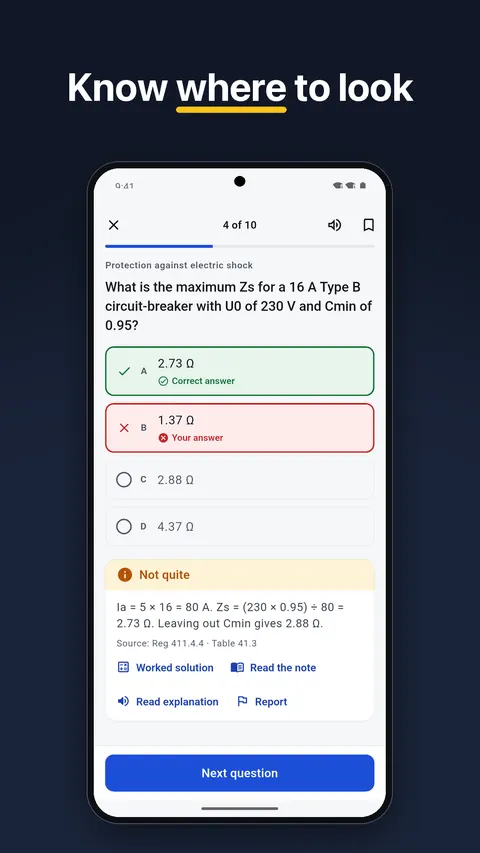
10 original questions from the Sparkwise app, each with the answer and an explanation. Open book: have your copy of BS 7671:2018+A4:2026 ready and look each answer up, as you would in the exam. No sign-up, nothing saved. These are not the real exam questions: no app or website can show you those.
Question 1 · Choose one answer
When must initial verification of a new installation be carried out?
- Within twelve months of completion
- During erection and before first use
- Only when the client asks for a certificate
- After the first periodic inspection
Show the answer
Answer B: During erection and before first use
Inspection and testing take place during erection, as far as practicable, and on completion before the installation is used.
Where to look: Reg 641.1
Question 2 · Select TWO answers
Which TWO items are checked during the inspection stage of initial verification? Select TWO.
- Presence of fire barriers and seals
- Presence of warning notices and labels
- The earth fault loop impedance value
- The RCD operating time
Show the answer
Answer A: Presence of fire barriers and seals, B: Presence of warning notices and labels
Fire barriers and notices are inspected visually. Loop impedance and RCD times are measured during testing.
Where to look: Reg 642.3
Question 3 · Choose one answer
A test fails and the fault is repaired. What does Part 6 require next?
- Only the failed test is repeated
- That test and any earlier affected tests
- All tests are skipped and C2 recorded
- The certificate is issued with a note
Show the answer
Answer B: That test and any earlier affected tests
After repair, repeat that test and any preceding tests whose results may have been influenced by the fault.
Where to look: Reg 643.1
Question 4 · Choose one answer
What insulation resistance test voltage is used for a 230 V final circuit?
- 250 V DC
- 500 V DC
- 1000 V DC
- 230 V AC
Show the answer
Answer B: 500 V DC
Circuits up to and including 500 V (other than SELV/PELV) are tested at 500 V DC.
Where to look: Table 64
Question 5 · Choose one answer
Socket-outlets with built-in SPDs cannot be disconnected for an insulation resistance test. What does BS 7671 allow?
- Leave those circuits untested
- Test at 250 V DC, still needing 1 MΩ
- Test at 1000 V DC for a short time
- Test at 500 V DC, accepting 0.25 MΩ
Show the answer
Answer B: Test at 250 V DC, still needing 1 MΩ
Where disconnecting such equipment is not practicable, the test voltage may be reduced to 250 V DC, but the result must still be at least 1 MΩ.
Where to look: Reg 643.3.2
Question 6 · Choose one answer
In which system type is earth electrode resistance testing normally required at initial verification?
- TN-S
- TN-C-S (PME)
- TT
- SELV
Show the answer
Answer C: TT
In a TT system the installation relies on its own electrode, so its resistance must be measured.
Where to look: Reg 643.7.2
Question 7 · Choose one answer
Which certificate is issued for a new installation, or for a new circuit added to an existing one?
- Electrical Installation Condition Report
- Minor Electrical Installation Works Certificate
- Electrical Installation Certificate
- PAT record
Show the answer
Answer C: Electrical Installation Certificate
New installations and new circuits are certified on an Electrical Installation Certificate with its schedules (Appendix 6). A minor works certificate covers an addition or alteration that does not add a new circuit, and a condition report covers an existing installation.
Where to look: Reg 644.1
Question 8 · Choose one answer
Who signs an Electrical Installation Certificate?
- The client who ordered the work
- The designer, installer and inspector
- The distribution network operator
- The local building control officer
Show the answer
Answer B: The designer, installer and inspector
The EIC is signed for design, construction and inspection and testing. One person may sign all three if responsible for all.
Where to look: Reg 644.4 · Appendix 6
Question 9 · Choose one answer
Who decides the recommended interval until the next periodic inspection?
- Fixed at 10 years for all homes by BS 7671
- The inspector, based on use and condition
- The electricity supplier for the property
- The local authority building control
Show the answer
Answer B: The inspector, based on use and condition
The interval depends on the type of installation, its use, quality of maintenance and external influences, and is recorded on the report.
Where to look: Reg 652.1
Question 10 · Choose one answer
Where in BS 7671 would you look for the sequence of tests for initial verification?
- Chapter 64
- Chapter 65
- Chapter 13
- Appendix 6
Show the answer
Answer A: Chapter 64
Chapter 64 (initial verification) sets out the tests in Regulation 643.
Where to look: Chapter 64
You’ve seen 10 of 36 questions in this topic
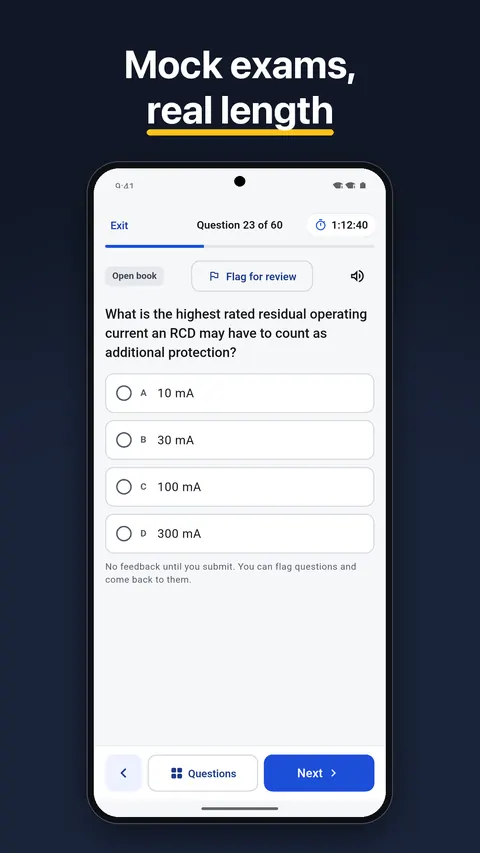
The Sparkwise app has all 36, each with an explanation. Across the whole 18th Edition there are 538 questions in 16 topics, plus timed 60-question mock exams of 2 hours.
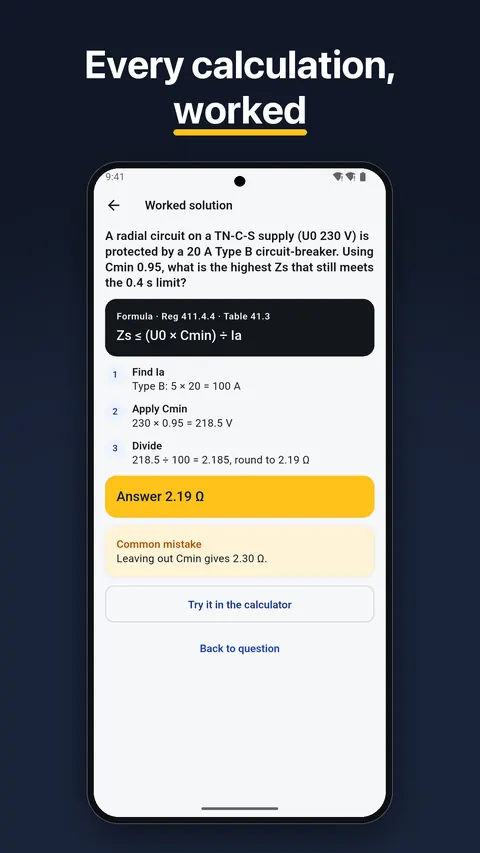
All 36 are free in the app. Sparkwise Pro is £12.99 one-off and unlocks every question, every mock exam and every worked solution for both exams. No subscription.
Android now; iPhone version not yet available.
Revision notes
Initial verification: the basics
Every installation must be inspected and tested during erection, as far as practicable, and on completion before it is put into service. The aim is to confirm, so far as reasonably practicable, that the Regulations have been met. The person doing it must be a skilled person competent in verification, must have the diagrams and information required by Section 514, and must take precautions so that the process causes no danger to people or livestock and no damage to property, even if the installation is faulty. For an addition or alteration, the work must comply and must not impair the existing installation.
Inspection comes first
Inspection precedes testing and is normally done with the part being inspected disconnected from the supply. It checks that equipment is correctly selected and erected, undamaged and suitable for the external influences. Typical items include connections, conductor identification, cable routes and safe zones, conductor sizes for current-carrying capacity and voltage drop, fire barriers, methods of protection against electric shock, devices for isolation and switching, presence of diagrams, warning notices and labels, and access to equipment.
The test sequence
Dead tests are done first, in this order where relevant: continuity of protective conductors, including main and supplementary bonding; continuity of ring final circuit conductors; insulation resistance; protection by SELV, PELV or electrical separation; protection by barriers or enclosures; insulation resistance of non-conducting floors and walls; and polarity. Then, with the supply connected: earth electrode resistance, earth fault loop impedance, prospective fault current, additional protection (RCD), phase sequence, functional testing and, where needed, voltage drop. If a test fails, that test and any earlier tests the fault could have affected are repeated after repair.
Continuity and the ring final circuit test
For a ring final circuit, first measure the end-to-end resistances of the line (r1), neutral (rn) and protective (r2) loops. r1 and rn should be about equal (guidance often quotes within 0.05 Ω); with 2.5/1.5 mm² cable r2 is about 1.67 times r1. Then cross-connect line to neutral and measure at each socket: readings should be about (r1 + rn) ÷ 4. Repeat with line cross-connected to the protective conductor: readings about (r1 + r2) ÷ 4, the highest of which is R1 + R2 for the circuit. A steady pattern shows the ring is unbroken with no interconnections.
Insulation resistance values
Table 64 gives test voltages and minimum values. SELV and PELV circuits are tested at 250 V DC and need at least 0.5 MΩ. Circuits up to and including 500 V, the usual 230/400 V circuits, are tested at 500 V DC and need at least 1 MΩ. Circuits above 500 V are tested at 1000 V DC and need at least 1 MΩ. Equipment that could be damaged or affect the result, such as SPDs, should be disconnected; if that is not practicable, the test voltage may be reduced to 250 V DC, but the minimum value is still 1 MΩ.
Polarity, earth electrode, loop impedance and RCDs
Polarity testing confirms that every fuse and single-pole switch or protective device is in the line conductor only, that the centre contact of bayonet and Edison screw lampholders is connected to line (except E14 and E27 lampholders to BS EN 60238), and that sockets are correctly wired. In TT systems the earth electrode resistance is measured. Earth fault loop impedance is measured and compared with the limits, and prospective fault current is found at the origin and other relevant points. RCDs are tested with an instrument to BS EN 61557-6, and test buttons are checked in the functional tests.
Certificates for new work
On completion, an Electrical Installation Certificate (EIC) is issued with a schedule of inspections and a schedule of circuit details and test results. It is signed by the people responsible for design, construction, and inspection and testing (one person can sign for all three if they did all three). A Minor Electrical Installation Works Certificate may be used for an addition or alteration that does not include a new circuit, such as adding a socket-outlet to an existing circuit. Replacing a consumer unit is certified on an EIC.
Periodic inspection and the EICR
Periodic inspection and testing finds out, so far as reasonably practicable, whether an installation is in a satisfactory condition for continued use. The extent and limitations are agreed with the person ordering the work, and the results are reported on an Electrical Installation Condition Report (EICR). Observations are coded: C1 danger present, immediate action; C2 potentially dangerous, urgent action; C3 improvement recommended; FI further investigation. Under A4, only C1 or C2 make the overall assessment unsatisfactory. The inspector recommends the interval to the next inspection.
More 18th Edition topics
- Previous: Other equipment, safety services and batteriesChapters 55, 56 and 57: generating sets, accessories, luminaires, safety services and stationary secondary batteries.
- Next: Bathrooms, pools, saunas and heatingSections 700, 701, 702, 703 and 753: zones, IP codes, socket distances, RCDs and bonding in wet and hot locations.
- 18th Edition exam guideFormat, rules, booking and how to prepare

Practise both exams in the Sparkwise app
927 original questions across every Part of BS 7671:2018+A4:2026 and every ECS HS&E syllabus area, timed mock exams in the real format, worked solutions for calculations and explanations that show where to look in the book.
- 18th Edition: 538 questions, 60-question mock exams in 2 hours, a maximum Zs calculator and a guide to Amendment 4
- ECS HS&E: 389 questions and 50-question mock tests in 30 minutes
- Works offline. No ads, no account, no data collected.
Free: two full topics in each exam, three questions in every other topic, one full mock exam for each exam, the maximum Zs calculator and checklists.
Sparkwise Pro, £12.99 one-off: every question, every mock exam and every worked solution, for both exams. No subscription.
Android now; iPhone version not yet available. Sparkwise helps you prepare; it cannot promise a pass.