Not a government app. Sparkwise is an independent study app made by Kodfu Bilisim. It is not affiliated with or endorsed by the IET, BSI, City & Guilds, ECS or JIB. It does not contain the real exam questions and never reproduces BS 7671 text.
Part 8 and the appendices: free 18th Edition practice questions
Energy efficiency, prosumer's installations and where to find things in the appendices: statutory regulations, model forms, colours and external influences.
10 original questions from the Sparkwise app, each with the answer and an explanation. Open book: have your copy of BS 7671:2018+A4:2026 ready and look each answer up, as you would in the exam. No sign-up, nothing saved. These are not the real exam questions: no app or website can show you those.
Question 1 · Choose one answer
In BS 7671:2018+A4:2026, which chapter covers prosumer's low-voltage electrical installations?
- Chapter 57
- Chapter 81
- Chapter 82
- Section 712
Show the answer
Answer C: Chapter 82
Chapter 82 covers prosumer's low-voltage electrical installations. Chapter 81 covers energy efficiency and Chapter 57 batteries.
Where to look: Part 8 · Chapter 82
Question 2 · True or false?
Chapter 81 requires every new installation to include specific technologies, such as solar PV and battery storage.
- True
- False
Show the answer
Answer B: False
Chapter 81 is informative. It points to the energy requirements of the Building Regulations and to BS HD 60364-8-1. It does not require any particular technology, such as solar PV or batteries.
Where to look: Chapter 81 (A4)
Question 3 · Select TWO answers
Chapter 82 recognises which TWO operating modes for a PEI? Select TWO.
- Connected to the public network
- Island mode, off the public network
- Standby mode with export blocked
- Bypass mode with RCDs shorted out
Show the answer
Answer A: Connected to the public network, B: Island mode, off the public network
A PEI may operate connected to the public network or in island mode. Protection must be effective in both.
Where to look: Chapter 82
Question 4 · Choose one answer
Which appendix lists the British Standards referred to in BS 7671?
- Appendix 1
- Appendix 2
- Appendix 6
- Appendix 16
Show the answer
Answer A: Appendix 1
Appendix 1 lists the standards referred to. Appendix 2 lists statutory regulations.
Where to look: Appendix 1
Question 5 · Choose one answer
You need to know what the external influence code AF4 means. Which appendix would you use?
- Appendix 2
- Appendix 5
- Appendix 6
- Appendix 9
Show the answer
Answer B: Appendix 5
Appendix 5 classifies external influences. AF codes relate to corrosive or polluting substances.
Where to look: Appendix 5
Question 6 · Choose one answer
In an old three-phase installation, the conductors are red, yellow and blue. Which harmonised colours correspond to yellow and blue?
- Yellow → black, blue → grey
- Yellow → grey, blue → black
- Yellow → brown, blue → blue
- Yellow → blue, blue → grey
Show the answer
Answer A: Yellow → black, blue → grey
Red, yellow and blue map to brown, black and grey. Old blue L3 is now grey, so blue must not be mistaken for neutral.
Where to look: Table 51 · Reg 514.14
Question 7 · Choose one answer
Which appendix explains the effect of harmonic currents on balanced three-phase systems?
- Appendix 4
- Appendix 8
- Appendix 11
- Appendix 16
Show the answer
Answer A: Appendix 4
Appendix 4 (section 5.5) explains how triple-n harmonics can raise neutral current and which rating factors to apply. Appendix 11 now gives examples of warning and instruction labels.
Where to look: Appendix 4 §5.5
Question 8 · Choose one answer
According to Appendix 15, what may a single non-fused spur from a ring final circuit supply?
- Up to three single socket-outlets
- One single or twin socket, or one item
- Two twin sockets in the same room
- Any number of sockets in one room
Show the answer
Answer B: One single or twin socket, or one item
A non-fused spur may feed only one single or twin/multiple socket-outlet, or one item of permanently connected equipment.
Where to look: Appendix 15
Question 9 · Choose one answer
Where in BS 7671 would you look for typical ring and radial final circuit arrangements?
- Appendix 4
- Appendix 10
- Appendix 14
- Appendix 15
Show the answer
Answer D: Appendix 15
Appendix 15 shows ring and radial final circuit arrangements.
Where to look: Appendix 15
Question 10 · Choose one answer
A fault current of 400 A flows through a 32 A Type B circuit-breaker. Using its time/current characteristic, how does it respond?
- It trips instantly, as 400 A exceeds 160 A
- It takes up to 5 s, as 400 A is below 10 × In
- It does not trip, as 400 A is below 20 × In
- It trips only once the cable overheats
Show the answer
Answer A: It trips instantly, as 400 A exceeds 160 A
Type B devices trip in the instantaneous region at 5 × In or more. 5 × 32 = 160 A, and 400 A is well above it.
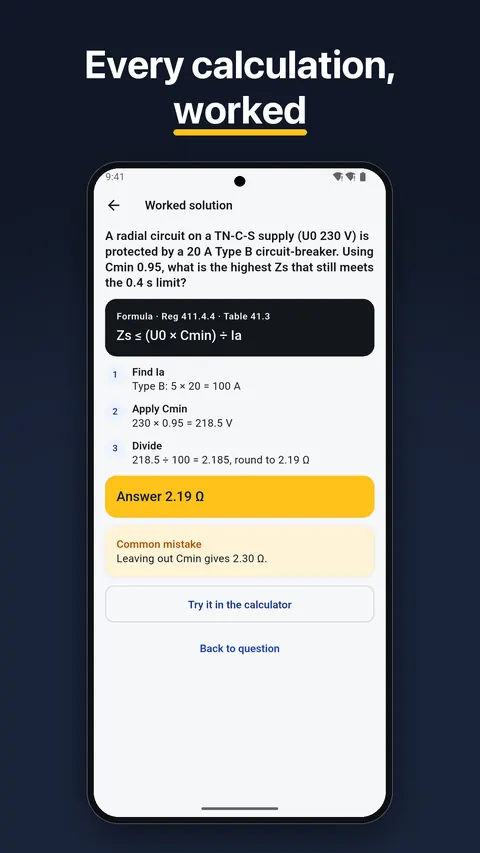
Worked solution. Formula: Instantaneous if I ≥ Ia (Type B: Ia = 5 × In)
- Find the instantaneous threshold: 5 × 32 = 160 A
- Compare with the fault current: 400 A is more than 160 A
- Read the curve: The device operates in its instantaneous region, well within 0.1 s
Common mistake: Using the Type C or D multiplier (10 or 20 × In) wrongly suggests a slow trip.
Where to look: Appendix 3 · time/current curves
You’ve seen 10 of 29 questions in this topic
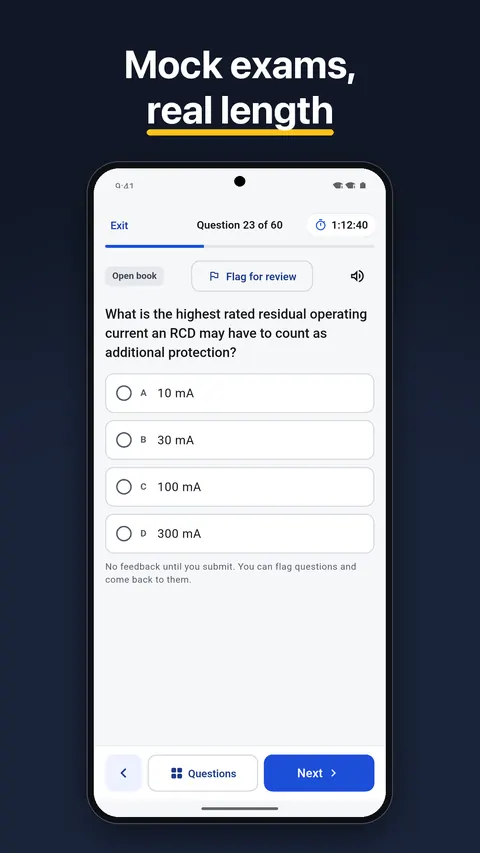
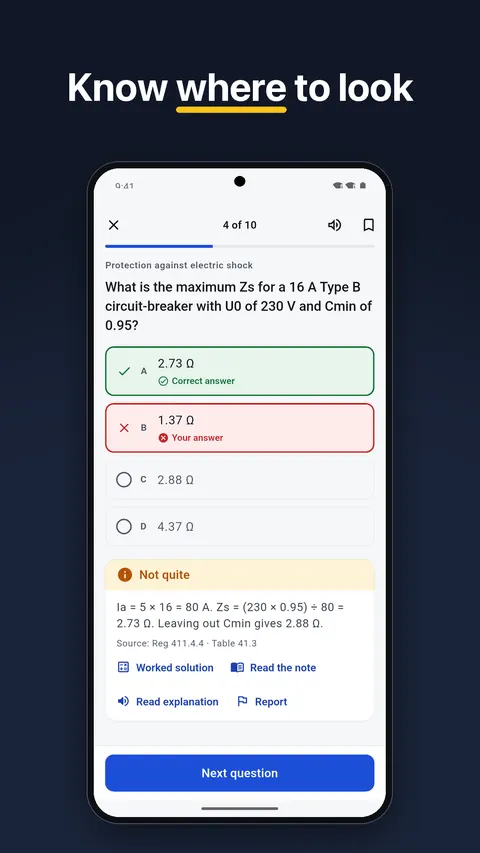
The Sparkwise app has all 29, each with an explanation, and 1 with a step-by-step worked solution. Across the whole 18th Edition there are 538 questions in 16 topics, plus timed 60-question mock exams of 2 hours.
3 of them are free in the app, the rest come with Pro. Sparkwise Pro is £12.99 one-off and unlocks every question, every mock exam and every worked solution for both exams. No subscription.
Android now; iPhone version not yet available.
Revision notes
What Part 8 contains
Part 8 sets functional requirements rather than safety rules alone. In BS 7671:2018+A4:2026 it holds Chapter 81 on energy efficiency, which A4 brought into the body of the standard in place of the old Appendix 17, and Chapter 82 on prosumer's low-voltage electrical installations, first added by Amendment 2. Questions in the exam on Part 8 usually ask what these chapters cover and how they relate to the safety requirements in Parts 4 and 5.
Energy efficiency (Chapter 81)
Chapter 81 on energy efficiency is informative: it is there for information and says the legal requirements for conserving energy are in the Building Regulations (Section 6 of the Technical Handbooks in Scotland). BS HD 60364-8-1 gives recommendations, such as placing distribution equipment near the load centre, sizing conductors on long, heavily loaded runs to cut losses, choosing efficient equipment and providing metering. Chapter 81 does not require any particular technology, and efficiency must never reduce safety.
Prosumer's installations (Chapter 82)
A prosumer's electrical installation (PEI) includes local sources such as PV or generators and often storage, so it can both take energy from and supply energy to the network. It may operate connected to the public network or in island mode, disconnected from it. An electrical energy management system (EEMS) controls sources, storage and loads. The designer must make sure protection, including earthing and automatic disconnection, still works in every operating mode and during changeover between them.
Appendices 1 to 4
Appendix 1 lists the British and other standards the Regulations refer to. Appendix 2 lists statutory regulations and associated memoranda, such as the Electricity at Work Regulations 1989, the ESQCR 2002 and Building Regulations. Appendix 3 gives time/current characteristics of overcurrent protective devices (its RCD table was removed in Amendment 2), which are used to find the current Ia that operates a device within a given time. Appendix 4 gives current-carrying capacities, voltage drop figures in mV/A/m, installation reference methods and rating factors for cables.
Appendices 5 to 7
Appendix 5 sets out the full classification of external influences, such as AD for water and BE for stored materials. Appendix 6 contains the model forms for certification and reporting: the Electrical Installation Certificate, the Minor Electrical Installation Works Certificate, the Electrical Installation Condition Report, and their schedules and guidance for recipients. The former Appendix 7 on old cable colours was deleted by Amendment 2; Table 51 and Section 514 now cover colours and the mixed-colour notice.
Appendices 8 to 16
The later appendices support specific design tasks. Appendix 8 covers current-carrying capacity and voltage drop for busbar trunking and powertrack. Appendix 9 covers multiple-source, DC and other systems. Appendix 10 covers protection of conductors in parallel against overcurrent. Appendix 11 gives examples of warning and instruction labels. Appendix 13 gives guidance on escape routes and fire protection, supporting Chapter 42. Appendix 14 covers determining prospective fault current. Appendix 15 shows ring and radial final circuit arrangements. Appendix 16 covers devices for protection against overvoltage. Harmonic currents in the neutral are dealt with in Appendix 4.
More 18th Edition topics
- Previous: Medical, solar PV, PoE and EV chargingSections 710, 712, 716 and 722: medical locations, solar photovoltaic systems, Power over Ethernet and electric vehicle charging.
- Next: Cable and fault calculationsRating factors, voltage drop, maximum Zs, prospective fault current and adiabatic checks, worked step by step.
- 18th Edition exam guideFormat, rules, booking and how to prepare

Practise both exams in the Sparkwise app
927 original questions across every Part of BS 7671:2018+A4:2026 and every ECS HS&E syllabus area, timed mock exams in the real format, worked solutions for calculations and explanations that show where to look in the book.
- 18th Edition: 538 questions, 60-question mock exams in 2 hours, a maximum Zs calculator and a guide to Amendment 4
- ECS HS&E: 389 questions and 50-question mock tests in 30 minutes
- Works offline. No ads, no account, no data collected.
Free: two full topics in each exam, three questions in every other topic, one full mock exam for each exam, the maximum Zs calculator and checklists.
Sparkwise Pro, £12.99 one-off: every question, every mock exam and every worked solution, for both exams. No subscription.
Android now; iPhone version not yet available. Sparkwise helps you prepare; it cannot promise a pass.