Not a government app. Sparkwise is an independent study app made by Kodfu Bilisim. It is not affiliated with or endorsed by the IET, BSI, City & Guilds, ECS or JIB. It does not contain the real exam questions and never reproduces BS 7671 text.
Medical, solar PV, PoE and EV charging: free 18th Edition practice questions
Sections 710, 712, 716 and 722: medical locations, solar photovoltaic systems, Power over Ethernet and electric vehicle charging.
10 original questions from the Sparkwise app, each with the answer and an explanation. Open book: have your copy of BS 7671:2018+A4:2026 ready and look each answer up, as you would in the exam. No sign-up, nothing saved. These are not the real exam questions: no app or website can show you those.
Question 1 · Choose one answer
In medical locations, which group covers applied parts used in intracardiac procedures and surgery where loss of supply could endanger life?
- Group 0
- Group 1
- Group 2
- Group 3
Show the answer
Answer C: Group 2
Group 2 is for life-critical uses such as intracardiac procedures, vital treatments and surgical operations.
Where to look: Reg 710.3
Question 2 · Choose one answer
What did Amendment 4 add for recording results in medical locations?
- A schedule for supplementary bonding results
- A new EV charging installation form
- A battery storage commissioning record
- A Power over Ethernet cable test sheet
Show the answer
Answer A: A schedule for supplementary bonding results
A4 revised Section 710 and added a schedule of test results for supplementary bonding conductor resistances.
Where to look: Section 710 (A4)
Question 3 · Choose one answer
Why is the DC side of a PV array treated as live in daylight?
- The inverter back-feeds it at all times
- PV modules generate voltage whenever lit
- The distributor supplies it directly
- The batteries are always connected
Show the answer
Answer B: PV modules generate voltage whenever lit
PV modules produce voltage whenever illuminated, so isolation upstream does not make the array dead.
Where to look: Section 712
Question 4 · Choose one answer
Which protective measure is usually preferred on the DC side of a PV installation?
- Placing out of reach of persons
- Double or reinforced insulation
- A non-conducting location
- Obstacles around the array
Show the answer
Answer B: Double or reinforced insulation
Class II construction on the DC side is the usual approach, since automatic disconnection is not practical there.
Where to look: Reg 712.412
Question 5 · Choose one answer
Which section did Amendment 4 add for Power over Ethernet?
- Section 712
- Section 715
- Section 716
- Section 722
Show the answer
Answer C: Section 716
A4 introduced Section 716 because PoE cabling now carries significant power alongside data, and bundled cables can heat up. The section sets rules for these extra-low voltage DC circuits run over information technology cabling.
Where to look: Section 716 (A4)
Question 6 · Choose one answer
What type of power does Power over Ethernet deliver to devices such as cameras and access points?
- 230 V AC over a separate cable
- Extra-low voltage DC over the data cable
- 400 V three-phase over spare pairs
- High-frequency AC at about 1 kV
Show the answer
Answer B: Extra-low voltage DC over the data cable
PoE supplies extra-low voltage DC along the same cabling that carries the data.
Where to look: Section 716 (A4)
Question 7 · Select TWO answers
An EV charger does not provide its own DC fault protection. Which TWO arrangements give the required protection against DC fault current? Select TWO.
- A 30 mA Type B RCD
- Type A RCD with RDC-DD
- A 30 mA Type AC RCD
- A 300 mA Type A RCD
Show the answer
Answer A: A 30 mA Type B RCD, B: Type A RCD with RDC-DD
Smooth DC from the vehicle can blind ordinary RCDs, so a Type B RCD or a Type A RCD with a 6 mA RDC-DD is used.
Where to look: Reg 722.531.3.101
Question 8 · Choose one answer
Which is a permitted option for using a PME earth at an outdoor EV charging point?
- A larger supply cable
- An open-PEN detection device
- A Type AC RCD at the origin
- Bonding the car to a water pipe
Show the answer
Answer B: An open-PEN detection device
An open-PEN protection device that switches off all live conductors and the protective conductor is one of the permitted options.
Where to look: Reg 722.411.4.1 (iii)
Question 9 · Choose one answer
Which section covers electric vehicle charging installations?
- Section 712
- Section 716
- Section 722
- Section 730
Show the answer
Answer C: Section 722
Section 722 covers EV charging. 712 is solar PV, 716 Power over Ethernet and 730 shore connections for vessels.
Where to look: Section 722
Question 10 · Choose one answer
Where in BS 7671 would you look for the requirements for operating theatres and other medical locations?
- Section 706
- Section 710
- Section 711
- Section 729
Show the answer
Answer B: Section 710
Section 710 covers medical locations, revised in A4.
Where to look: Section 710
You’ve seen 10 of 23 questions in this topic
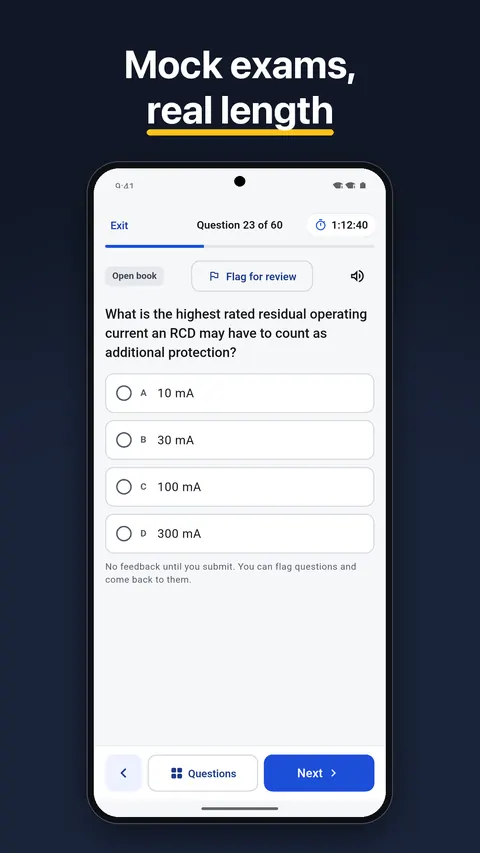
The Sparkwise app has all 23, each with an explanation. Across the whole 18th Edition there are 538 questions in 16 topics, plus timed 60-question mock exams of 2 hours.
3 of them are free in the app, the rest come with Pro. Sparkwise Pro is £12.99 one-off and unlocks every question, every mock exam and every worked solution for both exams. No subscription.
Android now; iPhone version not yet available.
Revision notes
Medical location groups
Section 710 classifies medical locations by how medical electrical equipment is used on patients. Group 0 has no applied parts. Group 1 uses applied parts externally or invasively, but not where loss of supply would endanger life. Group 2 covers applied parts used for intracardiac procedures, vital treatments and surgery, where interruption of supply could cause danger to life. Amendment 4 made a major revision of Section 710, including a new schedule for recording the resistance of supplementary protective equipotential bonding conductors.
Medical IT systems and safety supplies
In group 2 locations, circuits for life-critical medical equipment are fed from a medical IT system through an isolating transformer, so a first insulation fault raises an alarm through an insulation monitoring device instead of cutting the supply. Supplementary bonding keeps touch voltages very low, with tight limits on the resistance of protective conductors in group 2. Safety power supplies switch over within set times, for example 0.5 s for operating theatre lighting and 15 s for other essential equipment. Type AC RCDs are not used.
Solar PV systems
Section 712 covers solar photovoltaic power supply systems. A PV array produces DC voltage whenever light falls on it and cannot be switched off at the source, so the DC side is treated as live in daylight. Protection on the DC side is usually by double or reinforced insulation. Means of isolation are needed on both the DC and AC sides of the inverter. Warning labels at the origin, meter position, consumer unit and inverter show that the installation has more than one source.
RCDs with PV inverters
Some inverters can let smooth DC fault current pass into the AC installation. Where the PV system does not have at least simple separation between the AC and DC sides, an RCD providing fault protection on that circuit must be Type B, unless the inverter manufacturer states that it cannot feed DC fault current into the installation. Getting this wrong can leave a Type A or Type AC RCD unable to trip. Equipment selection should follow the inverter manufacturer's instructions.
Power over Ethernet (Section 716, new in A4)
Amendment 4 added Section 716 for Power over Ethernet, where data cabling also carries extra-low voltage DC power to devices such as cameras, wireless access points and lighting. Higher PoE power levels make cables warm, especially in large bundles or enclosed containment, so current-carrying capacity and installation conditions matter. General wiring principles, such as protection against mechanical damage, apply, and the electrical and ICT designers need to coordinate.
EV charging circuits
Section 722 covers electric vehicle charging installations. Each charging point is supplied by its own dedicated final circuit. Each connection point has its own RCD of no more than 30 mA, at least Type A, disconnecting all live conductors. Because vehicles can produce smooth DC residual current, protection against DC fault current is also needed unless the charging equipment provides it: either a Type B RCD, or a Type A RCD plus a residual direct current detecting device (RDC-DD) responding to 6 mA DC.
EV charging and PME
A PME earthing facility is not normally used for a charging point outdoors, because a broken PEN conductor in the supply could raise the vehicle body to a dangerous voltage relative to true earth. It may be used where one of the permitted options applies, such as a device that disconnects the charging point, including its protective conductor, if the voltage between the protective conductor and earth rises too far, or a suitable earth electrode. Otherwise the charging point is made part of a TT system.
More 18th Edition topics
- Previous: Sites, farms, caravans, marinas and eventsSections 704 to 740: construction sites, farms, restricted conductive locations, caravan parks and caravans, marinas, exhibitions, fairgrounds, outdoor and ELV lighting, mobile units and gangways.
- Next: Part 8 and the appendicesEnergy efficiency, prosumer's installations and where to find things in the appendices: statutory regulations, model forms, colours and external influences.
- 18th Edition exam guideFormat, rules, booking and how to prepare

Practise both exams in the Sparkwise app
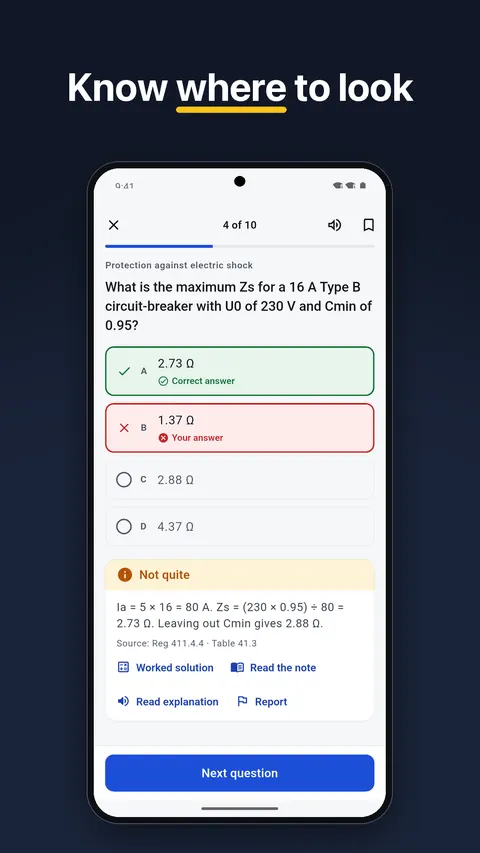
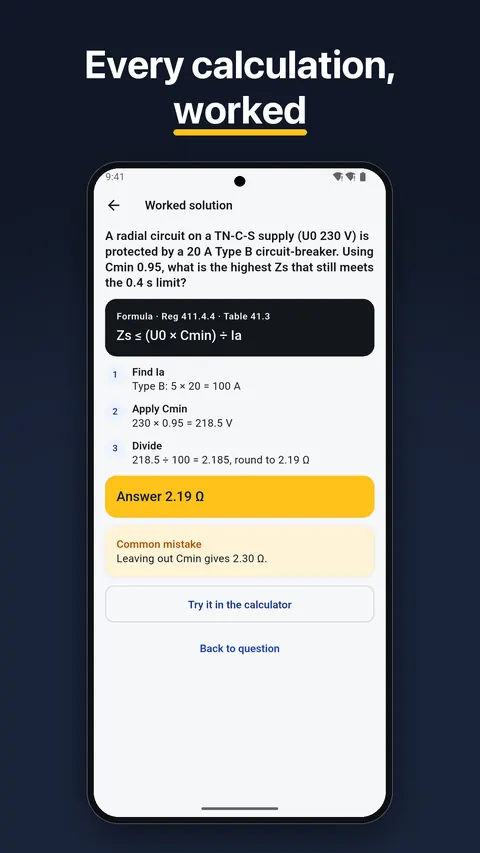
927 original questions across every Part of BS 7671:2018+A4:2026 and every ECS HS&E syllabus area, timed mock exams in the real format, worked solutions for calculations and explanations that show where to look in the book.
- 18th Edition: 538 questions, 60-question mock exams in 2 hours, a maximum Zs calculator and a guide to Amendment 4
- ECS HS&E: 389 questions and 50-question mock tests in 30 minutes
- Works offline. No ads, no account, no data collected.
Free: two full topics in each exam, three questions in every other topic, one full mock exam for each exam, the maximum Zs calculator and checklists.
Sparkwise Pro, £12.99 one-off: every question, every mock exam and every worked solution, for both exams. No subscription.
Android now; iPhone version not yet available. Sparkwise helps you prepare; it cannot promise a pass.