Not a government app. Sparkwise is an independent study app made by Kodfu Bilisim. It is not affiliated with or endorsed by the IET, BSI, City & Guilds, EAL, NET, the ECS, the JIB, NICEIC, NAPIT, MCS, HSE or OZEV. It does not contain the real exam questions and never reproduces BS 7671 text.
ECS health and safety mock test (HS&E assessment)
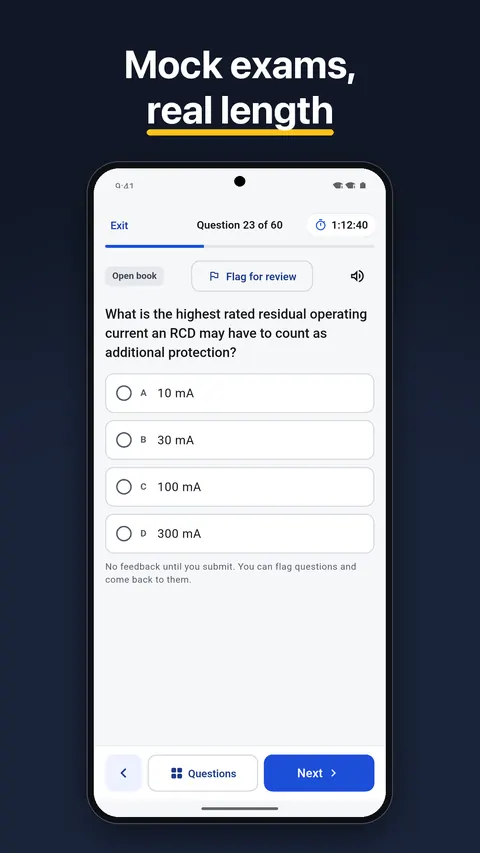
The ECS HS&E assessment gives you 50 questions, 30 minutes and no book, and you need 43 right. That leaves room for seven mistakes and about 36 seconds a question. A mock test is the only way to find out whether you can work at that pace and that accuracy before you pay for the real thing.
Start a free ECS mock: get Sparkwise on Google Play Try 10 free questions first
Free: your first full 50-question ECS mock, and every question in general health and safety and electrotechnical safety. Pro, £12.99 once: all 389 ECS questions, every numbered mock and random mocks, plus the 18th Edition. Android now; iPhone version not yet available.
On this page
What a real-format ECS mock looks like
The ECS says the assessment is 50 multiple-choice questions, each with one correct answer from four, picked at random from its question bank, to be finished in 30 minutes. It is closed book, and the pass mark is 43 out of 50. A mock that gives you an hour, lets you stop and look things up, or passes you at 35 will make you feel ready when you are not.
| Item | Real ECS HS&E | Sparkwise mock |
|---|---|---|
| Questions | 50, one answer from four | 50, one answer from four |
| Time | 30 minutes | 30-minute timer that keeps running if you leave the app |
| Book | Closed book | No notes or book: you answer from memory |
| Pass mark | 43 of 50 (86%) | 43 of 50 |
| Question mix | Spread over 11 syllabus areas | Weighted to follow the same areas |
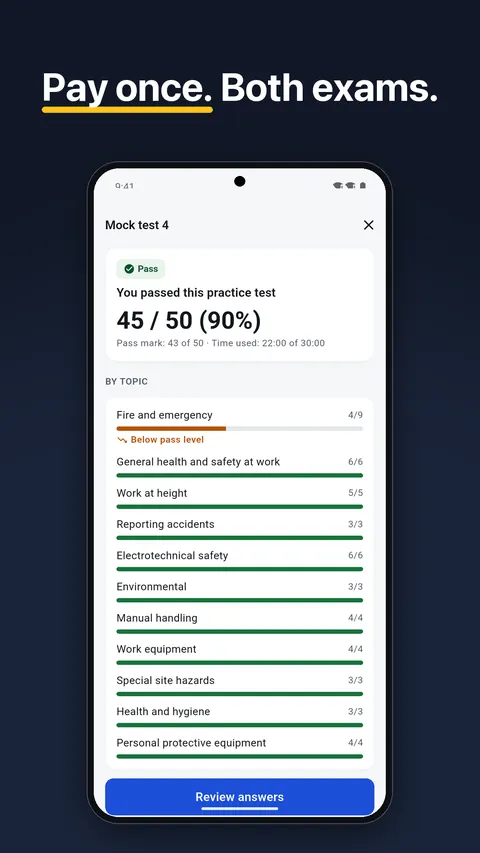
| Result | Pass or fail | Score, time used and marks by syllabus area, with the reason for every answer |
Sparkwise questions are original, written from health and safety law and HSE guidance on the same topics. They are not the ECS question bank, so use them alongside the ECS revision book, not instead of it. The ECS assessment guide lists the 11 areas and how many questions each one gets.
The pace: 36 seconds a question
Thirty minutes over 50 questions is 36 seconds each. Most people who fail the ECS test do not run out of knowledge; they run out of time on a few long questions, or they lose the last marks to careless reading. Here is a worked example of a timing plan:
| Stage | Clock | Target |
|---|---|---|
| First pass: answer at once, flag anything you hesitate over | 0 to 20 min | All 50 seen, about 42 answered |
| Second pass: the flagged questions | 20 to 27 min | The 8 flagged ones answered |
| Check: reread questions with "not", "first", "most" or "least" | 27 to 30 min | Nothing left blank |
A blank answer scores nothing, so always pick your best guess. If you can only manage 35 or 40 questions in 20 minutes on a mock, speed is your problem: practise topic by topic until the answers come without thinking, then sit another mock.
10 free ECS HS&E practice questions
One question from each of ten syllabus areas, taken from the questions that ship in the app. Pick an answer to see whether you were right and why.
Question 1 · Choose one answer
Under CDM 2015, what must a worker do if they see something likely to endanger themselves or others?
- Report it to the person in control
- Appoint a principal designer for it
- Prepare a new construction phase plan
- Notify the project to HSE themselves
Show the answer
Answer A: Report it to the person in control
Workers must report anything they see that is likely to endanger their own or others' health or safety. Planning and appointments are other people's duties.
Source: CDM 2015 reg 8(5)
Question 2 · Choose one answer
Two people are lifting a heavy panel together. What is important?
- They lift without talking to concentrate
- Each person lifts when they feel ready
- One person co-ordinates and gives the commands
- The stronger person takes nearly all of the weight
Show the answer
Answer C: One person co-ordinates and gives the commands
Team lifts need co-ordination so both people lift, move and lower at the same time.
Source: HSE: Manual handling at work (INDG143)
Question 3 · Choose one answer
Which of these is a reportable dangerous occurrence under RIDDOR?
- A ladder blowing over with nobody on it
- An RCD tripping when a drill is plugged in
- A MEWP boom touching an uninsulated 11 kV line
- A fuse blowing in a site office
Show the answer
Answer C: A MEWP boom touching an uninsulated 11 kV line
Contact with, or arcing from, an uninsulated overhead line above 200 V is listed as a dangerous occurrence even if nobody is hurt.
Source: RIDDOR 2013 reg 7 and Sch 2
Question 4 · Choose one answer
Which gloves are most suitable when handling wet cement or solvents?
- Fingerless knitted work gloves
- Thin cotton gloves worn under rigger gloves
- Chemical-resistant gloves, such as nitrile
- Electrical insulating rubber gloves
Show the answer
Answer C: Chemical-resistant gloves, such as nitrile
Cement and solvents cause skin burns and dermatitis. Chemical-resistant gloves stop them reaching the skin.
Source: COSHH 2002 · HSE: skin at work
Question 5 · Choose one answer
Which of these helps reduce the risk of hand-arm vibration syndrome?
- Using the tool for one long session
- Using blunt bits so the tool cuts slower
- Gripping the tool as tightly as possible
- Using low-vibration tools for less time
Show the answer
Answer D: Using low-vibration tools for less time
Low-vibration tools and less trigger time cut exposure. A tight grip, blunt bits and long sessions all increase the vibration reaching the hands.
Source: Control of Vibration at Work Regulations 2005
Question 6 · Choose one answer
How should you climb a mobile tower?
- By climbing up the stabilisers
- Up the outside of the tower's end frame
- Inside, using the built-in ladder
- Using a separate leaning ladder
Show the answer
Answer C: Inside, using the built-in ladder
Climbing inside keeps your weight within the base and lets you reach the platform through the trapdoor.
Source: PASMA code of practice · WAHR 2005
Question 7 · Choose one answer
Why should a domestic 230 V extension reel not be used to run tools on a construction site?
- It is the wrong colour for the site
- It is too long for most site jobs
- It is not built for sites and runs at 230 V
- It draws too much power from the site supply
Show the answer
Answer C: It is not built for sites and runs at 230 V
Site leads and connectors are built to withstand rough handling and wet conditions, and 110 V reduces shock risk.
Source: BS EN 60309 · BS 7375
Question 8 · Choose one answer
Which statement about trench collapse is correct?
- Firm clay sides never collapse
- Dry trenches are always safe to enter
- Trenches under 2 m deep never collapse
- Even a shallow trench can bury someone
Show the answer
Answer D: Even a shallow trench can bury someone
Soil is very heavy. A collapse in a shallow trench can trap or crush a person, so support or batter the sides where there is a risk.
Source: CDM 2015 reg 22 (excavations)
Question 9 · Choose one answer
Why are multimeters not recommended for proving dead?
- They can be set on the wrong range
- Their leads are always too short
- They always need two people to use
- They cannot measure AC voltage
Show the answer
Answer A: They can be set on the wrong range
A multimeter left on a current or resistance range may show no voltage, or blow up when connected to a live supply.
Source: HSE: GS38 electrical test equipment
Question 10 · Choose one answer
Which organisation enforces most environmental law in England?
- The Environment Agency
- The Department for Transport
- The local planning authority
- The Health and Safety Executive
Show the answer
Answer A: The Environment Agency
The Environment Agency covers England. SEPA, Natural Resources Wales and NIEA cover Scotland, Wales and Northern Ireland.
Source: Environment Agency pollution prevention guidance
You’ve seen 10 of 389 questions for the ECS HS&E
The Sparkwise app has all 389 across 11 topics, each with an explanation and where to look, and 1 calculations have a step-by-step worked solution. It also has timed mock exams.
113 of them are free in the app. Sparkwise Pro is £12.99 one-off and unlocks every question, every mock exam and every worked solution for both exams. No subscription.
Android now; iPhone version not yet available.
Reading your mock score
With a pass mark of 86%, a mock score of 43 or 44 is a warning, not a green light: two unlucky questions on the day and you fail. Before booking, many people aim to score 46 or more on two or three different mocks in a row. Then look at where the marks went:
- Fire and emergency: the largest area, with 9 of the 50 questions. Know the fire triangle, which extinguisher suits which fire, hot work and what to do for electric shock. Practise fire and emergency.
- General health and safety and electrotechnical safety: 12 questions between them, and both are free in the app. Weak marks here are the quickest to fix: general health and safety, electrotechnical safety.
- Work at height and work equipment: 9 questions on ladders, towers, MEWPs, PUWER and 110 V tools: work at height, work equipment.
- Small areas with 3 or 4 questions: RIDDOR, COSHH, asbestos and waste are easy to skip and easy to lose marks on. Work through reporting accidents, special site hazards and environmental once each.
A two-week plan before you book
The ECS asks you to get its revision book in good time before the assessment. A simple plan around it:
- Day 1: one cold mock. Sit a full 50-question mock without revising. The result shows your weakest areas and your pace.
- Days 2 to 8: read and practise by area. Read one section of the ECS revision book a day, then practise the same area until you get almost everything right. Start with the biggest and the weakest.
- Days 9 to 12: mixed practice and mistakes. Go back to every question you got wrong and make sure you know why the right answer is right.
- Days 13 and 14: two or three mocks in exam conditions. 30 minutes, phone notifications off, no notes. Book when you score with a margin above 43.
Sitting online? Run the ECS system checks for your webcam, microphone and connection before the day, and plan a quiet private room: the booking section of our guide covers the rules.
FAQ
Is there a free ECS health and safety mock test?
Yes. Sparkwise includes one full ECS mock for free: 50 questions, 30 minutes, marked against 43 out of 50. Two syllabus areas, general health and safety and electrotechnical safety, are free in full, and the other areas have free sample questions. You can also try the 10 questions on this page in your browser. Pro, £12.99 once, unlocks every ECS question and mock and the 18th Edition exam too.
Are these the real ECS test questions?
No. The ECS publishes its own question and answer book, which you should read. Sparkwise questions are original, written from health and safety law and HSE guidance on the same syllabus, with an explanation for every answer. Sparkwise is not affiliated with or endorsed by the ECS or the JIB.
What score do I need on a mock before booking?
The real pass mark is 43 out of 50. A mock score right on 43 leaves no margin, so many people wait until they score well above it on more than one mock. A mock score is practice, not a promise of the real result.
Can I use a CITB (CSCS) mock test for the ECS assessment?
Not as your main practice. The CITB HS&E test is a different test with its own format and question bank, and the ECS does not accept it for an ECS card. The ECS assessment has its own electrotechnical safety area and a large fire and emergency section. See how the two tests differ.
How many mock tests should I do?
There is no set number. One early mock to find your weak areas, topic practice in between, and two or three mocks under exam conditions at the end is a common pattern.
Not booked yet? Read the ECS HS&E assessment guide for who needs it, booking, cost and validity. Also sitting the wiring regulations exam? Try the 18th Edition mock test: Sparkwise Pro covers both exams.

Practise both exams in the Sparkwise app
927 original questions across every Part of BS 7671:2018+A4:2026 and every ECS HS&E syllabus area, timed mock exams in the real format, worked solutions for calculations and explanations that show where to look in the book.
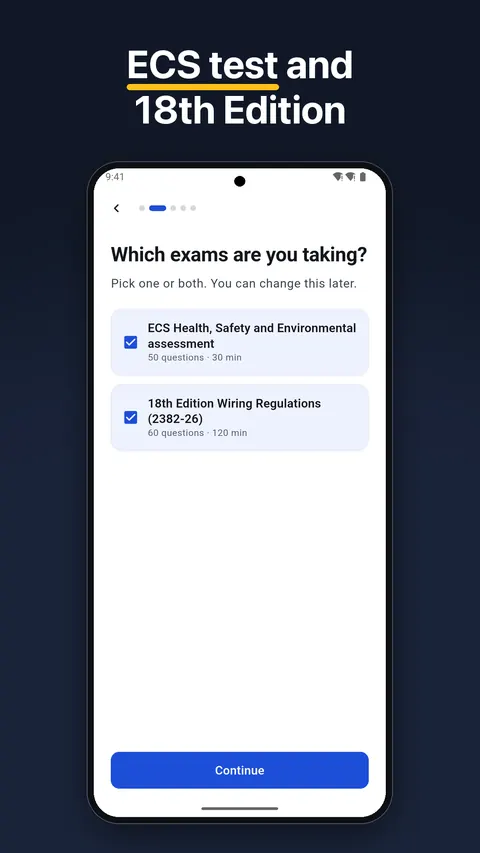
- 18th Edition: 538 questions, 60-question mock exams in 2 hours, a maximum Zs calculator and a guide to Amendment 4
- ECS HS&E: 389 questions and 50-question mock tests in 30 minutes
- Works offline. No ads, no account, no data collected.
Free: two full topics in each exam, three questions in every other topic, one full mock exam for each exam, the maximum Zs calculator and checklists.
Sparkwise Pro, £12.99 one-off: every question, every mock exam and every worked solution, for both exams. No subscription.
Also in Sparkwise, each sold on its own: PAT 2377, EV 2921-34, 2391, ECS Electrical Safety Unit, AM2 knowledge test, EWA entry test and solar PV and battery storage, or all 12 exams for £24.99.
Android now; iPhone version not yet available. Sparkwise helps you prepare; it cannot promise a pass.
Official sources
Check these public pages before you book, apply or claim.
- BS 7671 18th Edition wiring regulations (IET)
- Requirements for Electrical Installations (2382) (City & Guilds)
- Health, Safety & Environmental Assessment (ECS, run by the JIB)
- Electrical safety at work (Health and Safety Executive (HSE))
- The Electricity at Work Regulations 1989 (legislation.gov.uk)
Exam details can change. Check with the awarding body or your exam centre before you book, and always check real installations against your own copy of BS 7671.